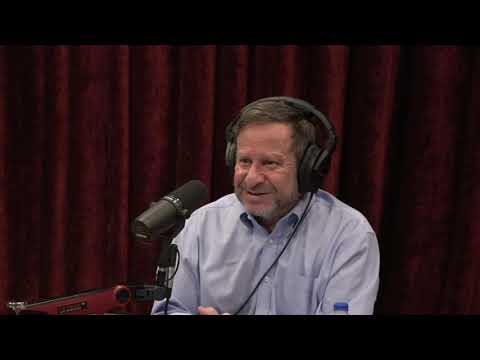
Joe Rogan Experience #1776 - Steven E. Koonin
Steven E. Koonin (guest), Joe Rogan (host), Narrator
In this episode of The Joe Rogan Experience, featuring Steven E. Koonin and Joe Rogan, Joe Rogan Experience #1776 - Steven E. Koonin explores physicist Challenges Climate Catastrophe Narrative, Calls Science ‘Unsettled’ Joe Rogan interviews physicist Steven E. Koonin about his book *Unsettled*, which argues that core elements of climate science are solid but the public narrative is exaggerated and selectively presented.
Physicist Challenges Climate Catastrophe Narrative, Calls Science ‘Unsettled’
Joe Rogan interviews physicist Steven E. Koonin about his book *Unsettled*, which argues that core elements of climate science are solid but the public narrative is exaggerated and selectively presented.
Koonin accepts that the climate is warming and humans contribute via greenhouse gases, yet maintains that the magnitude of human impact, the reliability of long‑range models, and the projected societal damage remain highly uncertain.
He illustrates discrepancies between official scientific reports and their political/media summaries, showing examples (hurricanes, sea level, Greenland ice, economic impacts) where nuance and natural variability are downplayed.
Koonin advocates slower, “graceful” decarbonization combined with adaptation and resilience, warning that rapid, aggressive policies may be costly, minimally effective globally, and driven more by politics and media than balanced science.
Key Takeaways
Distinguish between “climate is changing” and “climate catastrophe is certain.”
Koonin agrees the planet is warming and humans contribute, but argues that many high‑impact claims (on storms, droughts, economic collapse) are not strongly supported by long-term data and remain within historical natural variability.
Get the full analysis with uListen AI
Read primary reports, not just summaries or headlines.
He shows cases where UN and U. ...
Get the full analysis with uListen AI
Account for natural variability over long timescales.
Examples like centuries of Nile River levels, historical Greenland ice melt, and multi‑decadal sea‑level cycles illustrate that large swings occurred before significant human influence, complicating attribution of recent changes.
Get the full analysis with uListen AI
Treat climate models as rough tools, not precise forecasts.
Models slice the Earth into coarse 3D grids and must “tune” poorly understood processes (clouds, ocean cycles, biological feedbacks), leading to divergent projections and limited reliability for regional or detailed predictions.
Get the full analysis with uListen AI
Evaluate climate policy with full economic and global context.
Official estimates Koonin cites suggest a few percent hit to U. ...
Get the full analysis with uListen AI
Adaptation and resilience will likely dominate real-world responses.
Given development needs in poorer countries and slow technology turnover, Koonin expects societies to focus on infrastructure hardening, better water and agriculture management, and coastal protection rather than achieving global net‑zero on political timelines.
Get the full analysis with uListen AI
Be wary of social and institutional pressure in science communication.
Koonin recounts colleagues who privately agree with many of his points but fear speaking openly, and describes media consortiums and political moves that explicitly avoid airing dissent from the dominant narrative.
Get the full analysis with uListen AI
Notable Quotes
“The climate is changing, absolutely. Humans are influencing those changes, yes, absolutely. But the science is not anywhere near as settled as I thought it was.”
— Steven E. Koonin
“By overhyping the climate threat, we've taken away from non‑experts the ability to make their own judgments.”
— Steven E. Koonin
“In the part of the report that everyone's gonna read, you see this graph going up and it looks like all hell is gonna break loose. And then in the back it says, ‘We don't see any long‑term trends.’ That’s a swindle.”
— Steven E. Koonin
“There is an optimal pace to decarbonize. If you do it too rapidly, you incur a lot of cost. If you do it too slowly, you increase risk. Right now, we're pushing much too far and too fast.”
— Steven E. Koonin
“People should really understand that this is not a simple subject, and to do a little bit of investigating for themselves. Don't believe everything you hear in the media.”
— Steven E. Koonin
Questions Answered in This Episode
Where do mainstream climate scientists specifically disagree with Koonin’s interpretation of data on hurricanes, sea level, and Greenland ice, and how do they justify their positions?
Joe Rogan interviews physicist Steven E. ...
Get the full analysis with uListen AI
How should policymakers balance the relatively modest projected economic damages from warming against the high costs and risks of very rapid decarbonization?
Koonin accepts that the climate is warming and humans contribute via greenhouse gases, yet maintains that the magnitude of human impact, the reliability of long‑range models, and the projected societal damage remain highly uncertain.
Get the full analysis with uListen AI
What kinds of transparent, independent review processes (e.g., red‑team exercises) could improve trust in major climate assessment reports?
He illustrates discrepancies between official scientific reports and their political/media summaries, showing examples (hurricanes, sea level, Greenland ice, economic impacts) where nuance and natural variability are downplayed.
Get the full analysis with uListen AI
How can the global community realistically address emissions growth in rapidly developing countries without hindering their economic progress?
Koonin advocates slower, “graceful” decarbonization combined with adaptation and resilience, warning that rapid, aggressive policies may be costly, minimally effective globally, and driven more by politics and media than balanced science.
Get the full analysis with uListen AI
What mix of mitigation, adaptation, and potential geoengineering research represents a responsible, ethical climate strategy over the next 50–100 years?
Get the full analysis with uListen AI
Transcript Preview
(drum music) Joe Rogan podcast, check it out. The Joe Rogan Experience.
Train by day, Joe Rogan podcast by night, all day. (rock music) Well, uh, thank you for being here. Thanks, uh, um, I'm really appreciative of your time and the fact that you, uh, are willing to talk about this. This is a, uh, a very interesting book and extremely controversial. And I'm not exactly sure why that is, but I think it's a part of the times we're living in.
Yeah.
How many co-... Your, your book is called Unsettled?
Correct. That, uh, there, there it is, right?
How many, yes. How many copies of this book have you sold?
So, so we've sold, since it was published at the end of April, so about 10 months ago, we've sold more than 120,000 copies.
120,000 copies since you got it.
Yeah. Which, I, you know, I don't know anything about publishing, but my agent and publisher are sort of amazed at the numbers.
That's a lot.
Yeah.
And without much fanfare from the media, if any.
Well, depends which media you look at. Um-
Where, where have you gotten coverage?
So, so I've gotten good coverage from the Wall Street Journal. Uh, but if you look at the New York Times, Washington Post, uh, not very good coverage at all. Didn't make the New York Times bestseller list.
That seems strange 'cause it's a lot of copies.
Yeah, right. Well, you would think, right?
Yeah.
Okay. CNN, nothing. Um, and, uh, I think, you know, people are just ignoring it, which really surprises me.
Now, your book is on the climate. It's on climate change and climate science, and we should just establish right away, um, just because I know you're gonna experience so- some criticism, right?
Right.
Clearly, um, first of all, your credentials, you graduated from high school at 16.
(inhales deeply)
You, uh, w- went to MIT.
Uh, Caltech first.
Caltech.
I was an undergrad at Caltech, and then I went to MIT. I did a PhD there in theoretical physics in three years, and then I went back to Caltech, where I was on the faculty for 30 years.
And you were on the faculty at 23 years of age, which is-
That's correct.
... pretty extraordinary.
Yeah, it's unusual. Not unprecedented, but really quite unusual.
Now, um, there's a, there's a couple criticisms that people have of you, just, just to get these out of the way right away. One of 'em is that you used to work for BP.
Yeah.
That is, this is a big one.
Right.
So if you work for some sort of an oil company, you were chief scientist at BP?
I was chief scientist at BP for five years after Caltech. Um, and you know, they didn't bring me there to, uh, help 'em find oil, all right? They knew how to do that really well. I was brought in to help figure out what beyond petroleum really meant, and that was renewables and alternatives to oil and gas. And I helped during my five years to help plot a strategy for that, which is today, now, uh, 15 years later, uh, starting to be realized.
Install uListen to search the full transcript and get AI-powered insights
Get Full TranscriptGet more from every podcast
AI summaries, searchable transcripts, and fact-checking. Free forever.
Add to Chrome