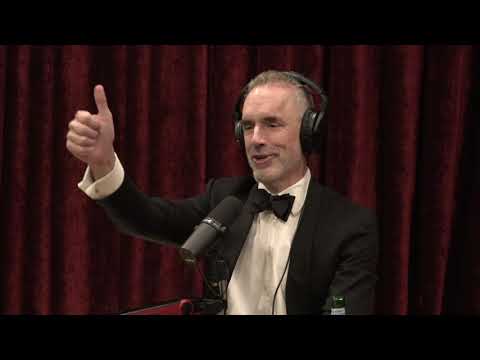
Joe Rogan Experience #1769 - Jordan Peterson
Jordan Peterson (guest), Joe Rogan (host), Narrator, Narrator
In this episode of The Joe Rogan Experience, featuring Jordan Peterson and Joe Rogan, Joe Rogan Experience #1769 - Jordan Peterson explores jordan Peterson And Joe Rogan Debate Climate, Meaning, Meat, And Madness Joe Rogan and Jordan Peterson range across climate change modeling, economic growth and poverty, energy policy, and how political ideologies distort environmental debates.
Jordan Peterson And Joe Rogan Debate Climate, Meaning, Meat, And Madness
Joe Rogan and Jordan Peterson range across climate change modeling, economic growth and poverty, energy policy, and how political ideologies distort environmental debates.
They dive into human psychology and meaning: time-discounting, risk, addiction, personality traits, nihilism, music, comedy, play, and how dialogue and storytelling structure our perception of reality.
Peterson details his health crisis, benzodiazepine withdrawal, and extreme meat-only diet, tying it to broader questions of medicine, stress, and personal responsibility.
The conversation also covers capitalism vs socialism, offshoring labor, censorship and social media, gender and trans issues, shamanism and psychedelics, and Peterson’s new creative and educational projects.
Key Takeaways
Climate models are inherently limited and uncertain over long time horizons.
Peterson argues that because 'climate' and 'environment' encompass effectively 'everything,' models must omit countless variables; as projections extend to 100 years, prediction errors compound so much that we may never be able to measure whether today’s policy changes truly worked.
Get the full analysis with uListen AI
Making poor people richer is, in Peterson’s view, the fastest path to sustainability.
Based on his work on UN sustainable development and extensive reading, he claims that once people are no longer in day-to-day survival mode, they spontaneously start caring about environmental quality; constraining economic growth tends to hurt the poor, not the rich.
Get the full analysis with uListen AI
Energy policy that raises costs disproportionately harms the most vulnerable.
Peterson stresses that hiking energy prices to pursue net-zero goals pushes those at the bottom of the economic hierarchy over the edge first—into unemployment, mental health crises, and deeper poverty—contradicting professed concern for the poor.
Get the full analysis with uListen AI
Offshoring labor both alleviated extreme poverty abroad and devastated some domestic workers.
They acknowledge that moving manufacturing to low-wage countries helped lift millions (e. ...
Get the full analysis with uListen AI
Addiction and self-destruction are often shaped by both biology and environment.
Peterson notes research showing a minority of monkeys or humans are biologically prone to heavy alcohol use, yet also emphasizes that isolated, stressed environments (for rats, monkeys, or people) make drug use more compelling, and that simply giving impulsive people more money can accelerate their downfall.
Get the full analysis with uListen AI
Comedy, music, and play operate on the edge of order and chaos and are deeply meaningful.
They frame stand-up, music, and playful dialogue as forms of 'dancing on the border' between predictability and surprise; this state—the 'zone'—is where people feel most alive, connected, and temporarily freed from the burden of mortality.
Get the full analysis with uListen AI
Social media outrage and anonymous criticism distort feedback and can be psychologically toxic.
Rogan describes Twitter as an outrage-addiction machine where the cost of being a 'prick' is near zero; Peterson notes that because real-life feedback is constrained by face-to-face norms, online attacks can be wildly disproportionate and misleading, making it rational to avoid comments entirely.
Get the full analysis with uListen AI
Notable Quotes
“If the price we have to pay to move towards a sustainable environment is increased energy costs, the absolutely 100% inevitable consequence of that will be that you sacrifice the poor.”
— Jordan Peterson
“The fastest way to make the planet sustainably green and ecologically viable is to make poor people as rich as possible as fast as we possibly can.”
— Jordan Peterson
“Music is an analog of the structure of existence itself… It puts you directly in touch with the meaning that sustains you in life.”
— Jordan Peterson
“The best part of friendships is laughing and joking around with each other… If you’re in a humorless group, that’s the same thing as killing the comedians.”
— Jordan Peterson
“All of my interactions with people are face to face… It’s a much healthier way to communicate with people.”
— Joe Rogan
Questions Answered in This Episode
How should policymakers balance the acknowledged uncertainty of long-term climate models with the moral imperative to reduce human-caused environmental harm?
Joe Rogan and Jordan Peterson range across climate change modeling, economic growth and poverty, energy policy, and how political ideologies distort environmental debates.
Get the full analysis with uListen AI
If making the poor richer is the most effective environmental strategy, what specific capitalist or market-based reforms would best accelerate that without deepening inequality?
They dive into human psychology and meaning: time-discounting, risk, addiction, personality traits, nihilism, music, comedy, play, and how dialogue and storytelling structure our perception of reality.
Get the full analysis with uListen AI
Where is the line between genuine concern for marginalized groups (e.g., trans people, the poor) and the kind of ideological weaponization of guilt Peterson warns about?
Peterson details his health crisis, benzodiazepine withdrawal, and extreme meat-only diet, tying it to broader questions of medicine, stress, and personal responsibility.
Get the full analysis with uListen AI
Given Peterson’s experience with benzodiazepines, what safeguards should exist around prescribing, monitoring, and tapering these drugs—and what alternatives should be prioritized?
The conversation also covers capitalism vs socialism, offshoring labor, censorship and social media, gender and trans issues, shamanism and psychedelics, and Peterson’s new creative and educational projects.
Get the full analysis with uListen AI
How can individuals practically cultivate the kind of meaningful dialogue, play, and creative risk-taking that Rogan and Peterson describe as antidotes to nihilism and resentment?
Get the full analysis with uListen AI
Transcript Preview
(drumming music) Joe Rogan podcast. Check it out. The Joe Rogan Experience. Train by day, Joe Rogan podcast by night, all day. (rock music) That state of intense concentration on that-
Mm-hmm.
... before you can really manage it, so.
I think there's mental endurance involved too, 'cause I think that... Are we up?
We're good.
I think there's mental endurance that comes with, uh, anything that you do on a day-to-day basis, whether it's writing, whether it's, uh, doing podcasts, whether it's, uh, doing stand-up comedy. I think anything where you have to think and, and manage, like, complex ideas and manipulate your language and your... the way you're speaking, and, and be able to e- e- engage in the dance between two people, I think you gotta do it all the time. Uh, uh, I think if you just do it every now and again, like especially, like, if you took time off of speaking to people, like if you hadn't talked to anybody in a long time and then you talk... Have you ever done that, where you haven't talked to anybody in a long time, then you talk to them? It feels odd.
Mm-hmm.
It feels awkward.
Mm-hmm.
'Cause I think there's, like, a thing where you have to get used to it. You gotta get used to it.
See, all I found that was particularly the case with the podcasts, is that it's hard to do that sporadically.
Yeah.
Um, you also g- lose that rhythm of preparation-
Mm-hmm.
... because you get... Well, I, I did. I- I'm not sure. How do you prepare for your podcasts? Like, if you have an author come on-
I usually read their book. It depends on-
When?
... um, with- like, I'm on... I have two books that I'm reading right now that are future, uh, people that are coming in February.
Hmm.
So, they're-
So a lot ahead.
Yeah. They'll be... Well, you know, it's like one of them is a climate change book, and it's, it's intense. And so, it's requiring a lot of thinking, and then I have to, like, look at the criticisms of this guy and criticisms of the work and, you know, you know, who believes that in 10 years Miami's gonna be underwater, who believes that this is probably hyperbole and that it's a, a gross exaggeration, and the reality is, you know, the world sort of always goes through these cycles of change, but human beings are definitely having an effect on it, but a small effect compared to cows and other, other things. It's like, it's hard to sort out. The climate change one is a weird one, so that one, I'm-
Well, that's 'cause there's no such thing as climate, right? Climate and everything are the same word. And I... That's what bothers me about the climate change types. It's like... This is something that bothers me about it, technically. It's like climate is about everything. So, okay. But your models aren't based on everything. Your models are based on a set-
Install uListen to search the full transcript and get AI-powered insights
Get Full TranscriptGet more from every podcast
AI summaries, searchable transcripts, and fact-checking. Free forever.
Add to Chrome