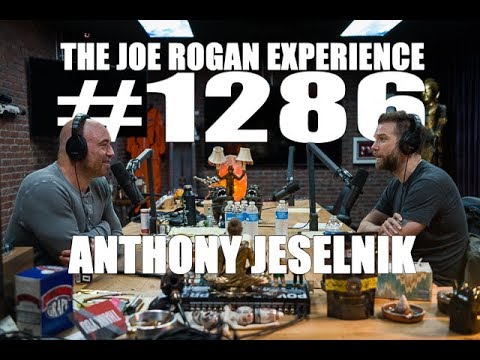
Joe Rogan Experience #1286 - Anthony Jeselnik
Joe Rogan (host), Anthony Jeselnik (guest), Jamie Vernon (guest)
In this episode of The Joe Rogan Experience, featuring Joe Rogan and Anthony Jeselnik, Joe Rogan Experience #1286 - Anthony Jeselnik explores anthony Jeselnik and Joe Rogan Deconstruct Comedy, Careers, and Controversy Joe Rogan and Anthony Jeselnik spend the episode dissecting standup comedy: how material is developed, why some comics stagnate, and how careers evolve over decades.
Anthony Jeselnik and Joe Rogan Deconstruct Comedy, Careers, and Controversy
Joe Rogan and Anthony Jeselnik spend the episode dissecting standup comedy: how material is developed, why some comics stagnate, and how careers evolve over decades.
They talk in depth about building specials on multi‑year cycles, the importance of working in real clubs versus only for your own fans, and the trap of personas and political comedy.
The conversation ranges into drugs, sobriety, relationships, divorce, jealousy, guns, mass shootings, and international touring, always looping back to how these experiences inform standup.
Jeselnik also promotes his then-new Netflix special “Fire in the Maternity Ward,” while candidly discussing industry stories, bad gigs, club politics, and the psychology of dark humor.
Key Takeaways
Treat each hour of standup as a multi‑year project, not disposable content.
Both Rogan and Jeselnik describe 2–3+ year cycles: building 40 minutes locally, then shaping it on the road, then tightening in theaters before taping. ...
Get the full analysis with uListen AI
Once material is filmed and released, retire it completely.
Jeselnik assumes every audience member has seen everything he’s done and refuses to repeat bits, while Rogan will only revisit an old bit with a disclaimer. ...
Get the full analysis with uListen AI
You must work in mixed, non‑fan crowds to stay sharp.
They stress that only playing to your own fans (or only easy rooms and festivals) makes you soft. ...
Get the full analysis with uListen AI
Avoid building your act or career on a narrow persona you can’t outgrow.
They cite examples like Dice, Kinison, and party‑guy personas that box comics in as they age. ...
Get the full analysis with uListen AI
Be obsessive about originality and aware of who you watch.
Both admit accidentally copying influences’ timing or mannerisms (Attell, Richard Jeni), then deliberately stopped watching them. ...
Get the full analysis with uListen AI
Dark or offensive material works only if the joke is undeniably strong.
Jeselnik says people tolerate jokes on taboo topics when the writing is sharp and tension is expertly broken; weak versions just feel cruel. ...
Get the full analysis with uListen AI
Industry choices (clubs, TV writing, festivals) should align with your long‑term voice.
Jeselnik’s year at Fallon showed him he can’t write safely in someone else’s likable voice, and certain clubs/festivals promote comics as generic brands rather than as distinct artists. ...
Get the full analysis with uListen AI
Notable Quotes
“As long as you don't quit, you don't ever get worse.”
— Joe Rogan
“My biggest fear is taping the special and then coming up with a great tag.”
— Anthony Jeselnik
“If you tell a comic advice, you’re just telling them how to be more like you.”
— Joe Rogan (paraphrasing Doug Stanhope)
“I assume the entire audience has seen everything I’ve ever done.”
— Anthony Jeselnik
“This is your legacy. Why would you want to put out a bad special ever?”
— Anthony Jeselnik
Questions Answered in This Episode
How much responsibility do comedians have to consider potential real‑world effects of violent or dark humor, if any?
Joe Rogan and Anthony Jeselnik spend the episode dissecting standup comedy: how material is developed, why some comics stagnate, and how careers evolve over decades.
Get the full analysis with uListen AI
Is the current pace of Netflix and streaming specials forcing comics to release material before it’s ready, and how might that change standup long‑term?
They talk in depth about building specials on multi‑year cycles, the importance of working in real clubs versus only for your own fans, and the trap of personas and political comedy.
Get the full analysis with uListen AI
Where is the ethical line between being influenced by another comic’s style and unintentionally stealing their voice or rhythm?
The conversation ranges into drugs, sobriety, relationships, divorce, jealousy, guns, mass shootings, and international touring, always looping back to how these experiences inform standup.
Get the full analysis with uListen AI
Given the growing global comedy scenes Jeselnik describes, how will international audiences reshape what American comics talk about and how they talk about it?
Jeselnik also promotes his then-new Netflix special “Fire in the Maternity Ward,” while candidly discussing industry stories, bad gigs, club politics, and the psychology of dark humor.
Get the full analysis with uListen AI
In a culture saturated with politics, is it still possible for a late‑night host or comic to remain mostly apolitical without becoming irrelevant?
Get the full analysis with uListen AI
Transcript Preview
... two, one. Yee-haw! Hello, Anthony Jeselnik. How are you, sir?
Great, Joe. Good to see you.
What's going on, buddy? Are you, uh, fully committed to the beard now?
Yeah. I wanna keep it as long as I can. I really enjoy it.
Are you gonna go mountain man? Or are you gonna just trim?
No, I d-
You trim a little?
I trim a little bit. Uh, I just let, like, the lady who cuts my hair trims it every, like, four weeks when I go in for a haircut, but I don't touch it at all. I'm afraid if I tried to trim it, I would just ruin it.
Mm.
Uh, but I love, love having a beard.
Why do you love having a beard?
It is like, it's like sunglasses for the bottom half of your face.
Oh, you get to, like-
You know what I mean?
... hide from the world.
Kind of, yeah.
Ah.
It, like, make it ... It, it chills me out a little more.
Mm, yeah.
You know? Especially on stage, like, when I'm, um, you're, you're under the lights, you know, uh, and I'm, I'm ... My lip would start to get a little bit sweaty.
(laughs)
And then I'm thinking about my lip, and I'm like, "Should I wipe this? Should I move it?" And then I start to sweat more, but now that I have the beard and mustache, if my lip gets a little sweaty, you can't tell. So I don't get more anxious over it.
Mm.
Uh-
Interesting.
Yeah.
So you used to, like, think, "Hmm, boy, there's a little, couple of beads-"
Mm-hmm.
"... on that upper lip."
Yeah, and I'm like, "Can they see it?"
(laughs)
"Should I wipe? Is it, like ... Is it too much if I'm wiping?" Like, I, uh, it drives me crazy.
You know what gets me? Boogers, if I think I have a booger, like a ... (sniffs) Like, "What is going on with my nose?" (sniffs) "What is that? Is that a booger? Shit, can they see that?"
Oh, I check for sure before I go on stage.
(laughs) I do too, but-
There's always a booger check, yeah.
... so, but I, I'm so, uh, animated and I'm always yelling and screaming, I'm always worried that something is, like, hanging off the tip of my nose.
Yeah.
And the people in the front row can't even enjoy it. They're like-
(laughs)
... "What the fuck, man?"
(laughs)
"Your nose, bro."
Never had that. I've had, like, definitely a fly-down situation-
Oh, yeah.
... but never a, never d- never, like, a booger that, uh, ruined the show.
Those are two things that people love to laugh at, your fly-down and if you put a beer down on stage and the foam comes over the top.
Install uListen to search the full transcript and get AI-powered insights
Get Full TranscriptGet more from every podcast
AI summaries, searchable transcripts, and fact-checking. Free forever.
Add to Chrome