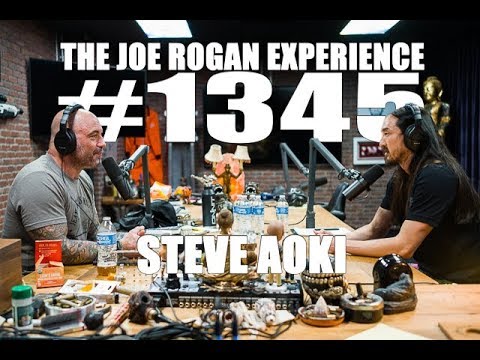
Joe Rogan Experience #1345 - Steve Aoki
Steve Aoki (guest), Joe Rogan (host), Narrator, Narrator, Narrator, Narrator, Narrator
In this episode of The Joe Rogan Experience, featuring Steve Aoki and Joe Rogan, Joe Rogan Experience #1345 - Steve Aoki explores steve Aoki on writing, brain science, longevity, and epic shows Steve Aoki joins Joe Rogan to discuss his memoir *Blue: The Color of Noise*, using writing and therapy to process his past, and opening up about family, hardship, and ambition.
Steve Aoki on writing, brain science, longevity, and epic shows
Steve Aoki joins Joe Rogan to discuss his memoir *Blue: The Color of Noise*, using writing and therapy to process his past, and opening up about family, hardship, and ambition.
They dive deep into brain science, anti-aging, cryonics, stem cells, and Aoki’s Aoki Foundation, which funds research into brain health and longevity.
Aoki explains how he sustains an extreme touring schedule, treats himself like an athlete, and experiments with cutting-edge health regimens while continually evolving his music and live shows.
The conversation also ranges through sci‑fi futures (time travel, simulation theory, AI), Vegas club culture, Bruce Lee, and the psychology of fame and success.
Key Takeaways
Use writing as a tool to process life and clarify thinking.
Aoki describes how journaling about therapy sessions and life events helped him understand his own patterns, organize memories, and ultimately shape a coherent memoir that reveals deeper vulnerabilities.
Get the full analysis with uListen AI
Stepping outside your comfort zone accelerates personal and artistic growth.
For a musician used to expressing himself through sound, tackling a book forced Aoki to confront different skills, emotions, and forms of vulnerability, which in turn deepened the emotional dimension of his music.
Get the full analysis with uListen AI
Treat creative careers like high-performance sports to sustain output.
Touring ~250 shows a year for over a decade, Aoki manages jet lag, sleep, nutrition, and training like an athlete, working with scientists and doctors and using himself as a guinea pig to stay physically and mentally functional.
Get the full analysis with uListen AI
Invest in brain health and longevity now, not later.
Triggered by his father’s death from complications related to hepatitis C and cancer, Aoki became obsessed with anti-aging, funding brain and longevity research, exploring early cancer-detection tests, and even signing up for cryonics as a long-shot “insurance policy.”
Get the full analysis with uListen AI
Regenerative medicine is already changing what’s possible for injury and aging.
Their discussion of stem cell treatments, Regenokine, and cutting-edge orthopedic techniques shows how athletes and performers are extending careers, healing disc and tendon damage, and avoiding major surgeries through new therapies.
Get the full analysis with uListen AI
Make your live experience uniquely yours to stand out.
Aoki’s now-iconic “caking” of fans began as a one-off stunt and evolved into a signature, highly participatory element of his shows, illustrating how a distinctive, interactive ritual can define your brand in a crowded field.
Get the full analysis with uListen AI
Channel fascination with sci‑fi futures into real-world action.
Aoki’s love of science fiction led him to collaborate with futurists like Ray Kurzweil, Yuval Noah Harari, and Aubrey de Grey on his *Neon Future* albums and to genuinely engage with questions about AI, immortality, and human–machine convergence.
Get the full analysis with uListen AI
Notable Quotes
“If you always do the same thing over and over again, you're never really learning.”
— Steve Aoki
“I think at the end of the day, we all want to live indefinitely… we just don’t want suffering and pain.”
— Steve Aoki
“I feel like I'm the chef in the kitchen making the food, and I go out and I get to watch people eat my food.”
— Steve Aoki
“You write to understand. And then you write to express it so that other people can understand.”
— Joe Rogan
“Some cars have small engines, and then there's rocket cars. [Elon Musk has] some sort of crazy quantum rocket car engine for a brain.”
— Joe Rogan
Questions Answered in This Episode
How has the process of writing *Blue: The Color of Noise* changed the way Steve Aoki approaches making music and designing live shows today?
Steve Aoki joins Joe Rogan to discuss his memoir *Blue: The Color of Noise*, using writing and therapy to process his past, and opening up about family, hardship, and ambition.
Get the full analysis with uListen AI
What ethical and psychological implications arise if technologies like cryonics, stem cells, and AI-enabled life extension become common and affordable?
They dive deep into brain science, anti-aging, cryonics, stem cells, and Aoki’s Aoki Foundation, which funds research into brain health and longevity.
Get the full analysis with uListen AI
Where should regulators draw the line between free information and harmful content when powerful platforms like Google can shape public awareness?
Aoki explains how he sustains an extreme touring schedule, treats himself like an athlete, and experiments with cutting-edge health regimens while continually evolving his music and live shows.
Get the full analysis with uListen AI
If we’re moving toward a future of brain–computer interfaces and human augmentation, how do we preserve what we value as “human” in that convergence?
The conversation also ranges through sci‑fi futures (time travel, simulation theory, AI), Vegas club culture, Bruce Lee, and the psychology of fame and success.
Get the full analysis with uListen AI
How can aspiring artists emulate Aoki’s discipline and health-first approach to sustain high-intensity creative careers without burning out?
Get the full analysis with uListen AI
Transcript Preview
These are pretty cool. And we're live. Hello, Steve. Yeah, that's the Kanye one. Nice. That's, that's the most recent. That's, uh, this guy, Plastisel, Phong Tran. He, uh, creates all these. H- he hand paints each one. They're really nice. Yeah. He sculpts it. Very nice. And then he makes, uh, like a mold and then, uh- Yeah. ... he's got a bunch of dope ones. It's all on his line. And you got a book, bro. I do. Color of Noise. Yeah. Blue: The Color of Noise. Yeah. What's this about? It's my memoir. It's, um, uh, talks about the beginnings, um, goes through my process. It goes through a lot of different things. I mean, at the end of the day, it's a memoir so it's more about... It's less about what's happening now and more about, like, how I- I got there, you know? Like, the story and different piecemeal stories that, that are thematic and, you know, with this overarching idea of blue, which is, like, the different shades of blue of my life. It's my favorite color and actually, my last name is, means blue tree. Really? Yeah. Yeah. So it's like there's a lot of synergy with the color so when I was coming up with the idea to name the book, you know, I had to think of, like, uh, you know, something that relates throughout my whole life. So there's so many different shades, emotions, feelings that are represented in, in all these different stories. D- have you always been a writer? Um, I'm like a, yeah, I guess, like a piecemeal writer, you know? Mm-hmm. I, I needed help finishing this book. There's no doubt about it. I had so much, it's like... You know, 'cause I'm still, like, you know, of the pen and paper still, you know? Like, I grew up before, before computers and all that stuff, I was, when I was writing, uh, lyrics for my bands, I was, it was always, like, a notepad. Mm-hmm. So I had just so many different stories that I didn't know how to put it all together. Um, I started the inception of writing, you know, these, these different stories of my life six years ago and then I shot a documentary for Netflix and, uh, we dropped it, called, it's called I'll Sleep When I'm Dead. We dropped it three years ago, four years ago? Fi- 2015, 2016, I think. And a- and I, after I saw the reception and, and how people responded to the doc, then I knew that, like, you know, this is really gonna take shape. (laughs) This is gonna be front and center as finishing and, and writing a m- a proper memoir. So the, the idea of writing a memoir is only... The idea of writing and writing about yourself is only to write this memoir? It's not like you, you write on a regular basis? No. I mean- No, no, no. I mean, you know, like, I am actually coming up with some new ideas for the next, you know, conception of what I would put out there in book form because it's a different process for me that's, like, quite exciting just to, like, the challenge to do something like this. 'Cause I'm, my natural way to express myself is through music and, um, and I love being able to step outside my comfort zones. I think at the end of the day, when you do that enough, you just, you just get better as a human being and- Yes. ... and try, you know. If you always do the same thing over and over again, you're never really learning. So it's, uh, it's, it's been like a great learning process, you know, putting out this memoir and, uh, and, and, and, like, actually opening up this vulnerable side to who I am that I, I don't necessarily, I don't talk about really. You know? Like- Mm-hmm. ... for people that know me, like my fans or my music fans, or anyone else that knows Steve Aoki, they don't really know what's in this book. You know, they might have a glimpse of it from my documentary which I did because I, I talk really deeply about my relationship with my father and, and, like, this drive that I have as a kid to make it. And, uh, and it shows you enough where it's, okay, now I have a little bit more than my live shows and what's already out there, but this goes, you know, obviously, a- a lot deeper because it's a book and we're going through emotions and the vulnerability and, and, um, and I, and I wanna tell stories of the hardships. And at the end of the day, I wanna speak to young kids out there, y- young people out there, even older people that are trying to figure th- their own thing out and, and because the documentary related in so many ways on a personal level that I shared there, this is how I wanted to share that through my own words. Do you find that writing these things down and just thinking about your life and, and, and trying to express it in a way that's gonna resonate with people, that this h- helps you think about it and helps you sort of, uh, categorize it and put it all in your head and... 'Cause d- do you know Eddie Huang? Do you know who that is? Yeah. Yeah. The famous chef? Yeah. Uh, yeah. Yeah. Definitely, yeah. Yeah. He's a friend of mine, great guy, and writes every day, and I asked him why, I'm like, "Why, why are you writing?" Because he's written books, but he's, he writes to sort of collect his own thoughts. Yes. You know? 100%. It's like once you, that's the trigger for me because even when I read, I write right after. Mm-hmm. Like, what I gain from it. Al- almost like it's like my note, my, uh, homework- Yeah. ... for retention on, on what I gather or take away from what I'm reading. So I'm always, like, reading and writing or writing and scribbling in my, in my book or, or, like, writing off the side in a notepad or, like now, like, you know, I, like, like a tablet or something. But- I wri- ... it's like you need to gather your, your, your headspace so you have retention. Yeah. You write to understand. Right. Yeah. And then you write to express it so that other people can understand. Yeah. And in that process, you kinda understand yourself better. Right. Yeah. I mean, that's, that's how I sort of, Eddie described it. And when he said it to me, I was like, "God dammit, I don't write enough like that." I write more comedy stuff. I try and write material and essays on things and pull jokes out of them. Right. But, like, I think there's probably a great benefit for anybody to just sort of write about your thoughts- Yeah. ... to your diary, you know? (laughs) You just ac- you think- (laughs) You know? I mean, there's something to that because in that time, I mean, you could speak to this because you've written a book on yourself, but in that time of writing-
Install uListen to search the full transcript and get AI-powered insights
Get Full TranscriptGet more from every podcast
AI summaries, searchable transcripts, and fact-checking. Free forever.
Add to Chrome