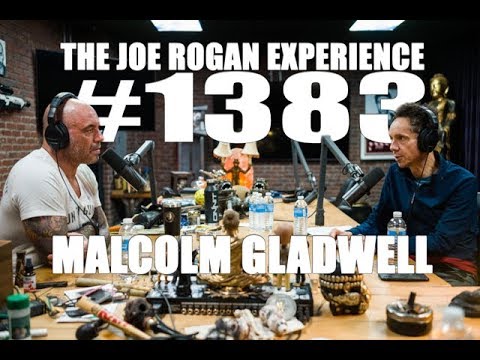
Joe Rogan Experience #1383 - Malcolm Gladwell
Joe Rogan (host), Malcolm Gladwell (guest), Narrator
In this episode of The Joe Rogan Experience, featuring Joe Rogan and Malcolm Gladwell, Joe Rogan Experience #1383 - Malcolm Gladwell explores malcolm Gladwell Dissects Misjudgment, Policing, Lies, and Human Communication Malcolm Gladwell joins Joe Rogan to explore themes from his book *Talking to Strangers*, focusing on how and why we so often misread people, from traffic stops to spycraft and financial frauds. They unpack the Sandra Bland case as an example of policing philosophy gone wrong, where training, fear, and power dynamics fuel needless escalation. The conversation widens into why humans are poor lie detectors, how trust and cultural context shape our judgments, and how technology might someday expose our thoughts and intentions. They close by comparing alcohol, drugs, and comedy craft, reflecting on how culture, incentives, and personal process shape behavior in everything from college drinking to standup specials.
Malcolm Gladwell Dissects Misjudgment, Policing, Lies, and Human Communication
Malcolm Gladwell joins Joe Rogan to explore themes from his book *Talking to Strangers*, focusing on how and why we so often misread people, from traffic stops to spycraft and financial frauds. They unpack the Sandra Bland case as an example of policing philosophy gone wrong, where training, fear, and power dynamics fuel needless escalation. The conversation widens into why humans are poor lie detectors, how trust and cultural context shape our judgments, and how technology might someday expose our thoughts and intentions. They close by comparing alcohol, drugs, and comedy craft, reflecting on how culture, incentives, and personal process shape behavior in everything from college drinking to standup specials.
Key Takeaways
We systematically overestimate our ability to read strangers.
Gladwell argues that high‑profile failures—from Sandra Bland and Larry Nassar to Bernie Madoff—share a common root: two sides misjudge each other’s intentions or character, often with catastrophic results.
Get the full analysis with uListen AI
Modern U.S. traffic policing incentivizes low‑yield, high‑friction stops.
Training doctrines like “go beyond the ticket” push officers to pull over huge numbers of drivers on thin pretexts, even though they almost never find serious crime, poisoning community–police relations for minimal payoff.
Get the full analysis with uListen AI
Humans are wired to default to believing others, not spotting lies.
Across professions, people’s accuracy at detecting deception hovers barely above chance; evolution favors trust because it makes social life and cooperation possible, so even brilliant investors fell for Madoff.
Get the full analysis with uListen AI
Time and de‑escalation are crucial in high‑stakes encounters.
Gladwell cites security expert Gavin de Becker and police shootings to show that when events unfold in seconds, everyone makes worse decisions; good policing should focus on slowing situations down, not speeding them up.
Get the full analysis with uListen AI
Context and culture radically change what a gesture means.
In the Bland stop, the officer read a cigarette as defiance; Gladwell reads it as a generational calming gesture, illustrating how age, culture, and training can invert the meaning of the same act.
Get the full analysis with uListen AI
Our social norms about alcohol are dangerously misaligned with its harms.
Rogan and Gladwell note that alcohol causes far more social damage than cannabis or even cigarettes, yet is the most socially accepted and heavily marketed—especially to the young—despite its role in violence and sexual assault.
Get the full analysis with uListen AI
Creative excellence depends on process, repetition, and brutal feedback.
Rogan describes building an hour of standup as years of writing, bombing, refining, and respecting audience judgment—paralleling Gladwell’s insistence that great writing requires endless revision and belief in a ‘perfect’ phrasing.
Get the full analysis with uListen AI
Notable Quotes
“You’d think at this point in human evolution we’d have talking to strangers down. And we clearly don’t.”
— Malcolm Gladwell
“You cannot conduct policing in a civil society like that and expect to have decent relationships between law enforcement and the civilian population.”
— Malcolm Gladwell
“If someone tells you they are good at spotting liars, there’s a 99% chance that they’re lying.”
— Malcolm Gladwell
“If you have a bit and you think it’s a great bit and the audience doesn’t laugh, they’re right.”
— Joe Rogan
“We have drinking, marijuana, and cigarettes, and our list of taboos is exactly backwards.”
— Malcolm Gladwell
Questions Answered in This Episode
How much of the Sandra Bland tragedy was about one flawed officer versus a broader policing philosophy that trained him to act that way?
Malcolm Gladwell joins Joe Rogan to explore themes from his book *Talking to Strangers*, focusing on how and why we so often misread people, from traffic stops to spycraft and financial frauds. ...
Get the full analysis with uListen AI
If humans are evolutionarily biased to trust, is it actually possible—or even desirable—to become significantly better at spotting lies?
Get the full analysis with uListen AI
What would policing look like if we legally and culturally prioritized slowing encounters down instead of maximizing stops and searches?
Get the full analysis with uListen AI
How might a future technology that can reveal thoughts or intent change our concepts of privacy, forgiveness, and taboo language?
Get the full analysis with uListen AI
Given alcohol’s outsized social harms, why do societies resist treating it as the most dangerous of our mainstream drugs?
Get the full analysis with uListen AI
Transcript Preview
(claps) Hello, Malcolm.
Hey, Joe.
How you doing?
I'm doing very well.
(laughs)
(laughs)
You sound like you.
(laughs) Good, good. That's always a good sign, no?
Through headphones. It's very interesting, 'cause I've been listening to, uh, Talking to Strangers.
Uh-huh.
I like that you narrate your books. It's very frustrating when someone who's a, a great speaker does not narrate their books, so thanks for doing that.
No, I actually, uh, I kind of enjoy... I used to hate that process with my first one, and then I've grown to enjoy it, because, uh, you... When you s- say your book out loud, you see it in a different way.
Mm.
Like, "Oh." You know, you get a l- little bit of a different perspective on it.
Well, I'm a giant fan of your work, man, particularly Outliers.
Oh, thank you.
I, I, I really love that book.
Yeah.
It's, uh, very illuminating, and it sort of peels away the, the mystery of talent.
Mm-hmm. Mm-hmm.
And, uh, so tell me what you're doing. What is this Talking to Strangers, I'm into about... I'm in the f- s- second chapter right now.
Oh, I see. Uh, well, that was... That was a book about... I was struck by how many of the kind of high-profile cases that we got obsessed with were, at their root, about the same thing, which is that individuals were... Two people who didn't know each other well had an exchange, and they got each other wrong. So, you know, everything from Amanda Knox to Bernie Madoff to the, to Larry Nassar at Michigan State, to Jerry Sandusky at Penn State. And then, to the signature case which the book is organized around, which is, uh, the Sandra Bland case. Remember, the young woman, Texas, who gets pulled over by the side of the road?
Yeah.
They're all, at root, fundamentally the same problem, which is there's a, there's an exchange between... And the exchange just goes wrong. And the question is why. That's what I began to get really fascinated by, is you'd think at this point in human evol- human evolution, we would've got this thing about talking to strangers down.
Mm.
And we clearly don't. And we're being pushed to talk more and more to strangers, right, in a kind of globalized world. And if we're bad at it, that doesn't bode well, does it?
Well, I think there's also an issue today with people not learning the necessary skills in how to talk to people, 'cause so much communication is done digitally.
Yeah.
That's, uh... It seems to be a giant issue with young kids. They're, they're more awkward initially talking to people than I think I remember.
Yeah, yeah. No, I think that's probably... You forget how much... I mean, adolescent- adolescence used to be this one, one long rehearsal in how to be a normal human being in-
Install uListen to search the full transcript and get AI-powered insights
Get Full TranscriptGet more from every podcast
AI summaries, searchable transcripts, and fact-checking. Free forever.
Add to Chrome