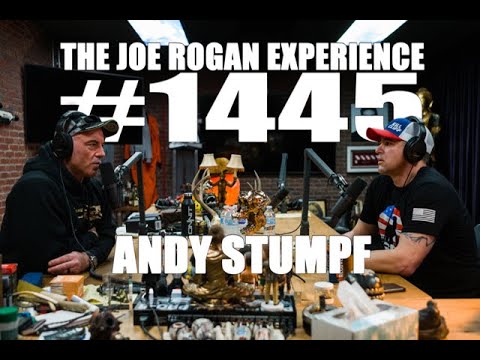
Joe Rogan Experience #1445 - Andy Stumpf
Joe Rogan (host), Andy Stumpf (guest), Jamie Vernon (guest), Jamie Vernon (guest), Narrator
In this episode of The Joe Rogan Experience, featuring Joe Rogan and Andy Stumpf, Joe Rogan Experience #1445 - Andy Stumpf explores ex-Navy SEAL Andy Stumpf Dissects COVID Panic, Fear, And Resilience Joe Rogan and former Navy SEAL/skydiver Andy Stumpf use the emerging COVID-19 crisis as a jumping‑off point to explore fear, media confusion, and how people behave under stress. They contrast rational risk assessment with the public’s panic buying and toilet-paper hoarding, arguing most danger comes from emotional overreaction, not the virus itself. Stumpf draws heavily on combat and SEAL training to explain decision‑making, discipline, and the importance of focusing only on what you can control. The conversation then branches into military experiences, law enforcement training, jiu-jitsu, hunting, and how hardship recalibrates gratitude for everyday life.
Ex-Navy SEAL Andy Stumpf Dissects COVID Panic, Fear, And Resilience
Joe Rogan and former Navy SEAL/skydiver Andy Stumpf use the emerging COVID-19 crisis as a jumping‑off point to explore fear, media confusion, and how people behave under stress. They contrast rational risk assessment with the public’s panic buying and toilet-paper hoarding, arguing most danger comes from emotional overreaction, not the virus itself. Stumpf draws heavily on combat and SEAL training to explain decision‑making, discipline, and the importance of focusing only on what you can control. The conversation then branches into military experiences, law enforcement training, jiu-jitsu, hunting, and how hardship recalibrates gratitude for everyday life.
Key Takeaways
Separate emotion from decision-making in crises.
Stumpf argues that fear is natural but deadly when it drives choices; like in a firefight, panicking or freezing lets external chaos maneuver around you. ...
Get the full analysis with uListen AI
Focus on your circle of control, not your circle of concern.
He uses a two‑circle model: most people obsess over things they can’t influence (news, stock market, toilet paper supply) instead of what they can—attitude, fitness, diet, hygiene, how they treat others. ...
Get the full analysis with uListen AI
Prioritize collective ‘we’ over individual ‘me’ behavior.
From hoarding toilet paper to ignoring distancing rules, they see many people acting purely out of self-preservation. ...
Get the full analysis with uListen AI
Hardship sharpens gratitude for everyday comfort.
Stumpf describes war zones and third‑world conditions (people defecating in their only water source) to frame how thin the margin is between Western abundance and scarcity. ...
Get the full analysis with uListen AI
Preparation is useful, but hoarding and extreme prepping aren’t the answer.
They argue there’s a reasonable middle ground between having no reserves and stockpiling five years of MREs. ...
Get the full analysis with uListen AI
Train real physical competence—especially grappling—for high-risk professions.
Stumpf and Rogan highlight how poorly trained officers can escalate encounters because they lack control skills on the ground. ...
Get the full analysis with uListen AI
Don’t mythologize war or military status; judge individuals by behavior.
Stumpf stresses that being a SEAL is just a job, not a moral credential, citing an honor man from his BUD/S class who became a murderer. ...
Get the full analysis with uListen AI
Notable Quotes
“The most dangerous thing you can do is lose control of your emotions or let your emotions take over your decision-making cycle.”
— Andy Stumpf
“People are super concerned about me and far less concerned about we.”
— Andy Stumpf
“We’re using the body to test the mind. BUD/S isn’t some complex course—it’s stressing the body to see how your brain behaves when you’re tired, hungry, and freezing.”
— Andy Stumpf
“I don’t think there’s a toilet paper shortage. There’s a shortage of people with common sense who are buying too much toilet paper.”
— Andy Stumpf
“People spend a lot of time, energy, and effort focusing on things that they cannot control. You have to surrender that mental horsepower and only focus on the things that you can—specifically yourself.”
— Andy Stumpf
Questions Answered in This Episode
How can individuals practically apply the ‘circle of control vs. circle of concern’ idea to their daily information diet and social media use during crises?
Joe Rogan and former Navy SEAL/skydiver Andy Stumpf use the emerging COVID-19 crisis as a jumping‑off point to explore fear, media confusion, and how people behave under stress. ...
Get the full analysis with uListen AI
What structures or cultural norms might help shift societies from ‘me first’ hoarding behavior toward more community-centered responses when resources feel scarce?
Get the full analysis with uListen AI
How should law enforcement training realistically change if we accept Stumpf’s argument that basic grappling and jiu-jitsu are essential tools for safer policing?
Get the full analysis with uListen AI
To what extent do Hollywood war films and ‘hero’ narratives shape public expectations of veterans—and how does that impact veterans’ mental health and identity after service?
Get the full analysis with uListen AI
What policies could balance necessary emergency powers (like lockdowns) with safeguards that prevent governments from permanently eroding civil liberties in the name of safety?
Get the full analysis with uListen AI
Transcript Preview
... two, one, and they stomp. How are you, buddy?
Hello. I'm good.
What's going on?
Uh, a lot.
There's a lot happening. Do you have a hot take on this, Andy? What's your hot take?
I get text messages from people saying, you know, "Give me the inside scoop as to what's happening and what I should do."
Yeah.
And I don't have a good answer. I have the same information sources that everybody else does.
My concern is, uh, not that we shouldn't protect people that are sick and people that are old. My concern is that these decisions are being done by politicians, and that they, they want to do this so that they can be elected come reelection. Th- they don't want people to be upset at them for not acting, and so they're making these decisions and they're not showing us exactly how they're gonna get out of this. Like, w- when you're shutting down Los Angeles for a month, the ... just the staggering amount of people that are gonna be in debt, and, uh, and, and there's some number that we, we looked it up recently of the amount of people that live check to check. It's crazy. It's like half of America.
The average American, the stat I saw was that they cannot absorb an expense outside of the normal over $400.
Right. That's gone. That's already gone. So already most Americans are fucked, now, just with this dip, and then they're talking about extending this to April 19th. (sighs) I just don't... I don't know if they have a plan. I don't know how they're gonna buy their way out of this. Like, what do you d- how do you, how do you help those folks?
I mean, I'm the wrong person to ask about that. But I would, I would hope at least that the politicians ... I'm sure there's an aspect always if you are a politician, in the back of your mind, "I have to conduct myself in a way where I can get reelected." Like, everything is probably viewed through that. But I would hope at least that they're viewing it through the humanity perspective. And as far as the decisions they're making, I don't think anybody knows what to do.
Yeah, I don't think anybody knows what to do either. They feel like they have to do something, so they're doing something. We all need to look at Idris Elba, 'cause that guy looks fucking great. (laughs)
He does.
He's got ... He's, he's got it. He's got it, and there's ... I mean, he seems fine. Tom Hanks, he says he's just kind of tired.
It's, uh, I, I can't make heads or tails of it, because if you-
No.
... if you go the longer you spend on li- your phone, I think the more ... or your computer, I think the more confused you'll actually become, because I don't know, uh, to be honest, who's telling the truth and who is not. There's stories of people saying, "Hey, I tested positive for this. I don't have any symptoms." "Hey, I live in Italy. Three people are dead in my hallway, and I got sick and I don't feel that good." And then you watch people walking around in zombie apocalypse suits with, you know, mop level 4 gear on, not listening to, you know, how ... You know, we were ... I was walking on the beach yesterday, and, you know, there's, there are people, these huge social bubbles, they don't want to be near each other.
Install uListen to search the full transcript and get AI-powered insights
Get Full TranscriptGet more from every podcast
AI summaries, searchable transcripts, and fact-checking. Free forever.
Add to Chrome