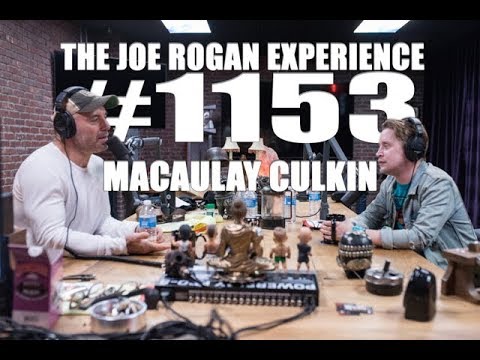
Joe Rogan Experience #1153 - Macaulay Culkin
Joe Rogan (host), Macaulay Culkin (guest), Narrator, Narrator, Narrator, Narrator
In this episode of The Joe Rogan Experience, featuring Joe Rogan and Macaulay Culkin, Joe Rogan Experience #1153 - Macaulay Culkin explores macaulay Culkin on child stardom, health scares, leisure, and reinvention Joe Rogan talks with Macaulay Culkin about growing up as an extraordinarily famous child actor and how he emerged relatively grounded, financially secure, and largely disinterested in chasing Hollywood work. Culkin describes his unusual childhood "job," his parents choosing roles, and later stepping away from the industry to live on his own terms in New York, Paris, and now Los Angeles as a self‑described “man of leisure.”
Macaulay Culkin on child stardom, health scares, leisure, and reinvention
Joe Rogan talks with Macaulay Culkin about growing up as an extraordinarily famous child actor and how he emerged relatively grounded, financially secure, and largely disinterested in chasing Hollywood work. Culkin describes his unusual childhood "job," his parents choosing roles, and later stepping away from the industry to live on his own terms in New York, Paris, and now Los Angeles as a self‑described “man of leisure.”
They dive into his recent health issues—ulcers, a parasite from Thailand, and past toxoplasmosis—and how these have forced lifestyle changes and sparked conversations about gut health, antibiotics, and behavioral effects of parasites. Culkin also explains his comedy site BunnyEars.com, a satire of celebrity lifestyle brands like Goop, and his podcast and creative hobbies.
The conversation ranges widely into boxing and MMA, European lifestyle and food, the economics and psychology of extreme fame, odd show‑business paths (Chuck Woolery, Johnny Depp, game‑show hosts), art history (Picasso, da Vinci, Kubrick), and how money, boredom, and bad incentives can warp people’s careers. Throughout, Culkin comes off as reflective, funny, and surprisingly normal given his history.
Key Takeaways
Extreme child fame can feel “normal” until you gain adult perspective.
Culkin emphasizes that as a kid he had no baseline for comparison: sets, long workdays, and being the center of attention were just his routine, and only later did he realize how unusual and potentially distorting that environment was.
Get the full analysis with uListen AI
Parents and producers, not child actors, often drive early career choices.
He never chose scripts or projects—his parents did—and his job was simply to show up, hit marks, and remember lines. ...
Get the full analysis with uListen AI
Financial planning early on can buy lifelong creative freedom later.
Because he earned and preserved substantial money as a child, Culkin now mostly lives off investments and interest, allowing him to pick only projects that genuinely interest him (like a friend’s film or his own satire site) rather than working for income.
Get the full analysis with uListen AI
Gut health, meds, and lifestyle interact in non‑obvious, compounding ways.
His ulcers and stomach problems seem to result from a mix of a parasite from Thailand, heavy antibiotics, frequent ibuprofen, red meat, smoking, and drinking—illustrating how multiple stressors can converge on gut damage and force major habit changes.
Get the full analysis with uListen AI
Parasites like toxoplasmosis can subtly shape human behavior and risk‑taking.
They discuss research showing toxoplasma (often from cats or undercooked meat) alters rat behavior and correlates with higher entrepreneurial and risk‑taking tendencies in humans, highlighting how biology can nudge personality and decisions.
Get the full analysis with uListen AI
Celebrity wellness and lifestyle brands are ripe for intelligent satire.
With BunnyEars. ...
Get the full analysis with uListen AI
Prolonged work you don’t enjoy often drives over‑spending and burnout.
Rogan and Culkin link examples like Johnny Depp and sitcom actors to a pattern: when artists feel trapped in lucrative but unfulfilling projects, they overcompensate with extravagant consumption (cars, islands, wine) as the primary reward for enduring the work.
Get the full analysis with uListen AI
Notable Quotes
“My life is unique to me… I'm almost like a peerless person.”
— Macaulay Culkin
“I don’t really pursue acting at all… I don’t like being on the circuit.”
— Macaulay Culkin
“I’m able to live the life that my circumstances afforded me. I’m very, very lucky.”
— Macaulay Culkin
“Once you put art out there, it’s not yours anymore. That’s the world’s.”
— Macaulay Culkin
“How rich is rich enough?… His whole life is doing movies so he can spend all that money.”
— Joe Rogan (about Johnny Depp)
Questions Answered in This Episode
How did stepping away from agents and auditions change your relationship to acting and creativity?
Joe Rogan talks with Macaulay Culkin about growing up as an extraordinarily famous child actor and how he emerged relatively grounded, financially secure, and largely disinterested in chasing Hollywood work. ...
Get the full analysis with uListen AI
Looking back now, is there anything you wish someone had done differently to protect or guide you as a child star?
They dive into his recent health issues—ulcers, a parasite from Thailand, and past toxoplasmosis—and how these have forced lifestyle changes and sparked conversations about gut health, antibiotics, and behavioral effects of parasites. ...
Get the full analysis with uListen AI
What specific experiences or readings most changed how you think about parasites, gut health, and their impact on mood and behavior?
The conversation ranges widely into boxing and MMA, European lifestyle and food, the economics and psychology of extreme fame, odd show‑business paths (Chuck Woolery, Johnny Depp, game‑show hosts), art history (Picasso, da Vinci, Kubrick), and how money, boredom, and bad incentives can warp people’s careers. ...
Get the full analysis with uListen AI
Where do you personally draw the line between responsible wellness advice and exploitative pseudoscience—especially as you parody it on BunnyEars?
Get the full analysis with uListen AI
If you did decide to direct or produce a film, what kind of story or subject would feel worth the time and stress for you now?
Get the full analysis with uListen AI
Transcript Preview
Boom, and we're live.
And we're live.
Hey, pull the sucker up there.
Get that a little closer? A little closer?
Yeah, okay. Yeah, right about there.
Yeah, here we go. All right.
How are you, fellas? What's going on?
Fantastic. Uh, how are you doing?
Very nice to meet you.
Nice to meet you, too.
You're remarkably normal.
Oh, thanks. (laughs)
(laughs)
You know, people are always struck at, uh, how normal I am.
(laughs)
I'm like, it's just like, "Wow, really?" I think my, my reputation-
Like, you made it through the maze-
I guess so.
... of being a famous child.
Yeah, yeah.
That's a very unusual maze.
Uh, yeah, uh, my life is unique to me. That's what I like to say. You know, yeah, and, uh, I'm almost like a peerless person, like to a certain-
Yeah.
... extent. There's not too many people I can look left and right, and we, you know, I, I ... And like, we have similar experiences, you know?
Yeah, is there anybody that you ever contacted, like Jodie Foster or someone who's made it through and seems pretty put together?
Not really. Like-
No?
No, not really. I mean, it's kind of a weird cold call, you know?
Right.
Kind of just like, "Hey, Jodie Foster." (laughs)
(laughs)
It's Mac.
But I would think that it's such a small clan of people. Like, if a comic called me that I knew, you know-
Mm-hmm.
... and they wanted to talk to me, I would talk to them 'cause it's such a small clan of people.
Well, I mean, I mean, we do have our weekly therapy sessions. Yeah, yeah. You know? Yeah. (laughs)
(laughs)
You know what I mean? It's just like, yeah, me, Elijah Wood-
Support group, right.
... you know, yeah, Jodie Foster, you know, yeah. Like, we all get together and, yeah, we, we-
(laughs)
... we, we weep, you know?
(laughs)
It's ... Actually we do primal screaming. That's what we do. (laughs)
I was describing what it was like ... I have a friend who, uh, Ricky Schroder, who, uh, is, um, you know, obviously he was very famous when he was young-
Mm-hmm.
... as well. And, uh-
One of my favorite theme songs, TV theme songs of all time.
Silver Spoons?
Silver Spoons? Oh, yeah.
Yeah.
Mm-hmm.
And I was saying, like, the, uh, you ... The way you developed is not like the way the recipe calls.
Mm-hmm.
Like, the recipe calls for you to have a childhood and try to figure out life and then become a man and then try to find yourself and then-
Install uListen to search the full transcript and get AI-powered insights
Get Full TranscriptGet more from every podcast
AI summaries, searchable transcripts, and fact-checking. Free forever.
Add to Chrome