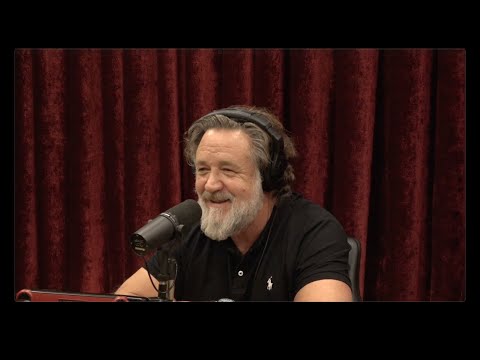
Joe Rogan Experience #2406 - Russell Crowe
Russell Crowe (guest), Narrator, Joe Rogan (host), Jamie Vernon (guest), Brian Simpson (guest), Tony Hinchcliffe (guest), Narrator, Narrator
In this episode of The Joe Rogan Experience, featuring Russell Crowe and Narrator, Joe Rogan Experience #2406 - Russell Crowe explores russell Crowe on Nuremberg, gambling, burnout, and rebuilding nature Russell Crowe joins Joe Rogan to discuss his new film *Nuremberg*, focusing on the psychology of Nazi leaders, the banality of evil, and how small incremental steps can lead societies into atrocity. They broaden this into a critique of polarization, media manipulation, and how social media and bots are weaponized to inflame division.
Russell Crowe on Nuremberg, gambling, burnout, and rebuilding nature
Russell Crowe joins Joe Rogan to discuss his new film *Nuremberg*, focusing on the psychology of Nazi leaders, the banality of evil, and how small incremental steps can lead societies into atrocity. They broaden this into a critique of polarization, media manipulation, and how social media and bots are weaponized to inflame division.
The conversation shifts into sports, gambling, and addiction—covering everything from cricket, rugby league, and NFL fairness to modern sports-betting scandals, Crowe’s family history with gambling, and Rogan’s views on personal freedom versus societal harm. They also delve into alcohol, drugs, and why education, not prohibition, is crucial.
Crowe talks candidly about overworking, making five films back-to-back, and “breaking his brain,” then describes how his remote Australian farm functions as a long-term psychological and physical reset. He explains his efforts to regenerate native forest, reduce invasive species, and build a sustainable, grounded life away from fame.
The episode closes by tying together themes of health, medicine, and systemic failure—particularly the U.S. healthcare system and pharmaceutical industry—while contrasting it with Australia’s approach, and reflecting on how societies should protect their citizens while still preserving individual freedoms.
Key Takeaways
Evil is often incremental and bureaucratic, not obviously monstrous.
Crowe emphasizes that the Nazis at Nuremberg were mostly rational, seemingly normal men whose decisions escalated step-by-step—illustrating how small, incremental policy changes and dehumanization can lead to horrific outcomes without dramatic turning points.
Get the full analysis with uListen AI
Dehumanization and rigid “red vs. blue” thinking destroy nuance and communication.
Both argue that forcing people into simplistic political camps erases subtlety, makes meaningful dialogue harder, and mirrors the dangerous ‘othering’ behavior seen historically in genocidal regimes.
Get the full analysis with uListen AI
Modern gambling is being normalized and embedded into everyday culture.
From news shows reading sports odds to kids casually using betting apps, Crowe and Rogan warn that gambling has shifted from a contained vice to a pervasive, always-on behavior that can quietly escalate into addiction—especially on smartphones.
Get the full analysis with uListen AI
Education and self-management are more realistic than blanket bans on risky behaviors.
Rogan supports legal access to alcohol, drugs like cannabis, and gambling but insists society must teach people how these things hijack dopamine, genetics, and impulse control, so individuals can recognize when thrills turn into destructive compulsions.
Get the full analysis with uListen AI
Creative overwork can lead to cognitive and emotional burnout that demands real recovery.
Crowe describes making five films in eight months, feeling mentally “empty,” and even considering stepping away from a major role—showing that even highly successful people must recognize limits and deliberately build in real downtime.
Get the full analysis with uListen AI
Immersion in nature is a powerful, underused therapy and long-term investment.
Crowe’s decision at 32 to buy raw bushland now gives him a crucial refuge where he wakes with the birds, checks cattle, and restores his mental health—while also carrying out long-horizon projects like planting tens of thousands of native trees.
Get the full analysis with uListen AI
The U.S. healthcare and pharma system structurally punishes ordinary people.
They contrast America, where hundreds of thousands go bankrupt annually from medical bills and drugs cost many times more than in Australia, with countries that provide universal care—arguing that elected officials have failed to prioritize citizens’ health over corporate profit.
Get the full analysis with uListen AI
Notable Quotes
“Gigantic jumps we can all read, but little incremental changes… you get to a point where the average person then turns around and goes, ‘How did we get to here?’”
— Russell Crowe
“It’s nuts… that you can split all of us into two camps. It takes out all the room for subtlety in a discussion.”
— Russell Crowe
“The idea that you’re just giving money away to a system where it’s not fair, it’s not gonna benefit you, and in the longer term you’re simply not gonna win—that drives me a little crazy.”
— Russell Crowe
“We’ve got to move at the pace of the slowest member of our community.”
— Russell Crowe
“The largest Western economy is punishing its citizens [with healthcare costs]… that just beggars belief.”
— Russell Crowe
Questions Answered in This Episode
How should filmmakers balance humanizing historical villains with the risk of appearing to excuse or normalize their actions?
Russell Crowe joins Joe Rogan to discuss his new film *Nuremberg*, focusing on the psychology of Nazi leaders, the banality of evil, and how small incremental steps can lead societies into atrocity. ...
Get the full analysis with uListen AI
What concrete steps could media and governments take to reduce the normalization of gambling without banning it outright?
The conversation shifts into sports, gambling, and addiction—covering everything from cricket, rugby league, and NFL fairness to modern sports-betting scandals, Crowe’s family history with gambling, and Rogan’s views on personal freedom versus societal harm. ...
Get the full analysis with uListen AI
Where should societies draw the line between individual freedom (to drink, gamble, or use drugs) and collective responsibility to protect vulnerable people?
Crowe talks candidly about overworking, making five films back-to-back, and “breaking his brain,” then describes how his remote Australian farm functions as a long-term psychological and physical reset. ...
Get the full analysis with uListen AI
How can high-performing creatives and professionals recognize early signs of burnout and design careers that include real, restorative downtime?
The episode closes by tying together themes of health, medicine, and systemic failure—particularly the U. ...
Get the full analysis with uListen AI
What practical models from countries like Australia could realistically be adapted to reform the U.S. healthcare and pharmaceutical systems without stifling innovation?
Get the full analysis with uListen AI
Transcript Preview
(drumbeats) Joe Rogan podcast. Check it out.
The Joe Rogan Experience. (drums)
Train by day, Joe Rogan podcast by night. All day. (rock music plays) Joe, ladies and gentlemen. How are you, sir? Good to see you.
Joe Rogan.
Yeah, good to see you.
Nice to see you, man.
Your movie's great. (smacks lips)
Thank you very much.
When does it come out?
Uh, in the United States, it comes out November 7th.
Okay, so it's-
And then, uh, various dates over the next month and a half or so around the rest of the world.
It's a fucking heavy movie, man.
Yeah.
It's a heavy movie.
Yeah.
The, um, the trial, that footage, was that all real footage, the Holocaust footage?
Yeah.
Real footage of the-
Yeah.
... the plows and-
I was one of the, one of the reasons that, that inspired Jamie to go ahead, that he was given access to that footage, some of which has never been seen since-
Oh.
... 1946.
Oh.
Yeah, uh, it's a very interesting way that he makes the subject matter accessible, because it's such a dry topic from the outside, right? "Here's a court case."
Right.
You know, "Here's yet another courtroom drama-"
Right.
"... procedural or whatever." So I can imagine that people would see that and go, "Well this, uh, you know, might not be an exciting watch or something." (laughs) But he sort of puts the audience in this position where he allows them to start to be amused by some of the things that are going on and the interpersonal relationships, and, you know, when the commandant of the, um, prison has to call up his two, um, top mental health experts and dress them down for getting into a fistfight. (laughs) You know, things like that. Kind of, it's, there's a charm to it, and then he gets you into the courtroom, and he locks the door.
Mm.
And he goes, "Now you're gonna see what we're talking about." So I think it was a very interesting film device to disarm people before he starts giving them the, the real juice, you know?
Yeah, it's, uh, it's also a fascinating psychological tape from the, uh, psychiatrist, from Kelly's perspective, you know, because the way he's describing all human beings-
Yeah.
... that all human beings are capable of these horrific acts.
Yeah, and that's the thing that was a very unpopular take at the time, actually led to his removal from the process, because he wasn't fulfilling what the War Department wanted him to say.
Yeah.
Which is, you know, all Nazis are crazy, you know, ruled by a madman, and, uh, this is a unique experience. But that's not what he found, and sitting down, talking to the 22, um, major Nazi sort of names that, that he was assigned to post-war, he realized that every single one of these people was, you know, as normal... Well, there was a couple (laughs) that were pretty out there. But, you know, for the most part, he was dealing with rational men.
Install uListen to search the full transcript and get AI-powered insights
Get Full TranscriptGet more from every podcast
AI summaries, searchable transcripts, and fact-checking. Free forever.
Add to Chrome