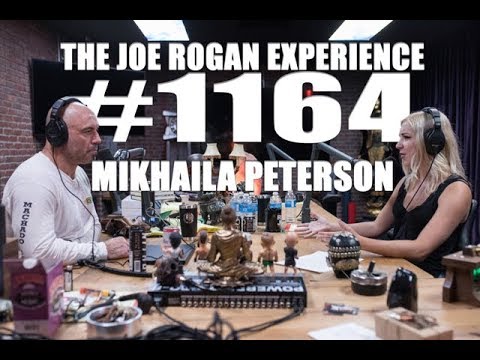
Joe Rogan Experience #1164 - Mikhaila Peterson
Joe Rogan (host), Mikhaila Peterson (guest), Narrator, Narrator, Narrator
In this episode of The Joe Rogan Experience, featuring Joe Rogan and Mikhaila Peterson, Joe Rogan Experience #1164 - Mikhaila Peterson explores jordan Peterson’s Daughter Explains Carnivore Diet, Media Bias, Autoimmunity Battle Mikhaila Peterson recounts growing up with Jordan Peterson, watching his sudden rise to fame and the disconnect between media portrayals and what she saw in real life, especially around the pronoun and “enforced monogamy” controversies.
Jordan Peterson’s Daughter Explains Carnivore Diet, Media Bias, Autoimmunity Battle
Mikhaila Peterson recounts growing up with Jordan Peterson, watching his sudden rise to fame and the disconnect between media portrayals and what she saw in real life, especially around the pronoun and “enforced monogamy” controversies.
The bulk of the conversation centers on her extreme autoimmune history—severe juvenile arthritis, hip and ankle replacements at 17, depression, hypersomnia—and how years of failed conventional treatment led her to radical dietary experimentation.
Through elimination diets she discovered dramatic links between specific foods and flares of arthritis, skin issues, hallucination-level depression, and eventually settled on an all–red-meat, salt, and water “carnivore” diet that she says eliminated most symptoms.
Rogan and Peterson discuss media clickbait incentives, ideological battles over nutrition (especially vegan vs carnivore), environmental objections, and the roles of discipline, exercise, and saunas in health, while acknowledging the lack of robust long‑term data on carnivore diets.
Key Takeaways
Elimination diets can reveal powerful food–symptom links missed by standard medicine.
Peterson’s joint pain, skin rashes, severe depression, and even brief hallucinations tracked tightly to specific foods (gluten, soy, almonds, sugar, even olives), which she only uncovered by aggressively stripping her diet down and reintroducing items one at a time.
Get the full analysis with uListen AI
Some autoimmune and mood disorders may be far more diet-responsive than assumed.
Despite heavy immunosuppressants, antidepressants, and Adderall, she kept deteriorating; cutting out most foods and eventually going full carnivore coincided with remission of arthritis symptoms, lifting of lifelong depression, and discontinuation of medications.
Get the full analysis with uListen AI
Carnivore diets remain controversial but may help a subset of highly sensitive people.
Peterson, her father, and others report outsized benefits from all‑meat diets, including stable mood and reduced inflammation, even while lab tests show mostly normal vitamin levels—challenging mainstream assumptions but still lacking rigorous long‑term studies.
Get the full analysis with uListen AI
Media incentives often favor conflict and distortion over accurate representation.
Rogan and Peterson describe editors rewriting headlines, cutting nuance, and spinning quotes (e. ...
Get the full analysis with uListen AI
Exercise and discipline are crucial, but physical health constraints are real.
Rogan argues many sedentary, overweight people underestimate their capacity to move and over-rely on excuses, whereas Peterson pushes back that low energy and undiagnosed issues (like her and her father’s pre-diet fatigue) can genuinely limit people until diet is corrected.
Get the full analysis with uListen AI
Non-drug tools like sauna and cryotherapy can meaningfully affect symptoms.
Peterson reports that infrared sauna sessions significantly blunt the severity of her food-reaction episodes, while Rogan notes strong mood and recovery benefits from traditional saunas and contrasts them with cryotherapy’s targeted pain relief.
Get the full analysis with uListen AI
Nutritional science is still evolving, and one-size-fits-all advice is risky.
The discussion highlights how people vary widely in tolerance to grains, emulsifiers, probiotics, and plant compounds, suggesting that rigid dietary dogmas (vegan, paleo, carnivore, etc. ...
Get the full analysis with uListen AI
Notable Quotes
““I was so sick before this it was like I was dying.””
— Mikhaila Peterson
““If you’re alive, you can exercise… Can you walk to the refrigerator? Then you can exercise.””
— Joe Rogan
““I thought honesty was how the world worked. Then I watched what the media did to my dad.””
— Mikhaila Peterson
““People want you to follow their diet so it reinforces that what they’re doing is correct.””
— Joe Rogan
““If your choice is to live with an autoimmune disorder and die slowly that way, you can do that and not eat meat if you want to.””
— Mikhaila Peterson
Questions Answered in This Episode
How could large-scale, rigorous clinical studies on carnivore diets be designed to test claims like Mikhaila’s without putting participants at undue risk?
Mikhaila Peterson recounts growing up with Jordan Peterson, watching his sudden rise to fame and the disconnect between media portrayals and what she saw in real life, especially around the pronoun and “enforced monogamy” controversies.
Get the full analysis with uListen AI
To what extent are current medical and nutritional guidelines failing people with rare or extreme autoimmune presentations like juvenile idiopathic arthritis?
The bulk of the conversation centers on her extreme autoimmune history—severe juvenile arthritis, hip and ankle replacements at 17, depression, hypersomnia—and how years of failed conventional treatment led her to radical dietary experimentation.
Get the full analysis with uListen AI
How do we balance environmental and ethical concerns about meat production with the needs of individuals who seem to function best on animal-based diets?
Through elimination diets she discovered dramatic links between specific foods and flares of arthritis, skin issues, hallucination-level depression, and eventually settled on an all–red-meat, salt, and water “carnivore” diet that she says eliminated most symptoms.
Get the full analysis with uListen AI
Could tools like continuous glucose monitors, microbiome sequencing, and genetic testing make personalized elimination diets more targeted and less extreme?
Rogan and Peterson discuss media clickbait incentives, ideological battles over nutrition (especially vegan vs carnivore), environmental objections, and the roles of discipline, exercise, and saunas in health, while acknowledging the lack of robust long‑term data on carnivore diets.
Get the full analysis with uListen AI
Where is the line between genuine physical limitation and avoidable lack of discipline when it comes to exercise and lifestyle change in chronically ill patients?
Get the full analysis with uListen AI
Transcript Preview
Five, four, three, two, one. And we're live? Yes. Hello.
Hello.
What's happening?
Not much. I'm excited to be here.
I'm excited to have you here. Uh, your father speaks very highly of you.
That's good.
What is it like to have Jordan Peterson as a dad? Is it weird? Do you have to check yourself constantly and make sure you're on, you know-
(laughs)
... on steady ground and-
I didn't-
... don't say anything ridiculous?
No. Not at all. Not at all. I didn't realize it was weird until I went away to university, and then kind of s- so, like, just was away for a while, and then when I came back to the house especially, 'cause the house is full of, like, paintings and masks and statues and, like, 32 different paint colors, and I came back and was like, "Oh, maybe he's a bit eccentric."
(laughs)
(laughs)
No, he's definitely eccentric. Um, we were talking off-air about what it was like to watch your dad become famous and, and become famous in, in his 50s, right? Like-
Yeah.
... I hope-
Like, 54, 55.
That's when he became famous. Before that, relatively unknown, respected professor. One issue with this one transgender bill, the, the, the preferred pronouns bill.
Mm-hmm.
And then boom, off to the races.
Yeah. It was-
Is this strange?
It was ... Yeah, it was super weird, especially how the media was portraying him and how what was actually happening at the events wasn't what was being portrayed in the media. So that was weird to watch, and then people recognizing him on the street is strange. It's ... Yes, it's-
When you say-
It's been weird.
... what, what happened in real life was not was, what was being portrayed, like, what was different?
Um, mostly what he was saying. So most of what he's said is on film anyway.
Mm-hmm.
So you can go to YouTube and see what he's been saying. Like, not, there's not, like, some secret that's going around. But what's been portrayed has been so much more negative than what he's actually said. Or they'll take, like, sound bites and just weave a story that isn't quite true, which I didn't re- for some reason I ... Now it looks silly, but for some reason I just thought that what the media was portraying was honest and-
Always.
Yeah.
Yeah. Yeah, me too. Yeah.
Yeah. And it's not.
Well, they're writers, you know? And what's ... There's a real issue today, um, that, that issue I've talked about this before, but the issue is clicks. Um-
Yeah.
... it's not just about what's the facts of the story. It's about these publications are struggling to stay alive, and one of the only ways that they can get people to click on stories is salacious headlines, real, make things really clickbait-y, and that's what they focus on. And they focus on negative aspects that are gonna get people riled up. They have to have an angle. And I've talked to people who are writers who, um, will write something, and then I'll, I'll talk to them, and I'll say, "Hey, man, this is not what we talked about or what happened." And they said, "I'm gonna be honest with you. I didn't even write that."
Install uListen to search the full transcript and get AI-powered insights
Get Full TranscriptGet more from every podcast
AI summaries, searchable transcripts, and fact-checking. Free forever.
Add to Chrome