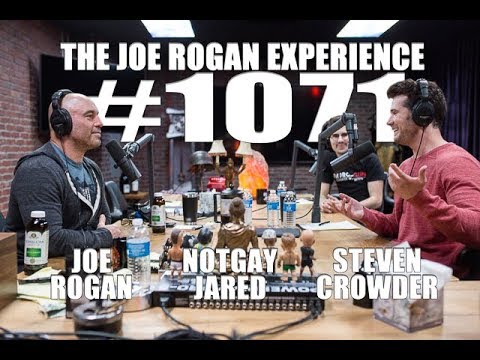
Joe Rogan Experience #1071 - Steven Crowder & NotGay Jared
Joe Rogan (host), Steven Crowder (guest), NotGay Jared (guest), Guest (guest), Guest (guest), Guest (guest), Guest (guest), Guest (guest), Guest (guest), Guest (guest), Guest (guest), Guest (guest), Guest (guest), Guest (guest), Guest (guest)
In this episode of The Joe Rogan Experience, featuring Joe Rogan and Steven Crowder, Joe Rogan Experience #1071 - Steven Crowder & NotGay Jared explores rogan, Crowder clash with YouTube, woke culture, and free speech Joe Rogan, Steven Crowder, and NotGayJared spend most of the episode dissecting perceived ideological bias at YouTube and in broader Silicon Valley, focusing on demonetization, content strikes, and inconsistent enforcement of policies. They detail specific run‑ins with YouTube, including parodies of Bob Ross and Mr. Rogers, and recount a contentious YouTube “conservative outreach” meeting that highlighted double standards in what’s considered advertiser‑friendly. The conversation then pivots into culture-war territory: antifa infiltration, gender ideology, puberty blockers for minors, campus activism, transgender politics, media cowardice, and conspiracy thinking. Throughout, they argue that selective censorship and ideological conformity on the left are driving polarization, fueling fringe movements, and making genuine debate nearly impossible.
Rogan, Crowder clash with YouTube, woke culture, and free speech
Joe Rogan, Steven Crowder, and NotGayJared spend most of the episode dissecting perceived ideological bias at YouTube and in broader Silicon Valley, focusing on demonetization, content strikes, and inconsistent enforcement of policies. They detail specific run‑ins with YouTube, including parodies of Bob Ross and Mr. Rogers, and recount a contentious YouTube “conservative outreach” meeting that highlighted double standards in what’s considered advertiser‑friendly. The conversation then pivots into culture-war territory: antifa infiltration, gender ideology, puberty blockers for minors, campus activism, transgender politics, media cowardice, and conspiracy thinking. Throughout, they argue that selective censorship and ideological conformity on the left are driving polarization, fueling fringe movements, and making genuine debate nearly impossible.
Key Takeaways
YouTube’s enforcement of policy appears inconsistent and ideologically skewed.
Crowder describes parody videos being struck or demonetized while graphic or highly profane left‑leaning content is promoted or monetized, suggesting that enforcement depends as much on viewpoint and internal culture as on written rules.
Get the full analysis with uListen AI
Creators have little recourse when large platforms misuse copyright and “safety” tools.
They recount estates and individuals using copyright or privacy complaints to force removals even when the content is clearly parody or legally recorded, illustrating how strike systems can be weaponized against unpopular speech.
Get the full analysis with uListen AI
Secretive or blunt moderation tools erode trust and push audiences toward extremes.
Rogan and Crowder argue that opaque demonetization, vague “hate speech” designations, and selective crackdowns make people feel persecuted and can radicalize both right and left by confirming persecution narratives.
Get the full analysis with uListen AI
Media often avoids inconvenient facts when they conflict with preferred narratives.
Their antifa sting—where organizers casually talked about knives and guns—was largely ignored or downplayed by on‑scene journalists, reinforcing their view that mainstream outlets protect certain movements from bad optics.
Get the full analysis with uListen AI
The line between protecting marginalized groups and suppressing dissent is blurring.
They cite examples where questioning puberty blockers for minors or critiquing gender ideology is labeled “hate speech,” making careful scientific or ethical debate about children’s medical treatment socially dangerous.
Get the full analysis with uListen AI
Overuse of labels like “Nazi” and “alt-right” dilutes meaning and backfires.
By branding figures like Ben Shapiro or Christina Hoff Sommers as extremists, critics lump together very different viewpoints, making real extremists harder to distinguish and sometimes pushing moderates further right.
Get the full analysis with uListen AI
Authenticity and long-form conversation are winning against legacy formats.
Rogan contrasts open-ended podcasts and unedited debates (e. ...
Get the full analysis with uListen AI
Notable Quotes
“You can't be authentic and play by YouTube's rules unless you completely agree with them.”
— Steven Crowder
“If you call someone a Nazi for reasonable views long enough, eventually they just say, 'Okay, fine, I'm a Nazi,' and the pendulum swings further the other way.”
— Steven Crowder
“I’m 100% in favor of grown adults deciding to transition. What drives me crazy is people making decisions for six‑year‑olds.”
— Joe Rogan
“The solution to media bias is not to have a bunch of people in Silicon Valley deciding what’s true.”
— Steven Crowder
“If you think someone’s wrong, the answer isn’t to lock them up for it. The answer is proving them wrong and having a conversation.”
— Joe Rogan
Questions Answered in This Episode
How should large platforms like YouTube design moderation systems that protect users from genuine harm without privileging one ideology over another?
Joe Rogan, Steven Crowder, and NotGayJared spend most of the episode dissecting perceived ideological bias at YouTube and in broader Silicon Valley, focusing on demonetization, content strikes, and inconsistent enforcement of policies. ...
Get the full analysis with uListen AI
Where should society draw the ethical line on medical interventions like puberty blockers for minors, and who should be allowed to question that line publicly?
Get the full analysis with uListen AI
Can mainstream media regain trust with politically diverse audiences, and if so, what concrete changes in coverage and sourcing would be necessary?
Get the full analysis with uListen AI
How do we distinguish between necessary social stigma (e.g., for pedophilia or deliberate disease transmission) and harmful stigmatization used to silence debate?
Get the full analysis with uListen AI
Is there a viable cultural or political “center” left in the U.S., or has the combination of algorithm-driven media and activist pressure made polarization irreversible?
Get the full analysis with uListen AI
Transcript Preview
... the dragon's mouth in this thing. Five, four, three, two, one. (silence) Yes, and we're live.
Oh, okay.
Gentlemen, hello.
Hello.
You still have the ability to go live, that's nice.
Yes.
Oh, yeah. You guys get fucked.
(laughs)
Who'd you get fucked by? Mr. Rogers fucked you?
Yeah, Mr. Rogers. It's funny-
(laughs)
... the people who go after us, the Bob Ross Estate, every Mr. Rogers-
Every woman over the age of 90's dream-
Yeah.
... to scream, "Mr. Rogers."
But this is what's confusing, which most of what you guys do in terms of, like, the Bob Ross thing in particular. First of all, that was, that took a lot of balls.
Thank you.
Because this is, uh, you- you had Bob Ross painting Muhammad.
Yeah.
Which is, uh-
In period blood, the second one, because they-
(laughs)
... the BuzzFeed women were doing the painting.
Yeah.
It was YouTube.
Yeah.
This was act- actually after a meeting with YouTube. Remember I said-
Never ask them how you can top something, because we'll- we'll period blood-
Pull the sucker right up to you. There you go.
Yeah, yeah.
It's almost like a no.
You should know.
I should almost say, "No, I'm not gonna work with these guys."
You're an SM7 in our studio.
Yeah.
(laughs)
Um-
I don't know.
But, yeah. We were- we went to YouTube.
Um, so the Bob Ross Estate got after you, but- but that's parody. How can they mock you or how can they get you in trouble for mocking something or doing parody? Well, it's like, here's why. You have a system with YouTube, right, where they just strike.
Yeah.
They just strike you and you lose your privileges whether you win or not. We've never lost.
True.
So the Bob Ross Estate sent us a message.
Mm-hmm.
Right? And it was saying like, "First off, have you no decency? You know this isn't in accordance with Islamic law."
Islamical law. (laughs)
We're sitting there, like, laughing our asses off.
In accordance with Islam? Like, you're supposed to be in accordance with Islamic law when you're doing parody?
They thought, they thought that we didn't know that it was offensive.
Yeah, they thought we didn't know.
Like-
Like we stumbled across this. (laughs) And so then-
Oh, that's hilarious.
... we respond- we responded to the lawyers as Bob Ross. Uh, we went, "Let's, uh, welcome back to The Joy of Painting. We're gonna draw our lawyer friends eating from a nice big pile of shit."
(laughs)
And we painted them eating from a pile of corn-infested shit.
Mm-hmm.
And then at the end of the video, we're like, "Oh, it looks like they need a friend," and put Muhammad right next to them in the pile. And it hangs above our bathroom and we've never heard from them again. They sent a cease and desist and we, we ran it past our lawyer.
Install uListen to search the full transcript and get AI-powered insights
Get Full TranscriptGet more from every podcast
AI summaries, searchable transcripts, and fact-checking. Free forever.
Add to Chrome