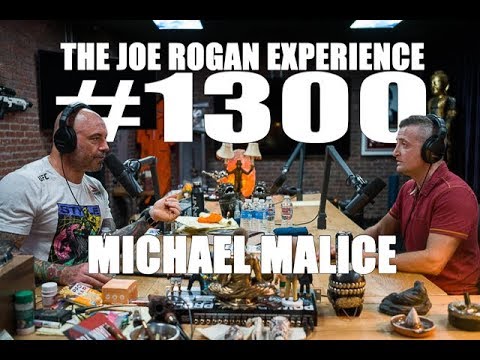
Joe Rogan Experience #1300 - Michael Malice
Joe Rogan (host), Michael Malice (guest), Jamie Vernon (guest), Narrator, Guest (guest)
In this episode of The Joe Rogan Experience, featuring Joe Rogan and Michael Malice, Joe Rogan Experience #1300 - Michael Malice explores free Speech, Deplatforming, and Fringe Politics in the Digital Age Joe Rogan and Michael Malice spend the episode dissecting deplatforming, political polarization, and how social media gatekeepers shape acceptable discourse. They argue that banning controversial figures or ideas often backfires, driving people toward extremist fringes and validating conspiracy narratives about censorship. The conversation ranges from Trump, online “orthodoxy,” and the alt‑right/New Right to vaccines, China’s social credit system, body modification, drugs, and the ethics of meat and factory farming. Malice also explains his new book on the New Right and why he embeds himself among fringe and extremist groups as an observer rather than an adherent.
Free Speech, Deplatforming, and Fringe Politics in the Digital Age
Joe Rogan and Michael Malice spend the episode dissecting deplatforming, political polarization, and how social media gatekeepers shape acceptable discourse. They argue that banning controversial figures or ideas often backfires, driving people toward extremist fringes and validating conspiracy narratives about censorship. The conversation ranges from Trump, online “orthodoxy,” and the alt‑right/New Right to vaccines, China’s social credit system, body modification, drugs, and the ethics of meat and factory farming. Malice also explains his new book on the New Right and why he embeds himself among fringe and extremist groups as an observer rather than an adherent.
Key Takeaways
Censorship and deplatforming often strengthen the very movements they target.
Rogan and Malice argue that when platforms ban “fringe” voices, it validates claims of persecution, pushes people into more radical echo chambers, and creates a martyr effect that can grow those audiences rather than shrink them.
Get the full analysis with uListen AI
The boundary of who is ‘unacceptable’ keeps expanding once bans are normalized.
They describe a slippery progression: from deplatforming explicit Nazis, to those adjacent to them, to parody accounts, and finally to mainstream figures who simply host controversial guests, reinforcing political and ideological conformity.
Get the full analysis with uListen AI
Talking to extremists can clarify your own beliefs and expose bad ideas.
Malice defends interviewing Nazis and fringe activists; he says direct engagement forces him to test his assumptions, sharpen his arguments, and shows audiences exactly how flawed or incoherent many radical positions actually are.
Get the full analysis with uListen AI
Social media companies wield quasi‑governmental power without clear accountability.
Platforms decide who is heard, what is amplified, and which political currents are labeled ‘dangerous. ...
Get the full analysis with uListen AI
Orthodox ‘acceptable’ thought is losing its monopoly, creating a legitimacy crisis.
With podcasts, YouTube, and social media, gatekeepers in legacy media no longer control the narrative. ...
Get the full analysis with uListen AI
Authoritarian systems increasingly use social scoring to enforce self‑censorship.
Malice highlights North Korea’s songbun caste system and China’s emerging social credit system as examples of governments rating citizens and quietly shaping their opportunities—paralleling softer, algorithmic reputational controls in the West.
Get the full analysis with uListen AI
Complex public‑health and science debates can’t be resolved by simply silencing one side.
On vaccines, climate, and health misinformation, Rogan notes that outright removal of content feeds conspiracies about cover‑ups; both argue that open debate with credible experts is more effective than blanket suppression.
Get the full analysis with uListen AI
Notable Quotes
“You take one red pill, but not the whole bottle.”
— Michael Malice
“This didn’t exist before. Now we have this unbelievable ability to communicate… If this really branches off so one side gets to do it and one side doesn’t, we’re gonna have a tremendous problem in this country.”
— Joe Rogan
“What they want, apparently, is for everyone to be self‑censoring and to be afraid. And that way it’s like, instead of saying, ‘We’re censorious,’ it’s, ‘You made that decision on your own.’”
— Michael Malice
“If someone is a name, you can say, ‘Delete this tweet, it violates our guidelines.’ They don’t do that. You’re just vanished overnight.”
— Michael Malice
“There’s no better way to get kids to hate learning than school.”
— Michael Malice
Questions Answered in This Episode
Where should the line be drawn between legitimate moderation and dangerous censorship on major platforms?
Joe Rogan and Michael Malice spend the episode dissecting deplatforming, political polarization, and how social media gatekeepers shape acceptable discourse. ...
Get the full analysis with uListen AI
Does engaging publicly with extremists reduce their influence by exposing their ideas, or normalize them by giving them a platform?
Get the full analysis with uListen AI
How different are Western reputational algorithms and deplatforming from China’s explicit social credit system in practice?
Get the full analysis with uListen AI
If social media companies have state‑level influence on politics and information flows, what kind of oversight—if any—should they be subject to?
Get the full analysis with uListen AI
How can individuals maintain intellectual independence and avoid getting pulled into fringe echo chambers in such a highly polarized, algorithm‑driven environment?
Get the full analysis with uListen AI
Transcript Preview
Boom. Here we go.
Yes.
What's up, buddy? How are you?
I'm-
Good to see you.
... great. Good to be here.
We were talking before the podcast about, uh, people who get mad when I have you on, like as if you're some sort of a monster, like if you're-
(laughs)
... you're a mean person. Like-
I'm a mean person.
... we were just saying, "You're a New York Jew." You're snarky.
Yeah. Yeah.
You say funny things. But this idea that you're a Nazi or something, like, uh, people have gotten so crazy.
This... (laughs) I like that this is this icebreaker.
This is how we get started.
Hey, welcome to my show. By the way, why do people think you're a Nazi? (laughs)
'Cause someone sent me, I don't read comments on Twitter, but someone sent me something like, uh, "You're having this guy on today." And I'm like, "That is so hilarious." I go, "This guy is, uh, uh, yeah, there's some shit you say I don't agree with."
Sure.
You're very reasonable and very intelligent.
Yeah, the last chapter of the book is me arguing with a Nazi.
Conversation, folks. It's not bad. It's not bad to talk to people.
I talk, I, I, I th- well, it's, it's kinda for them a religious thing, right?
It is a-
If someone is a sinner, you can't acknowledge them.
Right.
They have to be outside of the fort.
That's a good way to look at it. That is what it is. You know, what's interesting, it's I know all, these people don't mean to do this. This is not their plan. But if you wanted to keep Donald Trump (laughs) in office, the wa- the way the people that oppose Donald Trump are behaving is the perfect way to keep him in office.
If you tell high schoolers, "If you smoke, your parents are gonna get upset and the teachers are gonna get upset," that's the biggest com- c- commercial, right?
Yeah. That is... Yeah.
Right? So, you tell these kids, "Hey, if you go to these websites and read these books, then your parents and the establishment and the teachers are all gonna be afraid of you." Well, sign me up. I mean, it's as simple as that. It's the same exact psychology and they're driving people to the fringe.
Y- They are. And the, the deplatforming thing is, uh, fascinating, because the way this stuff works, folks, is, uh, when people get deplatformed, the first people that'll get deplatformed are people that you agree with getting deplatformed. People like, uh, you know, like a real Nazi, like someone who's, uh, an avowed white supremacy. You're like, "Yeah, deplatform that guy." And then it's a little slippery, 'cause then it's like, "This guy's-"
Install uListen to search the full transcript and get AI-powered insights
Get Full TranscriptGet more from every podcast
AI summaries, searchable transcripts, and fact-checking. Free forever.
Add to Chrome