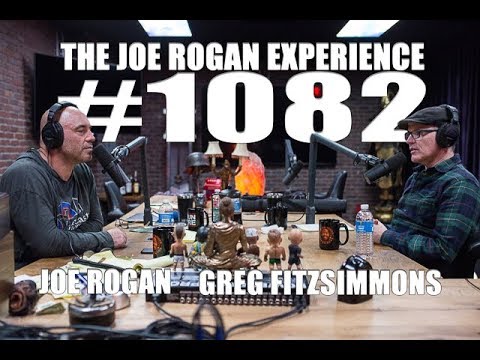
Joe Rogan Experience #1082 - Greg Fitzsimmons
Joe Rogan (host), Greg Fitzsimmons (guest), Narrator, Narrator
In this episode of The Joe Rogan Experience, featuring Joe Rogan and Greg Fitzsimmons, Joe Rogan Experience #1082 - Greg Fitzsimmons explores joe Rogan and Greg Fitzsimmons Deconstruct Comedy, Pain, and Survival Joe Rogan and Greg Fitzsimmons spend a long-form conversation weaving between stand-up comedy craft, the psychology and tragedies of comics like Richard Jeni, and the importance of camaraderie in a brutally competitive field.
Joe Rogan and Greg Fitzsimmons Deconstruct Comedy, Pain, and Survival
Joe Rogan and Greg Fitzsimmons spend a long-form conversation weaving between stand-up comedy craft, the psychology and tragedies of comics like Richard Jeni, and the importance of camaraderie in a brutally competitive field.
They branch into wide-ranging topics including predatory wildlife, travel, diet and inflammation, addiction and recovery, religion and Catholic guilt, parenting, martial arts effectiveness, and human kindness.
Throughout, they contrast destructive patterns—substance abuse, ego, misplaced competitiveness—with healthier practices like exercise, therapy, jiu-jitsu, and honest self-examination.
The episode functions as an unstructured but revealing look at how two veteran comics think about failure, discipline, mortality, and trying to live decently while chasing success.
Key Takeaways
Comedic brilliance doesn’t guarantee mainstream success or emotional stability.
Richard Jeni is held up as a world-class comic who never fully ‘broke’ despite incredible output and skill; his suicide underscores how external success and internal self-worth can diverge sharply.
Get the full analysis with uListen AI
Camaraderie among comics can be a crucial mental-health lifeline.
Rogan and Fitzsimmons stress how hanging at clubs like The Comedy Store functions as therapy—shared weirdness and mutual support help buffer isolation, depression, and the pressures of performance.
Get the full analysis with uListen AI
Healthy competition means wanting others to crush so you level up.
They argue against ‘stacking the deck’ with weak openers; following killers forces you to improve, teaches you to bring audiences to your own rhythm, and discourages petty resentment.
Get the full analysis with uListen AI
Inflammation and diet changes can significantly impact pain and energy.
Cutting bread, pasta, and sugar, plus consistent workouts, dramatically reduced Fitzsimmons’ belly and joint pain; Rogan links refined carbs and juice to energy crashes and inflammation, and emphasizes targeted vitamins when deficient.
Get the full analysis with uListen AI
Addiction recovery often requires reframing cravings as signals, not commands.
Fitzsimmons uses tools from 12-step literature and therapy: when he wants to drink, he pauses to ask what stress is driving it, treating the urge as diagnostic information rather than something to obey.
Get the full analysis with uListen AI
Organized religion can instill both valuable ethics and harmful shame.
They credit Catholicism for instilling service, charity, and manners, but criticize its emphasis on original sin, guilt, and its systemic enabling of clerical sexual abuse, arguing society often ‘throws the baby out with the bathwater.’
Get the full analysis with uListen AI
Learning to lose and be physically dominated can build resilience and humility.
Rogan sees jiu-jitsu and competitive sports as training for real-life setbacks: repeated tapping out normalizes failure, tempers ego, and prepares people to handle job loss, rejection, and change without collapsing.
Get the full analysis with uListen AI
Notable Quotes
“He was that good and he never really broke through. To us, he was a hero.”
— Greg Fitzsimmons (on Richard Jeni)
“If it’s not there, that means you’re probably not taking any chances.”
— Joe Rogan (on fear before going on stage)
“You don’t ride the wave. You let the wave settle and you start your own wave.”
— Greg Fitzsimmons (on following a high-energy comic)
“The people I know who are the most interesting have failed the hardest.”
— Joe Rogan
“I really think we all collectively, as a species, need to emphasize and learn how to be nicer to each other.”
— Joe Rogan
Questions Answered in This Episode
How many other ‘Richard Jeni’–level talents are out there now, overlooked by current distribution systems despite streaming and social media?
Joe Rogan and Greg Fitzsimmons spend a long-form conversation weaving between stand-up comedy craft, the psychology and tragedies of comics like Richard Jeni, and the importance of camaraderie in a brutally competitive field.
Get the full analysis with uListen AI
What would a healthier, more structured support network for comedians (or other performers) actually look like in practice?
They branch into wide-ranging topics including predatory wildlife, travel, diet and inflammation, addiction and recovery, religion and Catholic guilt, parenting, martial arts effectiveness, and human kindness.
Get the full analysis with uListen AI
Given what we know about diet, inflammation, and mental health, how should touring performers realistically eat and train on the road?
Throughout, they contrast destructive patterns—substance abuse, ego, misplaced competitiveness—with healthier practices like exercise, therapy, jiu-jitsu, and honest self-examination.
Get the full analysis with uListen AI
How can you keep the ethical benefits of religious traditions—service, community, moral codes—without inheriting their guilt, dogma, or institutional abuses?
The episode functions as an unstructured but revealing look at how two veteran comics think about failure, discipline, mortality, and trying to live decently while chasing success.
Get the full analysis with uListen AI
What is the best way for someone with no sports background to start learning to fail constructively—through martial arts, competition, or other controlled challenges?
Get the full analysis with uListen AI
Transcript Preview
(singing) Another episode of the Richard Jeni Fan Club. He's, he's a guy that I've been telling forever is probably the most underrated stand-up in the history of stand-up. I think he's, like, one of the all-time greats.
And he's got a body of work because he did a one-hour... Back before everybody was doing one-hour specials every year, he was doing that shit back in the, the '90s.
Oh, yeah. On Showtime-
Showtime, every year.
... he had a Showtime one. Like, when I was just starting out, so I think it was like '89 or '90, somewhere around the... He had a Showtime special.
Yeah.
And then he had a bu-
Platypus Man.
Yup, he had a bunch of HBO specials, but the last one that he did before he died in 2007, that is his masterpiece.
Really?
Yeah, it's called A Steaming Pile of Me. And I was listening to it one night coming home from a club and just laughing out la- loud in the car and clapping, (clapping) clapping in the car.
Yeah.
Like, goddamn, this guy was good.
Yeah, what a pro.
He was so good.
I mean, he was one of those guys that dressed... He put on a sharp outfit-
Yeah.
... with pleated pants. You know, really fucking corny, like, '90s looking-
(laughs)
... you know, coll- the collar with no... You know, the, the rounded priest collar shirts.
Well, he was from Bensonhurst.
Oh, is that right?
Yeah, yeah. It's th- that old school-
Oh, yeah.
... ginny mentality-
Right, right.
... from Brooklyn. (laughs)
Yeah. And he would, uh, he would give you li- I can remember, like, at least three times he would call me an hour after my set and give me taglines to bits.
Wow.
Yeah, and they were fucking good.
He was almost, like, on the spectrum with that.
Yeah, totally. He wouldn't look you in the eye. He'd be, like, looking down, and he'd go really fast and talk with his hands.
Yeah.
And, uh, and he... I think he... Obviously, if people don't know Richard Jeni, sadly he committed suicide in the end, and what was tough for him was that he was that good and he never really broke through. He had a sitcom, short-lived sitcom called Platypus Man that was on, like, one of those-
UPN I believe it was.
... UPN channels, yeah.
Yeah.
And after that, it was like... He was the guy who used to fill up his book in January, you know.
Mm-hmm.
He was, he was on the road 45 weeks a year and, you know, making, you know, $100,000 on corporate dates, $50,000 on corporate dates-
Yeah.
... with, you know, 15 of those a year.
Install uListen to search the full transcript and get AI-powered insights
Get Full TranscriptGet more from every podcast
AI summaries, searchable transcripts, and fact-checking. Free forever.
Add to Chrome