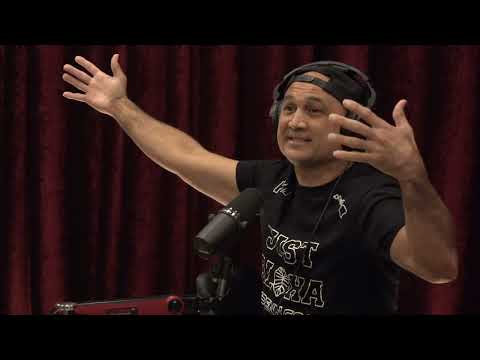
Joe Rogan Experience #2032 - BJ Penn & Tulsi Gabbard
Narrator, Narrator, Joe Rogan (host), Tulsi Gabbard (guest), BJ Penn (guest), Tulsi Gabbard (guest), Joe Rogan (host), Tulsi Gabbard (guest), Tulsi Gabbard (guest), Guest (hearing clip questioner) (guest), Guest (John Kerry in clip) (guest), Narrator, Joe Rogan (host)
In this episode of The Joe Rogan Experience, featuring Narrator and Narrator, Joe Rogan Experience #2032 - BJ Penn & Tulsi Gabbard explores rogan, Gabbard, Penn Blast Government Failures From Maui Fires To Ukraine Joe Rogan hosts Tulsi Gabbard and BJ Penn for a wide‑ranging discussion on government incompetence, media manipulation, and civil liberties, using the Maui wildfire response and the Ukraine war as primary case studies. Gabbard details systemic failures before, during, and after the Lahaina fire, from poor preparedness and blocked aid to lack of transparency and looming land grabs. They contrast massive, loosely tracked spending on Ukraine with meager, bureaucratic aid for U.S. communities like Maui and East Palestine, arguing this reflects a captured, self‑serving political class. The conversation expands into election integrity, censorship by Big Tech, COVID policies, and how fear is weaponized to control citizens and erode constitutional rights.
Rogan, Gabbard, Penn Blast Government Failures From Maui Fires To Ukraine
Joe Rogan hosts Tulsi Gabbard and BJ Penn for a wide‑ranging discussion on government incompetence, media manipulation, and civil liberties, using the Maui wildfire response and the Ukraine war as primary case studies. Gabbard details systemic failures before, during, and after the Lahaina fire, from poor preparedness and blocked aid to lack of transparency and looming land grabs. They contrast massive, loosely tracked spending on Ukraine with meager, bureaucratic aid for U.S. communities like Maui and East Palestine, arguing this reflects a captured, self‑serving political class. The conversation expands into election integrity, censorship by Big Tech, COVID policies, and how fear is weaponized to control citizens and erode constitutional rights.
Key Takeaways
Maui’s wildfire catastrophe exposed deep systemic incompetence and lack of transparency.
Gabbard describes how alarms weren’t used, water access failed, officials were off-island or absent for days, roads and citizen aid were inexplicably blocked, and local communities survived mainly through neighbors helping neighbors rather than government support.
Get the full analysis with uListen AI
There is widespread local fear that Lahaina residents could lose ancestral land after losing their homes.
The Hawaii governor publicly floated the idea of the state taking over burned lands for workforce housing or a memorial, which residents and the guests see as an unconscionable power grab that threatens generational property rights and community sovereignty.
Get the full analysis with uListen AI
Hawaii’s long‑standing water and land policies favor corporations and resorts over residents.
Historical diversion of streams for plantations and resorts turned once‑lush areas like Lahaina into fire‑prone dry zones and left firefighters and residents with inadequate water, while ordinary families face restrictions even as golf courses and hotels stay fully watered.
Get the full analysis with uListen AI
U.S. spending priorities suggest a captured state more responsive to war interests than its own citizens.
They highlight over $135 billion sent to Ukraine—with billions “miscalculated” or added—while Maui residents get a one‑time $700 FEMA payment and East Palestine residents see little long‑term support, arguing this reflects the influence of the military‑industrial complex and political corruption.
Get the full analysis with uListen AI
Corporate media and tech platforms actively shape political reality and suppress inconvenient truths.
The guests cite the suppression of the Hunter Biden laptop story, shadow‑banning and fact‑checking of dissenting voices (including Gabbard), and government pressure on platforms like Facebook and Twitter as de facto state censorship that distorts elections and public debate.
Get the full analysis with uListen AI
Election systems and results are vulnerable, and reforms are resisted by both parties’ elites.
Gabbard notes how easily voting machines can be hacked, the lack of paper audit trails in many states, and mail‑in ballot irregularities, explaining she introduced a simple paper‑backup bill that neither party seriously supported, while media gatekeepers frame acceptable and unacceptable candidates.
Get the full analysis with uListen AI
Fear—of disease, war, or chaos—is being weaponized to justify power grabs and rights erosion.
From COVID lockdowns and masking mandates to Ukraine war rhetoric and domestic counter‑terror labels on parents and critics, they argue that authorities deliberately stoke fear to win compliance for censorship, surveillance, and expanded government control.
Get the full analysis with uListen AI
Notable Quotes
“The result of their decisions left people and families and communities stranded in their most dire time of need.”
— Tulsi Gabbard (on Maui officials after the Lahaina fire)
“Taking away the sovereignty of people's rights to have a say over their home, in many cases their generational lands, is such an abuse of power.”
— Tulsi Gabbard
“We have people in positions of power who treat it as though it is a game, and the only ones who lose are the people.”
— Tulsi Gabbard
“It starts with us as Americans taking our own responsibility seriously… If we, the people, don’t participate in that democracy, we won’t have a government of, by, and for the people.”
— Tulsi Gabbard
“This is like true insanity, and this is like the opposite of what we—the whole idea of electing people for office is that these people are gonna care about us and do the right thing for the community because they're one of us.”
— Joe Rogan
Questions Answered in This Episode
How should disaster‑prone regions like Maui redesign their emergency systems and governance to avoid the catastrophic failures Gabbard describes?
Joe Rogan hosts Tulsi Gabbard and BJ Penn for a wide‑ranging discussion on government incompetence, media manipulation, and civil liberties, using the Maui wildfire response and the Ukraine war as primary case studies. ...
Get the full analysis with uListen AI
What concrete mechanisms could prevent post‑disaster land grabs and ensure local, generational communities retain control of their property?
Get the full analysis with uListen AI
Given the scale of Ukraine funding versus domestic neglect, what accountability and transparency standards should be imposed on all large federal expenditures?
Get the full analysis with uListen AI
How can citizens effectively push back against coordinated censorship by government, media, and Big Tech without relying on those same institutions?
Get the full analysis with uListen AI
What specific election reforms—such as mandatory paper backups or revamped media rules—would most meaningfully restore public trust in U.S. democracy?
Get the full analysis with uListen AI
Transcript Preview
(drumbeats) Joe Rogan podcast, check it out.
The Joe Rogan Experience. (drumbeat music)
Train by day, Joe Rogan podcast by night, all day. (rock music) Are we up?
We're up.
Yeah. We're doing, uh, Fight Companion Saturday night.
Okay, yeah.
Fight Companion's fun.
It is.
It is fun.
Have a little whiskey, watch the fights-
Right?
... talk a little shit. Eddie Bravo brings up some crazy conspiracies.
Oh, man.
(laughs) Every time. (laughs)
This time, Eddie's out, so Sam Tripoli's in. We brought him as-
Right on.
... 'cause he's even more deep into the world of conspiracies, so.
Wow.
(laughs)
And he's hilarious. That, that'll be fun.
But conspiracy theory is the code name for spoiler, spoiler alert now, right?
(laughs)
Right. (laughs) It used... Well, it was invented, the term con- c- conspiracy theories was invented after they conspired to kill the President. That w- you know, that's-
Huh.
... that's when conspiracy-
I didn't know that.
Yeah. Conspiracy theory, the term conspiracy theory started getting thrown around right around the time that Kennedy got assassinated.
Wow.
And it was directly because there were so many people that had all these theories. There was all these stories, stories about the shots from the gr- the grassy knoll.
Mm-hmm.
And until Gr- Dick Gregory went on the Geraldo Rivera Show, which I think was 11 years later? What year was it that Dick Gregory went on Geraldo Rivera and showed the Zapruder footage?
I just... uh, there's a... It says this was... They used it-
Many years later, like at least eight years later.
Right.
Well, after the assassination.
It says that they used it before that, though.
What, the Zapruder film came later, right?
They used it before that. Yeah.
But it was a different assassination attempt.
Oh, right.
Garfield.
Oh, it was another assassination attempt? Garfield. Interesting.
Oh, interesting. Wait.
Interesting.
Are we talking-
In 1881. Interesting.
They have it listed on a piece of paper.
Oh, conspiracy theorists.
Interesting.
But when did the Zapruder film come out?
So, they had the Zapruder film. Zapru... I think his name was Abraham Zapruder. He was at the scene, and he was filming the President as he was driving down. And as he was driving down, he caught the shots.
Hmm.
He caught the shot to the neck-
Mm-hmm.
... and he, he sees Kennedy holding his neck, and then he sees the head go back and to the left.
Hmm.
So 1975. Okay. L- think about that. The assassination was '63. So, '75-
Yeah. Wait, wait. What, what was, what was in '63?
Gosh, that's crazy.
What was in '63?
Install uListen to search the full transcript and get AI-powered insights
Get Full TranscriptGet more from every podcast
AI summaries, searchable transcripts, and fact-checking. Free forever.
Add to Chrome