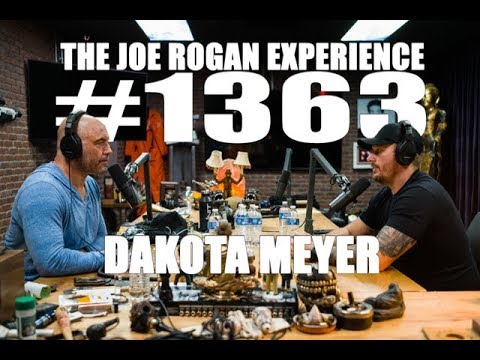
Joe Rogan Experience #1363 - Dakota Meyer
Joe Rogan (host), Dakota Meyer (guest), Jamie Vernon (guest), Guest (unidentified friend of Dakota Meyer) (guest)
In this episode of The Joe Rogan Experience, featuring Joe Rogan and Dakota Meyer, Joe Rogan Experience #1363 - Dakota Meyer explores medal of Honor Marine Explains War, Freedom, Trauma, And Real Gratitude Joe Rogan talks with Medal of Honor recipient Dakota Meyer about his combat experiences in Afghanistan, the realities of war, and the bond between American and Afghan soldiers. Meyer explains how simplistic anti‑war narratives often miss the reality that U.S. forces are usually fighting alongside, not against, locals to resist genuinely evil groups like the Taliban and ISIS. They dig into the psychological cost of combat, Meyer’s severe anxiety and PTSD, and the unconventional treatment (stellate ganglion block) that radically reduced his symptoms. The conversation widens into American privilege, victimhood culture, desensitization to violence, hunting and conservation, and Meyer's mission to help veterans transition and to inspire people to “own their dash” between birth and death.
Medal of Honor Marine Explains War, Freedom, Trauma, And Real Gratitude
Joe Rogan talks with Medal of Honor recipient Dakota Meyer about his combat experiences in Afghanistan, the realities of war, and the bond between American and Afghan soldiers. Meyer explains how simplistic anti‑war narratives often miss the reality that U.S. forces are usually fighting alongside, not against, locals to resist genuinely evil groups like the Taliban and ISIS. They dig into the psychological cost of combat, Meyer’s severe anxiety and PTSD, and the unconventional treatment (stellate ganglion block) that radically reduced his symptoms. The conversation widens into American privilege, victimhood culture, desensitization to violence, hunting and conservation, and Meyer's mission to help veterans transition and to inspire people to “own their dash” between birth and death.
Key Takeaways
War is often a simple struggle between good and evil, not a clean political abstraction.
Meyer describes fighting shoulder to shoulder with Afghan soldiers who wanted the same basic things Americans do—safety, family, and freedom from oppression—arguing that the core divide is between good and evil people, not nationalities.
Get the full analysis with uListen AI
Most Americans misunderstand U.S. wars as fights against countries rather than alongside them.
He clarifies that in Afghanistan and Iraq, U. ...
Get the full analysis with uListen AI
PTSD is common, deeply physical, and treatable with emerging medical interventions.
Meyer details crippling anxiety attacks years after combat and describes how a stellate ganglion block—a nerve injection in the neck—instantly reset his fight‑or‑flight system and dramatically reduced symptoms, highlighting the need for better, non‑pharmaceutical options.
Get the full analysis with uListen AI
Perspective can turn many “problems” into mere inconveniences.
A mentor told Meyer that if you can make choices to change a situation, it’s an inconvenience, not a true problem—real problems are things like terminal illness or a sick child. ...
Get the full analysis with uListen AI
Modern culture is desensitized to violence yet squeamish about healthy human behavior like sex.
Rogan and Meyer note how movies and games glorify graphic killing while explicit consensual sex on screen is treated as obscene, arguing this skewed comfort zone numbs empathy toward real suffering and trivializes life‑and‑death realities.
Get the full analysis with uListen AI
Freedom in America depends on volunteers willing to die for an idea, not a person.
Meyer stresses that U. ...
Get the full analysis with uListen AI
Owning your “dash” means intentionally defining how you live between birth and death.
Inspired by the poem ‘The Dash,’ Meyer urges people to focus on how they make others feel and what legacy they leave, waking up each day to be the best version of themselves rather than competing in victimhood or comparison.
Get the full analysis with uListen AI
Notable Quotes
“There’s only two types of people in this world. There’s good and evil.”
— Dakota Meyer
“We’re not fighting Iraq and fighting Afghanistan; we are fighting alongside both of those countries.”
— Dakota Meyer
“If you can make choices or decisions to change it, then it’s not a problem, it’s an inconvenience.”
— Dakota Meyer (relaying advice he received)
“No cause that you have that’s built on hate will survive.”
— Dakota Meyer
“I would never wish for another 9/11, but I would give anything for a 9/12.”
— Dakota Meyer
Questions Answered in This Episode
How would public opinion on foreign wars change if more civilians heard detailed first‑hand stories from soldiers and local allies, like Dakota’s Afghan teammates?
Joe Rogan talks with Medal of Honor recipient Dakota Meyer about his combat experiences in Afghanistan, the realities of war, and the bond between American and Afghan soldiers. ...
Get the full analysis with uListen AI
What ethical responsibilities do media creators and game developers have in depicting violence, given the desensitization Meyer describes?
Get the full analysis with uListen AI
Should treatments like the stellate ganglion block become standard early interventions for PTSD, and what barriers—bureaucratic, financial, cultural—stand in the way?
Get the full analysis with uListen AI
How can individuals practically shift from a “victimhood competition” mindset to “owning their dash” in everyday life?
Get the full analysis with uListen AI
To what extent is America’s relative safety from terrorism since 9/11 actually linked to fighting extremists abroad, as Meyer argues—and how could we rigorously evaluate that claim?
Get the full analysis with uListen AI
Transcript Preview
(singing) What's up, Dakota?
What's coming on?
How are you, man? We finally did this.
Good. I know, finally-
Finally.
... we've been talking about it.
Um, um, I feel super connected to you, man, because, uh, all day I've been listening to you on Jocko's podcast, and the wh- first of all, anybody who really wants to know you in depth, in your element, talking with, uh, a fellow warrior, I, like, strongly recommend that podcast.
Yeah.
Um, for, for people who don't, um, what, what number is it? Do you know which number pod-
(smacks lips) Ah, I, I don't even-
I'll tell you right now.
... I don't know what number it is.
I was just listening to it. It's, um, Jocko Podcast 115, Into the Fire and Beyond the Call of Duty.
Yeah.
And Jocko is a fucking beast, and you two together talking about the incidents that happened with you overseas, it's insane. I mean, it is, it is, like, I had to call a buddy of mine. I stopped the podcast and called my friend, Brendan, just to talk to him.
Yeah.
I was like, "This is so intense." It's like, I was driving, I was getting nervous, right?
(laughs) Yeah.
You know, I'm driving in my fucking c- my L- Tesla, right?
Yeah. (laughs)
My little electric car, I'm driving, my hands are sweating, and I'm breathing heavy. I'm like, "Fuck."
(laughs) Yeah.
It was...
Well, if you hear all those, like, you know, when you're listening to that podcast, that, that was, by far, the most... I mean, he, like, Jocko just pulled it out of me, like, right?
Yeah.
Like, you know, most everybody hits, like, the, the, the high points of it, but, you know, me and Jocko just made that connection. It was the first time we'd ever met, and, uh-
Oh, (snaps fingers) real?
... face-to-face. Yeah. We just went, like, you know, he picked me, he actually picked me up from the airport and we went, we went there. And we sat down and did the, the, uh, the podcast. And, and, I don't know, I, I, I think, I think he knew the questions to ask because I think it was good for both of us because-
Yeah.
... you know, if you got to the point, kind of, in the middle of it, if you start hearing those silences, it was both of us trying to keep from tears falling, right?
Right.
Like, it was like, it was like that moment you're trying to, I, it just, you know, it really, we've r- really connected and, and it was, you know, it was a tough podcast.
Well, you, you could tell because for Jocko, I mean, I, I listen to a lot of Jocko's podcasts, but that was one where he was really in his element. First of all, it's very obvious he has a, a deep respect for you and who you are and what you stand for, and then, two, it brought him back to his own experiences in war.
Install uListen to search the full transcript and get AI-powered insights
Get Full TranscriptGet more from every podcast
AI summaries, searchable transcripts, and fact-checking. Free forever.
Add to Chrome