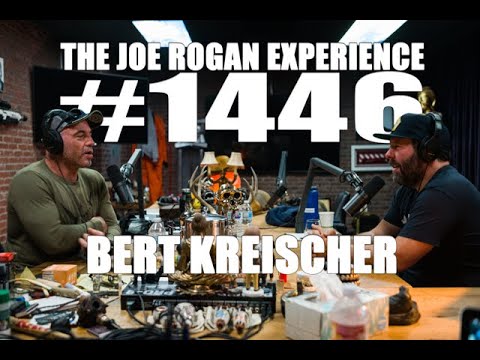
Joe Rogan Experience #1446 - Bert Kreischer
Joe Rogan (host), Bert Kreischer (guest), Jamie Vernon (guest), Jamie Vernon (guest), Jamie Vernon (guest), Jamie Vernon (guest), Narrator
In this episode of The Joe Rogan Experience, featuring Joe Rogan and Bert Kreischer, Joe Rogan Experience #1446 - Bert Kreischer explores rogan and Kreischer Confront Health, Humor, And A World Unraveling Joe Rogan and Bert Kreischer spend a long-form, freewheeling conversation grappling with the early stages of COVID-19, personal health, and the strange responsibilities of public personas. Rogan updates his views on the virus after friends’ serious cases and medical briefings, while Kreischer admits feeling trapped by his hard-partying image and dependency on alcohol and blood-pressure meds. From there they roam through stand-up culture, cancelability, parenting, guns, dogs, and apocalyptic scenarios, constantly looping back to how crisis exposes character and priorities. Underneath the jokes and stories is a steady drumbeat: this pandemic is a wake-up call to get healthier, take care of your community, and rethink what really matters.
Rogan and Kreischer Confront Health, Humor, And A World Unraveling
Joe Rogan and Bert Kreischer spend a long-form, freewheeling conversation grappling with the early stages of COVID-19, personal health, and the strange responsibilities of public personas. Rogan updates his views on the virus after friends’ serious cases and medical briefings, while Kreischer admits feeling trapped by his hard-partying image and dependency on alcohol and blood-pressure meds. From there they roam through stand-up culture, cancelability, parenting, guns, dogs, and apocalyptic scenarios, constantly looping back to how crisis exposes character and priorities. Underneath the jokes and stories is a steady drumbeat: this pandemic is a wake-up call to get healthier, take care of your community, and rethink what really matters.
Key Takeaways
COVID-19 isn’t just an “old and sick” person’s disease.
Rogan revises his stance after healthy friends like Michael Yo get hospitalized with pneumonia and near-death experiences, and doctors describe young, fit patients on ventilators, suggesting genetic and exposure factors we don’t yet understand.
Get the full analysis with uListen AI
Your lifestyle might be barely held together by good genetics.
Rogan tells Kreischer that his ability to drink heavily and still run marathons likely reflects “robust” genes—meaning if he stopped abusing his body, he could transform his health quickly instead of relying on pills.
Get the full analysis with uListen AI
Pandemics demand flexible thinking and willingness to update beliefs.
They highlight how rapidly the situation and scientific understanding change, arguing you must constantly absorb new data, abandon outdated assumptions, and avoid clinging to early, comforting narratives.
Get the full analysis with uListen AI
Comedians need spaces where risk-taking jokes are understood as play, not doctrine.
Rogan defends the “game” of comedy—saying outrageous things to be funny—contrasting real comics who respect that space with virtue-signaling critics who take lines literally or weaponize outrage.
Get the full analysis with uListen AI
Your social environment strongly shapes your risk and behavior.
Stories about wild childhood neighborhoods, bad kids, and office politics show how easily people get pulled into dangerous or repressed patterns, whether it’s teen crime or corporate self-censorship.
Get the full analysis with uListen AI
Modern life is structurally fragile despite feeling stable.
They compare humanity to a gigantic battleship that turns too slowly for sudden threats, pointing to power grids, the internet, and just-in-time economies as vulnerable pillars that a virus, solar flare, or disaster could easily disrupt.
Get the full analysis with uListen AI
Crisis can refocus you on health, family, and community support.
Both talk about spending time with kids, rethinking waste, and organizing help for comedy-club staff and struggling comics, framing the pandemic as a chance to reset priorities and act collectively.
Get the full analysis with uListen AI
Preparedness includes both mindset and practical skills like firearms training.
Rogan notes a surge in new gun buyers, warning that without safe handling and training, panic-driven purchases can be more dangerous than helpful.
Get the full analysis with uListen AI
Notable Quotes
““You’re like pouring sugar water into a 68 Charger… if you just cleaned that bitch up, that Hemi will purr.””
— Joe Rogan (to Bert Kreischer about his drinking)
““This is the big one of our lifetime, maybe the biggest one ever, because this shit could go on for a long-ass time.””
— Joe Rogan
““I should make a video to let everyone know my special’s on Netflix… then I went, ‘Hold on, man. There’s a lot going on in this world, and my special being watched is not the most important thing.’””
— Bert Kreischer
““No one should be confident. You’re a jelly bag made out of human skin covering brittle bones, on a planet with no roof.””
— Joe Rogan
““If we come out on the other side, I think we’re gonna be stronger… we gotta learn in every way.””
— Joe Rogan
Questions Answered in This Episode
How did Rogan’s early COVID-19 framing influence his audience’s perception, and does this episode meaningfully correct it?
Joe Rogan and Bert Kreischer spend a long-form, freewheeling conversation grappling with the early stages of COVID-19, personal health, and the strange responsibilities of public personas. ...
Get the full analysis with uListen AI
To what extent is Kreischer genuinely ready to change his health habits versus performing self-awareness for the mic?
Get the full analysis with uListen AI
What responsibilities, if any, do comedians have to anticipate real-world consequences of “just jokes” in high-outrage times?
Get the full analysis with uListen AI
Does the episode underestimate the systemic solutions needed for economic and healthcare resilience, focusing too much on individual grit?
Get the full analysis with uListen AI
How might this conversation look different if recorded a year later, with more data on COVID outcomes and societal changes?
Get the full analysis with uListen AI
Transcript Preview
And we're live. Cheers, sir.
Cheers, brother.
Yeah. While the world is on fire, we might as well get a little- a little fucked up. Just a little bit.
I've been clean- I've been clean for seven days.
Mm.
No booze.
No nothing?
No nothing.
You look good. Your face looks good.
I know. It's- I can starting to see a- a direct difference when I quit drinking.
Do you feel trapped by your image, by your party image?
I would never have said yes until this week. I've exhaled for the first time in a very big way, like where I was like- I was like-
Right.
... no road. I'm not- I'm not doing social media. I'm- I mean, I'm doing stories and stuff, but I'm not trying to put... Like, when things shut down, I kinda shut down with America, and I was like... Yesterday, man, I sat in a hammock sober for, like, fucking two hours and just relaxed.
It is nice to be home for a while. It is nice. You- you realize what a beating our lifestyle takes on your body, the travel, and then if you're boozing, too, the travel and the boozing together. So, uh, we should tell everybody what we learned today. Um, I'm revising my thinking about this virus because of Michael Yeo. Michael Yeo caught it. Michael Yeo is healthy as fuck. He's- he's not- he's not in any high-risk group. Like, he's not- he doesn't have any preexisting conditions. He's in shape. And, uh, he got it, and he got pneumonia too, and he said it was a double combination, and he thought he was gonna die. And he was in the hospital, uh, for over a week, and four days ago, he said he thought he was gonna die. That's fucking terrifying 'cause Michael Yeo is healthy. He's not some 80-year-old man.
Yeah.
Um, I talked to my friend, uh, Dr. Peter Attia. Uh, he's a physician, and he, uh, gave me-
That's the guy that swam from Maui.
Yes. He swam all the islands. He's a fucking straight-up savage. So his take... I- this is my question to him. I said, "This is crazy shit. Uh, what is your take on how so many people experience very few symptoms, but others get wrecked?" And he said, "I still think most people below 55 sail through it. I've had two patients get it, uh, shitty cold and loss of a sense of smell and taste, which probably returns soon. But still, a small fraction of these folks get hurt. I know a doc taking care of a 28-year-old fitness instructor on a ventilator in New York City today." "Why?" He said, "Maybe some genetic predisposition. We know blood types matters. Uh, A is the worst. O is the best based on antibodies."
Bam.
He said, uh... I'm O positive.
Install uListen to search the full transcript and get AI-powered insights
Get Full TranscriptGet more from every podcast
AI summaries, searchable transcripts, and fact-checking. Free forever.
Add to Chrome