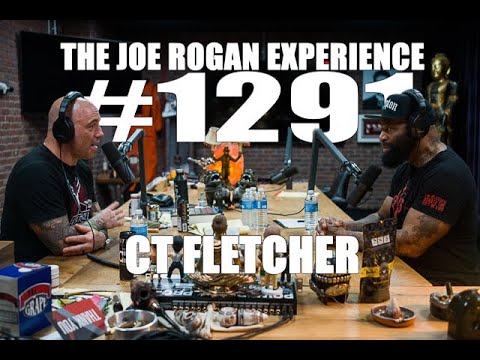
Joe Rogan Experience #1291 - C.T. Fletcher
Joe Rogan (host), C.T. Fletcher (guest), Narrator
In this episode of The Joe Rogan Experience, featuring Joe Rogan and C.T. Fletcher, Joe Rogan Experience #1291 - C.T. Fletcher explores from Death’s Door to Donor Advocate: C.T. Fletcher’s Second Life C.T. Fletcher returns to Joe Rogan one year after his heart transplant to describe, in raw detail, dying multiple times, the surgery, and what it’s like to live with a stranger’s heart—specifically, a woman’s heart that initially seemed too small for his body.
From Death’s Door to Donor Advocate: C.T. Fletcher’s Second Life
C.T. Fletcher returns to Joe Rogan one year after his heart transplant to describe, in raw detail, dying multiple times, the surgery, and what it’s like to live with a stranger’s heart—specifically, a woman’s heart that initially seemed too small for his body.
He recounts flatlining, the profound peace he felt while clinically dead, and how those experiences permanently erased his fear of death while radically softening his ego and priorities.
The conversation covers his grueling physical comeback from being unable to open jars or walk a block, to lifting again, along with his mission to promote organ donation and support for transplant patients and veterans with PTSD.
They also range into broader topics—racism and tribalism, religion versus faith, obsession and work ethic, combat sports, overtraining, and the importance of finding a meaningful struggle in life.
Key Takeaways
Surviving death can radically reframe your priorities.
C. ...
Get the full analysis with uListen AI
Early recovery demands brutal patience and humility.
Post-surgery, he could barely open jars or walk a block without stopping a dozen times; he emphasizes doing what you *can* do, not what your ego wants to do, and accepting ‘light’ training as progress.
Get the full analysis with uListen AI
If you’re not a registered donor, you’re wasting a life-saving opportunity.
He stresses how simple it is to become an organ donor (e. ...
Get the full analysis with uListen AI
Real faith is different from rigid, judgmental religion.
Raised in a strict Pentecostal home, C. ...
Get the full analysis with uListen AI
Our bodies differ on the outside; internally we’re interchangeable.
His female donor heart—and the fact organs can cross racial and ethnic lines—reinforces his view that racism and tribal divisions are irrational given how easily we can literally live off each other’s organs.
Get the full analysis with uListen AI
Obsession, properly directed, is a superpower.
Both men argue that being ‘obsessed’—with lifting, fighting, or a craft—can create an extraordinary life if you control it like a dangerous dog on a leash, not let it wreck your responsibilities.
Get the full analysis with uListen AI
If you hate your life, start by finding *any* meaningful struggle.
They urge people stuck in dead-end jobs or apathy to pick *something*—lifting, jiu-jitsu, art, whatever sparks emotion—and attack it, because consistent effort in one domain teaches you that you can improve in others.
Get the full analysis with uListen AI
Notable Quotes
“When you’re dead, you don’t feel nothing, man.”
— C.T. Fletcher
“Death is totally different… it erased any fear that I might have had.”
— C.T. Fletcher
“Time is such a precious commodity. Billionaires, you cannot buy one second of life.”
— C.T. Fletcher
“We’re interchangeable, Joe… they can take livers and hearts from any nationality and switch ’em around.”
— C.T. Fletcher
“If you’re lucky, you get 100 years. If you’re lucky. So anything you’re thinking about doing, get to stepping.”
— Joe Rogan, paraphrasing the shared sentiment
Questions Answered in This Episode
How should we interpret near-death experiences like C.T.’s—neurological events, spiritual glimpses, or something else entirely?
C. ...
Get the full analysis with uListen AI
What ethical questions arise from transplanting organs across sex, age, and racial lines, especially when survival data is mixed?
He recounts flatlining, the profound peace he felt while clinically dead, and how those experiences permanently erased his fear of death while radically softening his ego and priorities.
Get the full analysis with uListen AI
How can we increase organ donation rates without triggering people’s fears about medical misuse or premature end-of-life decisions?
The conversation covers his grueling physical comeback from being unable to open jars or walk a block, to lifting again, along with his mission to promote organ donation and support for transplant patients and veterans with PTSD.
Get the full analysis with uListen AI
What’s the right balance between ‘obsession’ for greatness and maintaining health, relationships, and mental stability?
They also range into broader topics—racism and tribalism, religion versus faith, obsession and work ethic, combat sports, overtraining, and the importance of finding a meaningful struggle in life.
Get the full analysis with uListen AI
Given how interchangeable we are biologically, why does tribal identity still feel so powerful and divisive, and how can we practically reduce that?
Get the full analysis with uListen AI
Transcript Preview
Boom, and we're live. What's up, brother? How are you?
Man, Joe Rogan, I am so happy to be here. I-
I'm so happy to see you.
Fuck!
You've gone through a journey.
Oh, man, since the last time I seen you.
Is t- yesterday was one year-
Yes.
... from your heart transplant anniversary.
Exactly.
Wow.
One year. And, Joe, if I told you it was easy, I'd be lying. But, man, it was so worth the journey and it ain't even funny, man.
What does it feel like right now? Like having-
Uh.
... another person's heart in your body? What does that feel like?
Well, a lot of times you'll, it feels like I actually did die and this is just a dream that I'm-
Wow.
... living right now. Yep.
Wow.
This, this is, uh, I think this, this would be my heaven.
You look great. You're still-
Well, thank you.
... jacked.
No, no, I d- I don't think it's-
You're not losing any weight.
Oh, yeah. Yeah. I'm-
Yeah, but I mean, you still look, you're still jacked. You still got-
Well-
... muscles.
Uh, (laughs)
(laughs)
You know, it's, it's such a, a fall from where I was, you know. I really appreciate that, though. But, uh, I, I, you know, I look at myself now and it's just a, you know, fragment of what I used to be. But, you know, I'm still here. (claps hands) That's what's so important to me, man. The-
Well, the ridiculous thing you were doing, you were making videos of your working out, like getting ready, and y- after your heart ac-, uh, heart operation, this, you have a heart transplant and you're running in a parking lot and you trip and fall.
(laughs)
I'm like, "Jesus, man. Slow down." Like-
Yeah.
Y- you-
Yeah, I got a little hot under there. (laughs)
You just decided that you were just gonna start pushing from the beginning.
Well, uh, actually, uh, my brain was ready (laughs) but my body wasn't, so-
Did they warn you about doing that? Did they say it was okay? Like what did-
Uh, they told me that, you know, they, they gave me permission to walk. And you know me, I'm like, "Uh, walk? Shit, I can run." (laughs)
(laughs)
Yeah. At least my mind said I could run.
Right. What does it feel like, though? Like when you, like d- what is the difference between the way your heart feels now?
(smacks lips) Uh, it's night and day. You know, before I got the transplant, it, it had got really bad, you know, really bad. I had, uh, flat-lined two more times, uh, you know, before the actual transplant and it was, I couldn't go through one, another flat-line. I mean, that would've been it. But, uh, the difference now, I mean, it feels, I, I-
Install uListen to search the full transcript and get AI-powered insights
Get Full TranscriptGet more from every podcast
AI summaries, searchable transcripts, and fact-checking. Free forever.
Add to Chrome