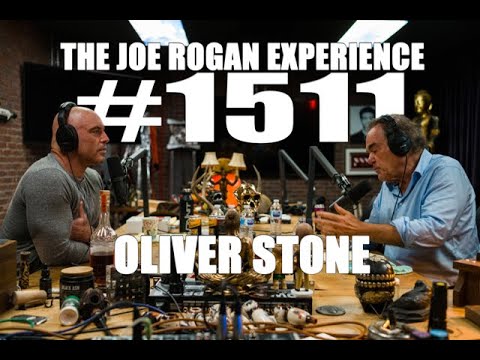
Joe Rogan Experience #1511 - Oliver Stone
Joe Rogan (host), Oliver Stone (guest), Guest (guest), Narrator
In this episode of The Joe Rogan Experience, featuring Joe Rogan and Oliver Stone, Joe Rogan Experience #1511 - Oliver Stone explores oliver Stone Reveals War’s Truth, Hollywood Battles, And Hidden History Oliver Stone recounts how his Vietnam combat experience shaped the realism, tone, and politics of Platoon, and why Hollywood repeatedly rejected it as too honest and unpatriotic before it became a global phenomenon.
Oliver Stone Reveals War’s Truth, Hollywood Battles, And Hidden History
Oliver Stone recounts how his Vietnam combat experience shaped the realism, tone, and politics of Platoon, and why Hollywood repeatedly rejected it as too honest and unpatriotic before it became a global phenomenon.
He and Joe Rogan dig into the distortions of modern war films, Pentagon influence on media, friendly-fire and PTSD cover‑ups, and Stone’s broader critique of U.S. militarism from Vietnam through Central America to today’s drug war and surveillance state.
Stone explains his approach to dramatizing controversial history in films like JFK, Scarface, and Snowden, his research-heavy Untold History of the United States series, and the institutional resistance he’s faced when challenging official narratives.
Across personal stories—from dosing his Cold War–hawk father with LSD to near‑death research trips with cartels and militants—Stone frames his career as an ongoing effort to expose uncomfortable truths about American power, propaganda, and empire.
Key Takeaways
Real combat experience undercuts Hollywood’s heroic war myths.
Stone emphasizes that actual firefights are messy, confusing, and often less “cinematic” than films portray, which is why he built Platoon from granular details—training actors in the jungle, emphasizing exhaustion, chaos, and moral ambiguity instead of nonstop heroics.
Get the full analysis with uListen AI
Institutional gatekeepers actively shape which war stories get told.
Platoon was repeatedly rejected as too bleak and controversial; Stone recounts studios invoking board members like Henry Kissinger and Pentagon objections to fragging and friendly fire, illustrating how political and military interests narrow acceptable depictions of war.
Get the full analysis with uListen AI
Friendly fire and psychological trauma are underreported by design.
Stone estimates 15–20% of U. ...
Get the full analysis with uListen AI
U.S. foreign policy follows a repeatable pattern of covert manipulation.
From Vietnam to Central America, Afghanistan, and the drug war, Stone argues the U. ...
Get the full analysis with uListen AI
Challenging official history requires both drama and deep research.
Stone describes blending rigorous archival work (e. ...
Get the full analysis with uListen AI
Mass surveillance and cyber operations quietly redefine state power.
Discussing Snowden, Stone stresses that warrantless data collection on ordinary citizens, plus offensive cyber and information tools for regime change, represent a profound, largely unacknowledged shift in how the U. ...
Get the full analysis with uListen AI
Presidents operate inside a hardened national security consensus.
Stone argues Kennedy tried to pull out of Vietnam and rein in the CIA, whereas later presidents, including Obama, largely conformed to military‑industrial pressures—illustrating how structural forces often override campaign promises or personal intentions.
Get the full analysis with uListen AI
Notable Quotes
“Battle is often just confusion, breaking down, things don’t work.”
— Oliver Stone
“For every film you do there’s like five abortions.”
— Oliver Stone
“We always create wars. We call it war on drugs, war on poverty, war on this, war on that.”
— Oliver Stone
“This is the biggest story, one of the biggest stories of our time, and we couldn’t get support from any of the studios.”
— Oliver Stone (on Snowden)
“It seems like you can’t get off that path in this country.”
— Oliver Stone (on presidents trying to change U.S. national security policy)
Questions Answered in This Episode
How might public understanding of recent wars change if films depicted friendly fire, civilian casualties, and moral breakdowns with the same honesty as Platoon?
Oliver Stone recounts how his Vietnam combat experience shaped the realism, tone, and politics of Platoon, and why Hollywood repeatedly rejected it as too honest and unpatriotic before it became a global phenomenon.
Get the full analysis with uListen AI
What concrete mechanisms—formal or informal—do studios and the Pentagon use today to discourage films that challenge official narratives about U.S. foreign policy?
He and Joe Rogan dig into the distortions of modern war films, Pentagon influence on media, friendly-fire and PTSD cover‑ups, and Stone’s broader critique of U. ...
Get the full analysis with uListen AI
Given Stone’s account of repeated historical patterns, what would actually be required to break the cycle of interventionism and regime change he describes?
Stone explains his approach to dramatizing controversial history in films like JFK, Scarface, and Snowden, his research-heavy Untold History of the United States series, and the institutional resistance he’s faced when challenging official narratives.
Get the full analysis with uListen AI
How should filmmakers balance dramatic liberties with factual rigor when tackling events like the JFK assassination or mass surveillance programs?
Across personal stories—from dosing his Cold War–hawk father with LSD to near‑death research trips with cartels and militants—Stone frames his career as an ongoing effort to expose uncomfortable truths about American power, propaganda, and empire.
Get the full analysis with uListen AI
If structural forces constrain presidents as much as Stone suggests, where does meaningful democratic accountability for foreign policy and intelligence actions really reside?
Get the full analysis with uListen AI
Transcript Preview
All right, here we go. Thank you very much for being here. I'm a really big fan, so this is a-
Thank you.
... an honor for me. I'm real, real excited. I'm really excited about your book, I'm really excited about, uh, just your films, The Unto- Untold History in the United States, which I think is fantastic. I mean, that is, that's one of my favorite things that you've ever done, and, and, and so thorough and so interesting. But, um, the book, uh, first of all, look how good you look in there, on the cover there. You young-
Well, it's an old shot. (laughs)
... young handsome bastard. Look at ya.
Yeah.
Looking good there.
Actually, it was-
What, what year is that from?
... it was 1968, November.
Wow.
I'd just come off the last mission in Vietnam.
Wow.
It was on a hilltop. We got stuck, uh, in the rain, in the A Shau Valley. It was First Cavalry, and, uh, we really, the helicopters couldn't get in for 11 days. It was awful.
Wow.
We had leeches everywhere, and we ... and the enemy, we didn't know where they were, but we felt that they were gonna close in. It was ... but it was too wet ultimately for them to close in, but they knew we were there. So we were praying. (laughs)
(laughs)
So the whole time was kind of nerve-wracking, 'cause it was my last few days, you understand. I was supposed to get out of there, uh, DROs, leave the country. I was due out. Uh, I had volun- I had volunteered for an extra three months in order to get out of the Army three months sooner.
Wow.
In other words, they had, there, normally you had to serve, uh, if a two-year deal, you had to serve six, uh, six months stateside on the backside of it. So, uh, I didn't wanna do that 'cause I was going nuts with the rules and the regulations, and I'd gotten into some trouble with that. So I extended in combat for another three months, and that ended up in this mission.
(laughs) How much did your time serving impact your, your directing? And you, like y- you've had these life experiences as someone who's just a filmmaker, th- they really can't draw upon. Like, you, you've had actual combat experience, and when you're making movies about combat, I mean, that has to be a, a, a gigantic advantage. Or at least it l- it adds layers to it that are almost impossible to cre- to recreate for someone who's just trying to imagine what it's like.
Yeah, and that was very important when we did Platoon. Uh, I wa- I was trying to get the exact distances and what ... and the amount of firepower is not as us- it's not as intense, generally speaking, as the movies make it.
Install uListen to search the full transcript and get AI-powered insights
Get Full TranscriptGet more from every podcast
AI summaries, searchable transcripts, and fact-checking. Free forever.
Add to Chrome