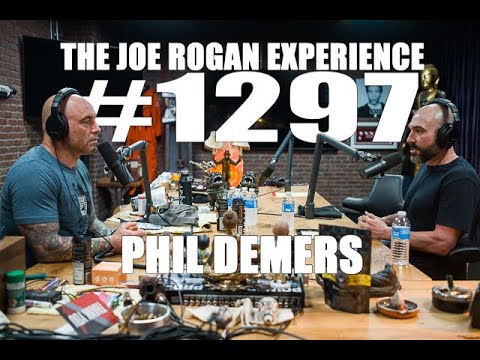
Joe Rogan Experience #1297 - Phil Demers
Joe Rogan (host), Phil Demers (guest), Guest (unidentified, brief contributor) (guest)
In this episode of The Joe Rogan Experience, featuring Joe Rogan and Phil Demers, Joe Rogan Experience #1297 - Phil Demers explores whistleblower Trainer Battles Marineland, Exposes Cruelty Of Captive Whales Former Marineland trainer Phil Demers recounts his years‑long legal battle after exposing what he describes as abusive, neglectful conditions for whales, dolphins, and his imprinted walrus, Smooshi.
Whistleblower Trainer Battles Marineland, Exposes Cruelty Of Captive Whales
Former Marineland trainer Phil Demers recounts his years‑long legal battle after exposing what he describes as abusive, neglectful conditions for whales, dolphins, and his imprinted walrus, Smooshi.
He and Rogan argue that keeping highly intelligent marine mammals in concrete pools is morally comparable to historical atrocities and will be viewed as such in the future.
Demers details Canada’s landmark anti‑captivity bill (S‑203), industry efforts to offload animals before laws change, and global issues like Russia’s ‘whale jail’ and China’s booming marine park trade.
The conversation also covers the emotional and cognitive sophistication of cetaceans, the weaponization of lawsuits to silence critics, and Demers’ personal sacrifices to keep speaking out.
Key Takeaways
Cetaceans possess complex emotional and social lives that captivity destroys.
Orcas and dolphins have enlarged, specialized brain regions for communication and emotion, lifelong family bonds, dialects, and even visible grief—making their confinement in small tanks a form of profound psychological trauma rather than entertainment.
Get the full analysis with uListen AI
Captive marine parks use litigation as a weapon to silence critics.
Demers describes Marineland’s multi‑million‑dollar, years‑long lawsuit against him (and others) as a ‘fictitious’ abuse of process designed to exhaust him financially and scare activists, illustrating how corporations can use courts to chill free speech.
Get the full analysis with uListen AI
Policy change is possible but requires relentless, coordinated pressure.
Canada’s Bill S‑203—banning cetacean captivity and breeding—was nearly killed multiple times by a single obstructive senator and last‑minute maneuvers, but focused public campaigns, direct lobbying, and social media pressure kept it alive to the brink of becoming law.
Get the full analysis with uListen AI
As laws tighten, facilities are racing to liquidate or move animals.
Marineland is rapidly exporting belugas and other animals, sometimes via accreditation loopholes and inter‑zoo networks, to get them out of Canada before full legal restrictions and public scrutiny make transfers or sales far harder.
Get the full analysis with uListen AI
Whale sanctuaries offer a realistic alternative to show tanks.
Projects like the Whale Sanctuary Project plan large, netted sea enclosures with staged rehabilitation, giving ex‑show animals space, privacy, and partial wildness; with such infrastructure, courts could deem sanctuaries in animals’ ‘best interests’ and block exports to other parks.
Get the full analysis with uListen AI
Public awareness and media platforms can materially alter outcomes.
Demers credits appearances on Rogan’s podcast, viral coverage, and allies like comedians and legal NGOs with raising funds, pressuring politicians, and shifting public opinion—demonstrating how storytelling at scale can move policy and corporate behavior.
Get the full analysis with uListen AI
Personal sacrifice and boundaries matter in long‑term activism.
Demers has burned through savings, endured intimidation, and structured his entire life around this case, yet insists on a trial and refuses gag orders; he also acknowledges the mental toll and reliance on ‘plant medicine’, highlighting the need for resilience and support in advocacy work.
Get the full analysis with uListen AI
Notable Quotes
““We gotta stop doing that with dolphins and orcas. It’s gonna be thought of the same way we think about slavery today.””
— Joe Rogan
““This lawsuit is a fictitious lawsuit. It’s full of lies and bullshit… They fucked with the wrong guy.””
— Phil Demers
““That walrus is like my daughter, dude.””
— Phil Demers
““If there was no captive dolphins and orcas, and someone just went around and kidnapped them… it would be a global outrage.””
— Joe Rogan
““I don’t want your money. I want the walrus.””
— Phil Demers
Questions Answered in This Episode
How can legal systems be reformed to prevent corporations from using strategic lawsuits to silence whistleblowers and activists?
Former Marineland trainer Phil Demers recounts his years‑long legal battle after exposing what he describes as abusive, neglectful conditions for whales, dolphins, and his imprinted walrus, Smooshi.
Get the full analysis with uListen AI
What specific, evidence‑based steps are needed to scale whale sanctuaries so they can realistically absorb large numbers of retired show animals worldwide?
He and Rogan argue that keeping highly intelligent marine mammals in concrete pools is morally comparable to historical atrocities and will be viewed as such in the future.
Get the full analysis with uListen AI
At what point does captivity for ‘education’ or ‘conservation’ become indefensible, and who should decide that threshold?
Demers details Canada’s landmark anti‑captivity bill (S‑203), industry efforts to offload animals before laws change, and global issues like Russia’s ‘whale jail’ and China’s booming marine park trade.
Get the full analysis with uListen AI
How might breakthroughs in understanding cetacean communication and cognition further change our moral obligations toward them?
The conversation also covers the emotional and cognitive sophistication of cetaceans, the weaponization of lawsuits to silence critics, and Demers’ personal sacrifices to keep speaking out.
Get the full analysis with uListen AI
What practical actions can ordinary people take—beyond not buying tickets—to accelerate the end of marine mammal entertainment parks globally?
Get the full analysis with uListen AI
Transcript Preview
Oh. Hey, fella. What you got there?
(laughs)
What is that, legal marijuana in your hands?
You want a closer look?
You activist, you.
I'm such a radical, man. Uh, the streets are- are not safe when I'm out on the loose.
Are you radical?
(laughs)
You seem like a regular guy.
Yeah, yeah. Regular guy, uh, with a irregular amount of stress.
With the walrus right there.
Dude, you don't mind my putting it there?
No, no, not at all. Of course. Yeah.
I'm so happy to come back and see it.
No, it stays on the desk.
Yeah, that thing's amazing.
This, uh, means as much to us as anybody, except for you.
Well, it's nice to see it. This is my, uh, this is my happy place. This is my safe place. (laughs)
(laughs)
I gotta travel across the country to be safe, but, uh, it's- it's certainly a pleasure to be here again. And Joe, I always have to thank you. Bottom of my heart, brother.
Uh, listen, brother, I thank you too. I was texting Whitney today, I said, "You're a hero." You're a legitimate hero. (clears throat) For people who don't know what this is all about, I'll give everybody the backstory. Um, Phil used to work at Marineland. He was an orca trainer, and he also trained a walrus named Smooshy. And Smooshy is still allegedly in captivity at Marineland, although there's no photographic evidence, but you're pretty sure she's still there?
I was told that she is still there and she's in good shape, and I'm hanging onto that.
Since you came on the podcast the first time, which was how many years ago now?
So six years ago, I think. That's 2013.
Six years. So he's been living this lawsuit life for six years, trapped in a lawsuit with a gigantic corporation with incredible amounts of money that's been trying to crush him. And, um, they've made up stuff. Well, tell me what's- what's happened. Give- give me your- your perspective on how it all went down.
So back in 2012, I made, I- I was forced to make a very difficult decision. Uh, I elected to speak out against the conditions of which, uh, Marineland's animals were living in. Um, I did so knowing the risks, knowing that Marineland was a litigious company, but I did so on account to the fact that the animals were suffering incredibly. Uh, before quitting, I had an agreement with Marineland that, look, I'm leaving ... this is long before I'd spoke out- I'd spoken out. I'm leaving, but, you know, we have to establish that I can maintain this relationship with the walrus because sh- I imprinted on her. It's important to stress that, that she thinks I'm her mom.
She was a baby.
She was a baby when she came in, so she was wild caught, and you can imagine probably witnessed her mother get slaughtered. That's the, uh, that's the method of collecting babies, um, by the- by the captors in Russia. And, uh, so she comes in traumatic at the age of, we estimate about 18 months of age, which is pretty old, in fact, uh, for, uh, in our experience, Marineland's experience of- of acquiring these wild caught baby walruses. Um, and through a sort of traumatic experience with her that I was th- there with her, this anomalous thing happened where her brain circuitry opened up, and much like in the wild where in the case of herd animals, the babies, uh, become familiar with the mother's sound, scent, look, everything. All the senses are acute. They're- they're aware of who they, of where they are so that they can, you know, find each other amidst these thousands of animals. Well, this happened to her. So the brain circuitry opens, suddenly I'm imprinted on her. I wasn't prepared to leave Marineland unless it was of the understanding that I can continue to help her because historically, my relationship with her, uh, you know, had everything to do with her health and well-being. I quit with the understanding with Marineland this was to be the case. I'd been gone for a month. I come back unannounced. They don't want to let me in. They're hiding something. I get in, I see her. She's in terrible shape. I snap a few photos, I leave. Now, amidst this-
Install uListen to search the full transcript and get AI-powered insights
Get Full TranscriptGet more from every podcast
AI summaries, searchable transcripts, and fact-checking. Free forever.
Add to Chrome