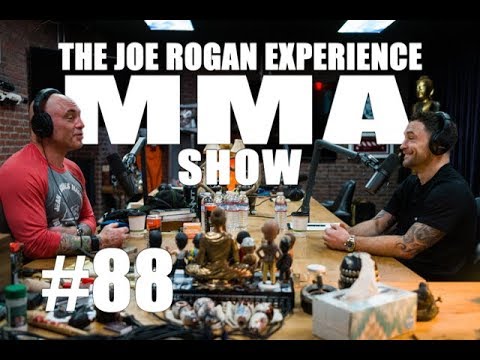
JRE MMA Show #88 with Frankie Edgar
Joe Rogan (host), Frankie Edgar (guest), Guest (third participant, likely producer/assistant) (guest), Narrator, Guest (medical/procedure discussion) (guest)
In this episode of The Joe Rogan Experience, featuring Joe Rogan and Frankie Edgar, JRE MMA Show #88 with Frankie Edgar explores frankie Edgar Reflects On Wars, Aging, Weight Cuts, And Evolution Frankie Edgar joins Joe Rogan to look back on his career, from winning the UFC lightweight title as an undersized 155er to his plans to drop to bantamweight late in his career.
Frankie Edgar Reflects On Wars, Aging, Weight Cuts, And Evolution
Frankie Edgar joins Joe Rogan to look back on his career, from winning the UFC lightweight title as an undersized 155er to his plans to drop to bantamweight late in his career.
They dive into damage, knockouts, refereeing, training evolution, injuries, and new recovery methods like stem cells and regenerative treatments.
Edgar explains how the sport, athletes, and training approaches have transformed since he debuted, and how he’s adapting his sparring, strength work, and lifestyle at 38.
The conversation also ranges into MMA history, dangerous heavyweights, Dagestani wrestling culture, Lyme disease, and how promotion and personality now shape fighters’ opportunities.
Key Takeaways
Durability has a cost—even if you never get ‘turned off.’
Edgar describes multiple legendary fights (Gray Maynard, Benson Henderson) where he doesn’t remember large portions of the bout, highlighting how concussion and accumulated damage can exist even without clean knockouts.
Get the full analysis with uListen AI
Refereeing standards have tightened over time.
He and Rogan note that his early wars likely wouldn’t be allowed to continue under today’s more cautious stoppage norms, illustrating how safety culture and expectations have shifted in MMA.
Get the full analysis with uListen AI
Older fighters must spar smarter, not just harder.
Edgar has reduced hard sparring from three sessions a week to two and is more deliberate about volume and recovery, showing how veterans can stay competitive by managing brain and body wear.
Get the full analysis with uListen AI
High-level conditioning is as mental as it is physical.
Frankie believes his gas tank comes largely from mindset—pushing through fatigue and not being afraid to get tired—mirroring what made fighters like Cain Velasquez so overwhelming.
Get the full analysis with uListen AI
Weight class choice shapes legacies and opportunities.
Despite becoming champion at 155 without cutting, Edgar now feels 135 is more appropriate; they also argue for reorganizing UFC weight classes (e. ...
Get the full analysis with uListen AI
Regenerative medicine is reshaping how athletes handle damage.
They discuss stem cells, Regenokine, epidurals, and other therapies Edgar and Rogan have used for shoulders, backs, and necks, underscoring a trend away from immediate surgery toward biologic repair.
Get the full analysis with uListen AI
Modern fighters are more complete and start younger.
Compared to Edgar’s era of ‘tough guys who wanted to fight,’ the new generation arrives in the UFC already polished across striking, wrestling, and grappling, often after training MMA as a single integrated sport.
Get the full analysis with uListen AI
Notable Quotes
“I’ve never been turned off. I don’t know if that’s a good thing or not.”
— Frankie Edgar
“As long as I enjoy it, I’m competitive, and my body holds up—that’s when I’ll keep fighting.”
— Frankie Edgar
“We were just guys that wanted to fight. Now these kids are polished right away.”
— Frankie Edgar
“Martial arts have evolved more in the last 20 years than in the last 20,000.”
— Joe Rogan
“You can’t say someone quit if their nose is broken and their orbital’s broken.”
— Joe Rogan (on Stephen A. Smith’s comments about Donald Cerrone)
Questions Answered in This Episode
How should referees balance a fighter’s desire for ‘the benefit of the doubt’ with long‑term brain safety in situations like Edgar’s Maynard wars?
Frankie Edgar joins Joe Rogan to look back on his career, from winning the UFC lightweight title as an undersized 155er to his plans to drop to bantamweight late in his career.
Get the full analysis with uListen AI
What is the optimal trade‑off between hard sparring and longevity for fighters in their mid‑ to late‑30s?
They dive into damage, knockouts, refereeing, training evolution, injuries, and new recovery methods like stem cells and regenerative treatments.
Get the full analysis with uListen AI
If the UFC adopted 10‑pound weight increments (including 165), how might that have changed careers like Frankie Edgar’s, Diego Sanchez’s, or Rafael dos Anjos’?
Edgar explains how the sport, athletes, and training approaches have transformed since he debuted, and how he’s adapting his sparring, strength work, and lifestyle at 38.
Get the full analysis with uListen AI
To what extent can regenerative therapies like stem cells and Regenokine safely extend high‑level MMA careers without masking serious damage?
The conversation also ranges into MMA history, dangerous heavyweights, Dagestani wrestling culture, Lyme disease, and how promotion and personality now shape fighters’ opportunities.
Get the full analysis with uListen AI
Given how quickly young athletes now become ‘complete’ mixed martial artists, will late‑career weight moves (like Edgar to 135) become more or less viable in the future?
Get the full analysis with uListen AI
Transcript Preview
Boom. What's up, Frankie? How are you, brother?
What's up, Joe?
Good to see you, man.
Hey, good to be here and see Joe.
Good to have you. We talked about this many times.
We have. Uh, you know, uh, my buddy, Chris Liguori, I gotta shout him out 'cause he got me listening to you, you know, years ago, and, uh, he's been telling me to come on this podcast for- forever. So, I'm fi- I'm glad to finally get it done, so shout out to Chris. I know he's listening.
Hi, Chris.
(laughs)
Um, so you got your own podcast now?
I do. Uh, me and Roger Mathews from, uh, Jersey Shore fame, he was the ex-husband of, of J- J-Woww.
(laughs)
Uh, so we- the Champ and the Tramp.
(laughs)
Champ and the Tramp, yeah.
Is that what you guys are called? (laughs)
Yeah, Champ and the Tramp.
That's hilarious. That's hilarious. So, uh, what's happening, man? You, you just got off of the, um, Chan Sung Jung fight.
Yeah.
And what's next? What are you up to?
I'm gonna go down 35.
Yeah?
You know, uh-
How much do you walk around at?
I'm probably, like, 56 right now.
Wow.
You know, so for (can opening) - for 45, or, well, for 55-
Marlon's gotta be bigger than you, right?
Marlon is b- about a little bit bigger than me. Yeah, I think so. I think he walks around a little heavier. He's a little bit more of an eater than I am. (laughs)
Dude, that guy, I can't- I have a hard time believing he makes 35 sometimes.
Yeah.
You look at him, he's so jacked.
He has such a small waist, though.
Hmm.
But, I mean, he's so- his legs and shoulders are so big-
Yeah.
... but his waist is kinda small, so maybe that's how he carries it.
So, have you done a cut like that before?
I haven't been, but, I mean, even my last fight, I think I, I was, you know, getting down to 45. I got down to, like, 44.5. I mean, that's only 8 1/2 over where I gotta be for it to make 36, and it was such an easy cut for this last time.
So, it's- you're, you're in an interesting situation, man, because, like, you won the title at 55 and you didn't cut any weight at all. And a lot of people were like, "Well, fuck, man. If Frankie Edgar could do it..." 'Cause you- the thing about you at 55 was you were so durable. Like, that was one of the craziest things about some of your fights, like, the Gray Maynard fights.
Yeah.
Like, fucking A, man. Who, who reffed those fights?
Install uListen to search the full transcript and get AI-powered insights
Get Full TranscriptGet more from every podcast
AI summaries, searchable transcripts, and fact-checking. Free forever.
Add to Chrome