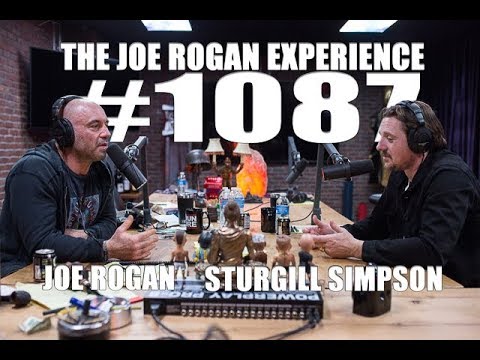
Joe Rogan Experience #1087 - Sturgill Simpson
Sturgill Simpson (guest), Joe Rogan (host), Guest (guest), Narrator
In this episode of The Joe Rogan Experience, featuring Sturgill Simpson and Joe Rogan, Joe Rogan Experience #1087 - Sturgill Simpson explores sturgill Simpson and Joe Rogan Explore Art, Freedom, Weed, and Work Joe Rogan and Sturgill Simpson have a long-form, freewheeling conversation that ranges from life on the road as touring performers to the pressures of fame, health, and creativity.
Sturgill Simpson and Joe Rogan Explore Art, Freedom, Weed, and Work
Joe Rogan and Sturgill Simpson have a long-form, freewheeling conversation that ranges from life on the road as touring performers to the pressures of fame, health, and creativity.
They dig into practical realities of music and comedy careers—travel exhaustion, band dynamics, record labels, and how to structure life so you’re not owned by your job or your success.
Weed, psychedelics, and big pharma come up repeatedly, both as social issues (legalization, propaganda, hemp history) and as tools that can genuinely help with pain, recovery, and creative work.
Underlying everything is a shared concern with autonomy: building a life where you work for yourself, protect your family, and stay creatively honest in a culture driven by money, distraction, and surveillance tech.
Key Takeaways
Design your touring or work schedule around health and family, not just money.
Both Rogan and Simpson deliberately limit how long they’re on the road because constant travel is physically draining, wrecks routines, and strains relationships; they optimize for being home, feeling healthy, and delivering high-quality shows instead of sheer volume.
Get the full analysis with uListen AI
The best bands and teams are built around “the hang” as much as talent.
Sturgill emphasizes that who you travel with matters: you’re stuck together for weeks, so shared temperament, humor, and low drama are as important as musicianship for keeping the road sustainable.
Get the full analysis with uListen AI
Obsessive practice is often a feature, not a bug, of great artistry.
They describe elite players—like Rogan’s classical guitarist friend—who spend eight to ten hours a day repeating the same motions; Sturgill frames this as a kind of OCD-spectrum focus that’s almost required to reach that level.
Get the full analysis with uListen AI
Weed and hemp prohibition are driven more by politics and profit than science.
They walk through hemp’s history (Henry Ford’s hemp car, Hearst and DuPont’s interests, racist anti-‘marijuana’ propaganda) and point out that hemp can’t get you high, has massive industrial uses, and that cannabis has strong medical upside with virtually no overdose risk.
Get the full analysis with uListen AI
Surveillance and data-mining are baked into “free” tech services.
Stories about phones clearly influencing Netflix suggestions and ads, plus Snowden’s revelations, underline that microphones, email, and smart speakers are likely being mined for data—something most people effectively consent to via unread Terms of Service.
Get the full analysis with uListen AI
Record labels are essentially banks; treat them like business partners, not saviors.
Sturgill explains that the only real reason he signed with a label was to access bigger recording budgets and infrastructure; he keeps touring, publishing, and creative control separate, seeing labels as capital and reach, not artistic authorities.
Get the full analysis with uListen AI
Late-blooming success can protect your art—and your life—from self-destruction.
Simpson is explicit that if he’d broken big in his twenties he’d likely have imploded; working railroads and other jobs until his mid-30s gave him perspective, a family, and a clear sense of the kind of career and autonomy he wants.
Get the full analysis with uListen AI
Notable Quotes
“I realized very early on I get paid to travel. The shows are free.”
— Sturgill Simpson
“We can’t have an alpha chimp… you can’t get voted into the number one person on the world. That’s fucking ridiculous.”
— Joe Rogan
“I’m gonna be in the Sturgill business, not the music business.”
— Sturgill Simpson
“Weed is one of the most amazing plants we’ve ever discovered. You can make your house out of it, you can eat it, you can get high with it.”
— Joe Rogan
“At this point in my life, I just assume everything is a pyramid scheme.”
— Sturgill Simpson
Questions Answered in This Episode
How much creative freedom can a modern artist realistically maintain while partnering with big labels, streamers, or studios?
Joe Rogan and Sturgill Simpson have a long-form, freewheeling conversation that ranges from life on the road as touring performers to the pressures of fame, health, and creativity.
Get the full analysis with uListen AI
If hemp and cannabis were fully legalized and normalized, how would that reshape rural economies, pharma, and the prison system?
They dig into practical realities of music and comedy careers—travel exhaustion, band dynamics, record labels, and how to structure life so you’re not owned by your job or your success.
Get the full analysis with uListen AI
Where is the line between using data to improve services and violating basic expectations of privacy in our homes and devices?
Weed, psychedelics, and big pharma come up repeatedly, both as social issues (legalization, propaganda, hemp history) and as tools that can genuinely help with pain, recovery, and creative work.
Get the full analysis with uListen AI
What personal safeguards should touring artists put in place—physically, mentally, and financially—to avoid burnout and dependency?
Underlying everything is a shared concern with autonomy: building a life where you work for yourself, protect your family, and stay creatively honest in a culture driven by money, distraction, and surveillance tech.
Get the full analysis with uListen AI
In an age of constant exposure and social media, is it still possible to cultivate mystery and myth around an artist the way it existed in the ’60s and ’70s?
Get the full analysis with uListen AI
Transcript Preview
How long is it going to take me to get to LAX and what time should I be there?
If you leave at 2:00, you have no problems at all.
Okay.
No problems.
Cool.
So if you leave at 2:00, you're just gonna coast in. Are we live? We're trying to figure out LA traffic, ladies and gentlemen. You gotta plan for that shit. Like-
You do, man.
... like a natural disaster.
(laughs) In many ways, they're very similar.
When I moved to Colorado for just a few months and then came back here, it was instantaneous, like the recognition of like what effect it has on me. You know, like ev- there's so many people. You're driving and it's like ... When you go somewhere where there's very few people, you have, there's a, a real feeling of relaxation.
Yes.
Like it's legitimate. It's real.
Yes.
Yeah, it's almost like if you could buy that, like, uh, "Yeah, man, I'm taking this gum that puts you in like a small town feel, like woodsy Colorado feel, going through evergreen, looking at the mountains."
But you can, you can buy that. You just have to get out of, out of California, you know.
Yeah, no, for sure. But I was just thinking if you had a pill, a pill that did that, that would be a really expensive pill or a patch or some gum, you know, like nicotine gum, some, some, you know, peace and quiet gum.
Transports you to the wilderness.
(laughs) How much would people pay for that, right? Like think about the people that buy Xanax and shit and just anything to just take a little bit of the edge off. Just take, take this edge off.
I don't know. I would, uh, I'd probably just buy it and smoke it.
Yeah, I'd smoke the shit out of that.
Right.
But then, but you'd be happy like living in downtown LA in some graffiti covered building.
No, no.
Hearing the horns go off.
I love the weather here. I do. I think that's why I have to come out for work or anything else, I never mind because every day it's perfect except I've been here for like four days and it's rained most of the time, so that's my luck, but uh...
LA's got beautiful-
The traffic, man, you just basically, I think you just sort of accept that you're gonna live in your car, right?
You're gonna be in your car a lot.
You're gonna be in your car. So everybody has nice cars, that's why everybody drives nice cars in LA.
It's also because we're all really, really shallow.
Oh.
We wanna show everybody, like, "Look what I got, bitch." You know? There's a lot of that.
I like cars.
Install uListen to search the full transcript and get AI-powered insights
Get Full TranscriptGet more from every podcast
AI summaries, searchable transcripts, and fact-checking. Free forever.
Add to Chrome