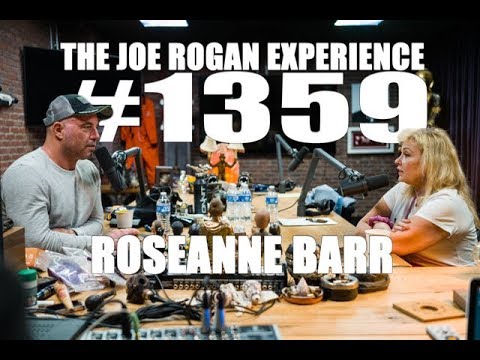
Joe Rogan Experience #1359 - Roseanne Barr
Roseanne Barr (guest), Joe Rogan (host), Narrator, Joe Rogan (host), Joe Rogan (host), Joe Rogan (host)
In this episode of The Joe Rogan Experience, featuring Roseanne Barr and Joe Rogan, Joe Rogan Experience #1359 - Roseanne Barr explores roseanne Barr, censorship, and chaos: comedy, conspiracies, and redemption Roseanne Barr joins Joe Rogan to talk about her return to stand-up, her mental health struggles, and the fallout from her firing and public ‘cancellation.’
Roseanne Barr, censorship, and chaos: comedy, conspiracies, and redemption
Roseanne Barr joins Joe Rogan to talk about her return to stand-up, her mental health struggles, and the fallout from her firing and public ‘cancellation.’
They move between serious issues—online censorship, homelessness, drug crises, mental illness, and media manipulation—and Roseanne’s free‑wheeling conspiratorial takes on AI, Babylon, and global politics.
Throughout, they examine how comedy works, what happens when jokes miss, and how outrage culture and platforms like YouTube and Google are reshaping what can be said publicly.
The episode ends with Roseanne expressing a desire to help others by talking honestly about catastrophic mental illness and with Rogan urging her to start her own podcast.
Key Takeaways
Comedians need room to miss if you want real comedy.
Rogan and Barr stress that comics are often improvising and exploring; if every misstep is punished as moral evil, comics self‑censor and the art form collapses into safe, unfunny material.
Get the full analysis with uListen AI
Platform rules shape public discourse as much as laws do.
They describe how YouTube’s and Google’s opaque policies and advertiser pressures effectively discourage controversial speech by demonetizing or throttling it, even if it’s not illegal or overtly harmful.
Get the full analysis with uListen AI
Mental health context matters when judging public outbursts.
Roseanne frames her infamous tweet in light of brain injury, bipolar disorder, Ambien use, and severe B12 deficiency that can cause psychosis, arguing that people with mental illness are often punished instead of helped.
Get the full analysis with uListen AI
Social problems like homelessness are heavily driven by untreated mental illness and addiction.
They discuss Los Angeles’s massive homeless population, noting that many are severely mentally ill or addicted, and that hand‑waving political rhetoric doesn’t replace treatment, housing, and long‑term support.
Get the full analysis with uListen AI
Outrage and self‑righteousness are powerful but destructive motivators.
Barr calls self‑righteous indignation “the devil,” pointing out how it justifies cruelty, fuels cancel culture, and stops people from listening, forgiving, or solving problems together.
Get the full analysis with uListen AI
Community‑scale, bottom‑up solutions may be more realistic than grand ideologies.
Roseanne imagines ‘grandmother‑led’ local communities with self‑sustaining economies (barter, land, food) and localized capitalism, arguing that real change will come from small, responsible units rather than centralized schemes.
Get the full analysis with uListen AI
Radical transparency and more conversations beat suppression.
Both suggest that instead of silencing controversial voices, society needs more open dialogue—about politics, censorship, and mental illness—so that people can see nuance instead of flattening others into villains.
Get the full analysis with uListen AI
Notable Quotes
“When a comic fucks up, they’re just trying to be funny. They missed.”
— Joe Rogan
“Nothing can ever stop me ’cause I’m a comic. We have to get the last laugh.”
— Roseanne Barr
“It was the lowest point of ever devaluing an artist and an artist’s work.”
— Roseanne Barr
“The problem is not what you’re saying. The problem is people reacting to you.”
— Joe Rogan
“I have learned to live with catastrophic mental illness.”
— Roseanne Barr
Questions Answered in This Episode
How should audiences and employers balance accountability with empathy when a performer has documented mental health issues?
Roseanne Barr joins Joe Rogan to talk about her return to stand-up, her mental health struggles, and the fallout from her firing and public ‘cancellation.’
Get the full analysis with uListen AI
To what extent are platforms like YouTube and Google acting as neutral businesses versus ideological gatekeepers?
They move between serious issues—online censorship, homelessness, drug crises, mental illness, and media manipulation—and Roseanne’s free‑wheeling conspiratorial takes on AI, Babylon, and global politics.
Get the full analysis with uListen AI
Where is the line between legitimate concern about harmful speech and overreaching censorship that kills comedy and honest debate?
Throughout, they examine how comedy works, what happens when jokes miss, and how outrage culture and platforms like YouTube and Google are reshaping what can be said publicly.
Get the full analysis with uListen AI
What practical, scalable models exist for the kind of local, self‑sustaining, community‑driven solutions Roseanne describes?
The episode ends with Roseanne expressing a desire to help others by talking honestly about catastrophic mental illness and with Rogan urging her to start her own podcast.
Get the full analysis with uListen AI
How can we encourage more open conversations about mental illness without letting it become a blanket excuse for harmful actions?
Get the full analysis with uListen AI
Transcript Preview
Can't do much more to-
No.
... me, can they? Well, Joe, it's so great to see you.
Great to see you, too. I love the sunglasses. They're pretty slick.
Aren't they the coolest?
They're perfect.
These are... Okay, I thought I was getting the coolest ones, but then my friends who were shopping with me, they came running back and they were like, "Uh-uh, uh-uh, don't pay yet, don't pay yet. Honey, take a look at these." And I looked, and there's a separation, like, between the frame.
Right.
See, you wanna look.
Okay.
I did my own eye makeup, so it's a mess. I couldn't get anybody to fix my makeup today.
What's the benefit of the separation?
Fucking art.
Just looks dope?
Fuck yeah. (laughs)
I get it. I, I agree with you.
You got a little bit of brow peeping through.
I see.
See?
I like 'em a lot. They're very cool.
And look at the pinker flesh, or whatever you call this. That's my color.
I like the bracelet too. The pink one? That's jamming.
The pink one.
It's pretty dope.
I've had it for a long, long time.
(laughs)
Like Phyllis Diller, I just collect weird costumes, you know?
Yeah.
And just wear 'em in the house. But I decided to start wearing 'em out more now.
I like it.
Yeah, it's fun.
It works. You could pull it off for sure. I like the hair now too.
Well, I'm going into my rock star-
You're all blonde now.
Hells yeah.
Yeah, you're all Debbie Harry.
I'm all going rock star now, 'cause I'm like, "Okay, well, you know, whatever." Okay. Nothing can ever stop me (laughs) 'cause I'm a comic, right?
Right.
Nothing can stop us.
Nothing.
'Cause we have some fucking weird DNA bend that we just have to get the fucking last laugh, right? We have to get the laugh.
And-
And so I have to.
... I'm just glad you're back to standup too. I'm l- I'm really, really excited about that.
Oh, I don't know about that. It wasn't sparking joy, as that woman says. She says, "If you do anything in your life that is not sparking joy, then fuck it."
Who said that?
That lady that tells you to throw out your clothes that don't spark joy.
Oh, is she, like, a minimalist lady?
Uh, I don't know. She's on the internet.
Oh, okay. (laughs)
She's really helped me 'cause I'm a hoarder.
(laughs) Yeah, me too a little bit.
Oh yeah?
I mean, you can see it, tell by this desk. I got a lot of knickknacks and stuff-
(laughs)
... that I save. Yeah.
Install uListen to search the full transcript and get AI-powered insights
Get Full TranscriptGet more from every podcast
AI summaries, searchable transcripts, and fact-checking. Free forever.
Add to Chrome