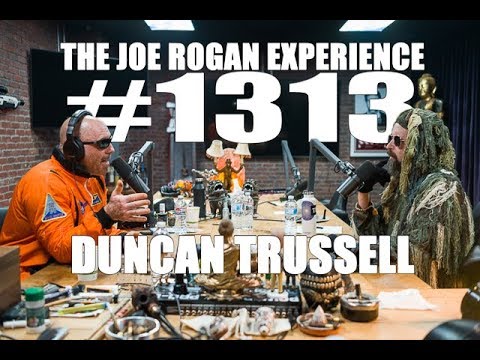
Joe Rogan Experience #1313 - Duncan Trussell
Joe Rogan (host), Duncan Trussell (guest), Narrator, Jamie Vernon (guest), Narrator
In this episode of The Joe Rogan Experience, featuring Joe Rogan and Duncan Trussell, Joe Rogan Experience #1313 - Duncan Trussell explores rogan and Trussell Deconstruct Reality, Religion, Tech, and Human Madness Joe Rogan and Duncan Trussell spend a long, freewheeling conversation unpacking superstition, religion, and the human need for stories—from Jesus and Mormonism to UFOs and simulation theory.
Rogan and Trussell Deconstruct Reality, Religion, Tech, and Human Madness
Joe Rogan and Duncan Trussell spend a long, freewheeling conversation unpacking superstition, religion, and the human need for stories—from Jesus and Mormonism to UFOs and simulation theory.
They dive into the nature of the self, how ideas might function like living entities, and how psychedelics and Buddhism challenge our default sense of reality and identity.
The discussion repeatedly returns to modern life’s distortions: social media addiction, junk information diets, deepfakes, centralized power, and our denial of ecological and existential threats.
Along the way, they use wildlife, gut biome science, cannibalistic tech trends, and darkly comic hypotheticals to explore how easily humans deceive themselves and how difficult genuine self-knowledge and compassion actually are.
Key Takeaways
Question inherited narratives—even when they organize society.
From religious doctrines (resurrection, Mormon origin stories) to hotel floors without a 13th, they argue that unexamined beliefs shape policy, identity, and behavior long after they’ve stopped making sense.
Get the full analysis with uListen AI
The “self” is less solid than we think, and that matters.
Drawing on Buddhism, they describe mind as layered consciousness, where identity is a shifting process influenced by subconscious material and a possible “collective mind”—not a fixed, independent entity.
Get the full analysis with uListen AI
Psychedelics and contemplative practices expose alternate “settings” of reality.
High-dose experiences and meditation can temporarily dissolve the everyday sense of self, revealing other modes of perception and suggesting our normal state is just one configuration among many.
Get the full analysis with uListen AI
Your “information diet” affects your psyche like junk food affects your body.
Endless doom-scrolling, clickbait, and outrage cycles act like cognitive Twinkies—creating numbness, anxiety, and distorted views of the world while consuming the mental bandwidth needed for real work or insight.
Get the full analysis with uListen AI
Biology, especially the gut microbiome, has deep influence on mood and behavior.
They discuss emerging research linking maternal microbiomes to neurodevelopment (including autism risk) and anecdotes of gut-focused treatment resolving autoimmune and skin issues, arguing we’re “keepers of a realm” of microbes, not lone individuals.
Get the full analysis with uListen AI
There is no bloodless lifestyle under industrial systems.
Large-scale agriculture kills huge numbers of animals and insects via machinery, so even plant-based diets involve harm; truly reducing harm requires rethinking scale (e. ...
Get the full analysis with uListen AI
Aggression and selfishness sabotage even noble causes.
Whether in politics (abortion debates, culture wars) or personal life, they stress that using anger and moral bullying to push “good” outcomes usually backfires, and that widening one’s sense of identity beyond the narrow self is a more effective antidote.
Get the full analysis with uListen AI
Notable Quotes
“We’re 51-year-old 16-year-olds… we thought we’d grow up and fix it, but that time never comes.”
— Joe Rogan
“The self that most people believe in is like Bigfoot—there are signs of it, but they’ve never really seen it.”
— Duncan Trussell
“You’re not just ‘you.’ You’re the keeper of a realm—an ecosystem of things living inside your body—and you’re feeding it Twinkies.”
— Joe Rogan
“Whatever you do, you give the planet permission to do.”
— Duncan Trussell
“How can you relax if you’re constantly creating an imaginary barrier between you and infinity called yourself?”
— Duncan Trussell
Questions Answered in This Episode
If our sense of self is largely constructed and unstable, how should that change the way we pursue success, legacy, or ‘finding ourselves’?
Joe Rogan and Duncan Trussell spend a long, freewheeling conversation unpacking superstition, religion, and the human need for stories—from Jesus and Mormonism to UFOs and simulation theory.
Get the full analysis with uListen AI
What practical steps can someone take to clean up their “information diet” the same way they might clean up their food diet?
They dive into the nature of the self, how ideas might function like living entities, and how psychedelics and Buddhism challenge our default sense of reality and identity.
Get the full analysis with uListen AI
How far should we go in redesigning agriculture or diet choices once we accept that all large-scale food production involves death and harm?
The discussion repeatedly returns to modern life’s distortions: social media addiction, junk information diets, deepfakes, centralized power, and our denial of ecological and existential threats.
Get the full analysis with uListen AI
In an era of deepfakes and AI personas, how will we decide what counts as a real person, and does that distinction even matter for our emotions and politics?
Along the way, they use wildlife, gut biome science, cannibalistic tech trends, and darkly comic hypotheticals to explore how easily humans deceive themselves and how difficult genuine self-knowledge and compassion actually are.
Get the full analysis with uListen AI
Can psychedelics or meditation-driven insights about interconnectedness realistically shift human civilization away from aggression and selfishness, or are we biologically locked into conflict?
Get the full analysis with uListen AI
Transcript Preview
(meditative chanting) Episode 1313, ladies and gentlemen. That's a, that's a number. It's a very important number.
Very important.
Tell me why.
Why 1313 is important?
Yes.
Well, we got two 13s back-to-back, so it doubles the normal potency of 13, which is already a mystical number, which terrifies people in the West.
Mm-hmm.
They think it's unlucky, but in Tibetan Buddhism, it's considered a very lucky and auspicious number.
Yeah, I was staying in a hotel in Vegas. They have no 13th floor and I don't think they had a fourth floor either.
A fourth?
Yeah, there's something about some cultures, the number four is unlucky.
How many cultures do we get to influence our buildings these days?
Whoa.
That's what's crazy. And what's crazier is, at some point, someone convinced a person, "Listen, can we just not do a 13th floor?" And they listened to him. They're like, "All right, I guess, we'll just go from 12 to 14."
Um, Shooter Jennings has it in a song, "When I check into 1410, I know what room I'm really in."
Ooh, that's cool.
Yeah.
Yeah, well I, you know what? That's what's so funny about it, is because, like, that's the whole problem, isn't it? Is like people wanna pretend they're not on the 13th floor when they fucking know they are-
Right.
... instead of just acknowledging, "This is where I'm at."
"No, no, no. We're in the 14, we're 14."
It's 14, call it the 14th floor. Just call it and it'll be that. Dude, I went, when I was, uh, in college, we had to do service for, like, to get the degree. You had to go do, like, s- service overseas. So we went to India, to Dharamsala, and we taught the monks English. And, uh, I was sitting with, like, listening, overhearing a monk in a conversation with someone teaching him English, and the person's trying to explain to him how there isn't a 13th floor in buildings in the West. And the monk was like, "Does it levitate?"
(laughs)
Like, "Is it missing?"
(laughs)
"How do they do it?" He was genuinely perplexed. It was like a magical thing.
Right. Yeah. Well, in a culture that forces its citizens, if they want to run the country, you have to believe in something that, whether you're a Christian or whether you're a b- baptist, or s- Mormon, whatever, whatever you are, there's certain parts of your religion that if you just didn't wanna analyze them, just wanna put them out on paper, and we'll say, "Okay, did this really happen? Did this guy really die and come back to life? Did, uh, is everybody agreeing on this?"
Mm-hmm.
Everyone's agreeing that a zombie, a guy became a zombie, and he came back three days later, and we're cool with that. This is a part of the doctrine.
Install uListen to search the full transcript and get AI-powered insights
Get Full TranscriptGet more from every podcast
AI summaries, searchable transcripts, and fact-checking. Free forever.
Add to Chrome