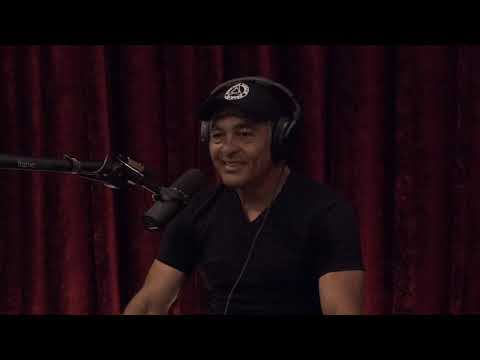
JRE MMA Show #114 with Rickson Gracie
Joe Rogan (host), Rickson Gracie (guest)
In this episode of The Joe Rogan Experience, featuring Joe Rogan and Rickson Gracie, JRE MMA Show #114 with Rickson Gracie explores rickson Gracie Explains Breath, Fear, and Real Martial Mastery Rickson Gracie and Joe Rogan discuss how cold exposure, breathwork, and spiritual preparation shaped Rickson’s approach to fighting and life. Rickson explains developing his mental and emotional resilience through extreme self-imposed stress, then discovering diaphragmatic breathing as the key to unlocking his physical and spiritual potential. They contrast old-school, no-rules vale tudo with modern sport jiu-jitsu and MMA, emphasizing how rules, time limits, and points have shifted the art toward entertainment and away from pure effectiveness. Rickson also talks about his new book “Breathe,” his online academy, injuries and aging, and the broader life value of martial arts beyond competition.
Rickson Gracie Explains Breath, Fear, and Real Martial Mastery
Rickson Gracie and Joe Rogan discuss how cold exposure, breathwork, and spiritual preparation shaped Rickson’s approach to fighting and life. Rickson explains developing his mental and emotional resilience through extreme self-imposed stress, then discovering diaphragmatic breathing as the key to unlocking his physical and spiritual potential. They contrast old-school, no-rules vale tudo with modern sport jiu-jitsu and MMA, emphasizing how rules, time limits, and points have shifted the art toward entertainment and away from pure effectiveness. Rickson also talks about his new book “Breathe,” his online academy, injuries and aging, and the broader life value of martial arts beyond competition.
Key Takeaways
Use controlled stress to train emotional and spiritual resilience, not just toughness.
Rickson’s cold plunges with his head fully submerged, big-wave surfing, and even being rolled in a carpet as a child were deliberate ways to confront panic and learn to stay calm and spiritually surrendered in terrifying situations—directly transferable to fighting and life crises.
Get the full analysis with uListen AI
Master diaphragmatic breathing to expand performance, clarity, and recovery.
He distinguishes shallow chest breathing from deep diaphragmatic breathing that fills the lower and back parts of the lungs, claiming it increased his performance capacity by roughly 40% and kept his mind sharp even when his body fatigued.
Get the full analysis with uListen AI
Prioritize exhale and hyperventilation when under duress instead of gasping.
Rickson emphasizes that effective breathing under stress starts with forcefully emptying “bad gas” (CO₂) and using the diaphragm; inhalation then happens naturally, reducing panic and restoring control during exertion, submersion, or combat.
Get the full analysis with uListen AI
Treat mental weakness and the urge to quit as your primary opponent.
In his first major fight against Zulu, Rickson’s impulse to quit between rounds showed him his worst enemy was in his own mind; he resolved thereafter that if he entered a fight, quitting would not be an option, focusing on one external enemy instead of two.
Get the full analysis with uListen AI
Build jiu-jitsu on leverage and fundamentals so it works for anyone.
Echoing Helio Gracie’s innovations born from physical weakness, Rickson argues that true jiu-jitsu must rely on angles, connection, and timing rather than strength, making it teachable to small, weak, or non-athletic people and applicable beyond sport rulesets.
Get the full analysis with uListen AI
Separate sport strategy from real-fight effectiveness in training.
He criticizes point-focused jiu-jitsu and time-limited MMA for rewarding stalling and strategic wins that wouldn’t translate in a no-rules, no-time situation, urging practitioners to maintain vale tudo guard awareness, tight control, and submission-oriented objectives.
Get the full analysis with uListen AI
Introduce beginners to jiu-jitsu without ego, injury, or early sparring.
Rickson notes most new students quit within six months; his online curriculum proposes a first year with no live opposition—only cooperative partners developing balance, escapes, and sensitivity—so people can gain confidence and functional skills before deciding whether to compete.
Get the full analysis with uListen AI
Notable Quotes
“My worst enemy was in my mind, telling me to quit.”
— Rickson Gracie
“Jiu-jitsu is an art for the weaker.”
— Rickson Gracie
“If you put points and judges in, it’s not martial arts anymore; it’s a game that uses martial arts.”
— Rickson Gracie
“You can spend seven days without food, three days without water, but five minutes without breathing you’re dead.”
— Rickson Gracie
“Life today dehumanizes you. Jiu-jitsu re-humanizes you.”
— Rickson Gracie
Questions Answered in This Episode
How can an everyday person practically start training diaphragmatic breathing the way Rickson describes, without a coach like Orlando Kani?
Rickson Gracie and Joe Rogan discuss how cold exposure, breathwork, and spiritual preparation shaped Rickson’s approach to fighting and life. ...
Get the full analysis with uListen AI
What would a modern, no-time-limit, no-judges combat format actually look like in practice, and could it coexist with today’s entertainment-driven MMA?
Get the full analysis with uListen AI
How should current competitors balance learning modern sport innovations—like lapel guards and advanced leg locks—with preserving the self-defense and vale tudo roots of jiu-jitsu?
Get the full analysis with uListen AI
What would it take for jiu-jitsu academies to adopt Rickson’s non-sparring first-year model, and how might that change dropout rates and gym culture?
Get the full analysis with uListen AI
In what ways can non-fighters apply Rickson’s ideas of visualization, spiritual surrender, and confronting fear to careers, relationships, and everyday adversity?
Get the full analysis with uListen AI
Transcript Preview
(drumbeats) Joe Rogan podcast, check it out.
The Joe Rogan Experience.
Train by day, Joe Rogan podcast by night, all day. (instrumental music plays) Thanks for being here, sir. Always good to see you.
It's always my pleasure, brother.
(laughs) Always good to see you. And, uh, it was good to talk to you, uh, before the podcast. We were talking about how you go into the cold plunge with a snorkel.
Yeah.
Tell me about that.
Yes. The, the cold water shower, the ice water, has always been very helpful for me in terms of controlling emotions and feel peace, peaceful in hell.
Yeah.
So I was doing only ice bath, but I always put a snorkel and put my head under the water because if you keep your head off the water, it becomes very physical, very discomfortable, but doesn't hit the emotional aspect. You don't feel like you're gonna die because you don't feel the fear on your face, the discomfortable in your ears and your head which brings a different dimension of, of terrifying feelings. So I was putting the snorkel and getting under the water and breathing (breathes deeply) . When I achieved the calmness in my heart and lungs, I was ready to, to leave the water. I don't like to stay there for 10, 15 minutes. I stay there for one, two, three minutes at the most until I feel very peaceful. And because for me, it was more like f- spiritual than actually physical. I don't that, I don't, I'm not there to treat microtraumas or something. It was more to give me the sense of ready to die any point and feel like if you stay too long under the water, you're gonna die, so if you have, you have to be peaceful and the same time aware and, and develop courage, develop calmness, develop spiritual surrender. For me, it's all everything I need to perform well.
And so you, y- y- you started doing cold water therapy a long time ago. I mean, it was obviously, it was in the movie Choke when you went into that frozen river.
Yes.
When did you start doing that?
Soon I felt I, I have to develop some kind of terrifying experience to make my spiritual mind become comfortable. So big wave surf is always something which terrifying me, and I was exposing myself to the ocean to understand the emotion of the ocean and, and be comfortable in this kind of discomfortable situation. Also, cold water and, and, and other things I, I always do.
And this was just always a part of y- developing yourself for fighting, developing yourself just for overall life?
My, my life is a very unique one because since I start to understand my, my status of representing the family through jiu-jitsu, I put myself against the unknown, which is no weight division, no time limits, no rules, no size. So all those unpredictable aspects give me something which is different than just a sport like lifestyle. I was living more the life of a guy who is ready to anything anytime. So that kind of preparation requires not only the, the mental and the t- the technical preparation, but also the spiritual preparation. And sometimes, spiritually speaking, you have to understand how to accept things, how to surrender things, and, and be above their physicality or actually the fear of dying.
Install uListen to search the full transcript and get AI-powered insights
Get Full TranscriptGet more from every podcast
AI summaries, searchable transcripts, and fact-checking. Free forever.
Add to Chrome