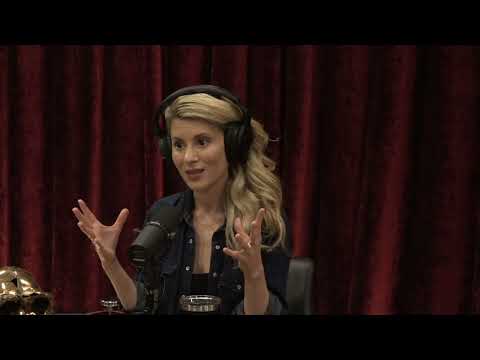
Joe Rogan Experience #1908 - Erika Thompson
Narrator, Joe Rogan (host), Erika Thompson (guest), Narrator, Narrator, Narrator
In this episode of The Joe Rogan Experience, featuring Narrator and Joe Rogan, Joe Rogan Experience #1908 - Erika Thompson explores inside the Secret Life of Bees: Communication, Queens, and Survival Joe Rogan interviews professional beekeeper Erika Thompson about honeybee biology, behavior, and her work relocating wild colonies. They explore how bee colonies function as a superorganism, including communication via pheromones, waggle dances, and the strict castes of queens, workers, and drones.
Inside the Secret Life of Bees: Communication, Queens, and Survival
Joe Rogan interviews professional beekeeper Erika Thompson about honeybee biology, behavior, and her work relocating wild colonies. They explore how bee colonies function as a superorganism, including communication via pheromones, waggle dances, and the strict castes of queens, workers, and drones.
Thompson explains the life cycles of different bees, how queens are made and replaced, how swarms choose new homes, and why male bees are largely expendable. She also details her no-suit bee removals, the meditative mindset required, and how she built a massive social media following by sharing these rescues.
The conversation broadens into threats facing bees—industrial agriculture, pesticides, habitat loss—and the critical role pollinators play in global food systems. They close by discussing ethical honey harvesting, fake honey in global trade, and practical ways individuals can support bees, such as buying local honey and planting native flowers.
Key Takeaways
Honeybee colonies operate as a superorganism, not a monarchy.
Although we call her the ‘queen,’ she’s essentially the reproductive organ of a much larger organism—the colony. ...
Get the full analysis with uListen AI
Queens are made, not born, through diet and special cells.
Any fertilized (female) egg can become a queen if workers feed the larva royal jelly for its entire development and build it a larger ‘queen cell. ...
Get the full analysis with uListen AI
Male drones are biologically important but mostly expendable.
Drones exist almost solely to mate with queens from other colonies; they don’t forage, build comb, or defend the hive. ...
Get the full analysis with uListen AI
Bee communication is rich and multi-modal.
Bees use pheromones (e. ...
Get the full analysis with uListen AI
Industrial agriculture stresses bees through monocultures and transport.
Commercial beekeepers truck hives around the country to pollinate crops like almonds, exposing bees to long-distance transport, single-crop diets, and possible pesticides. ...
Get the full analysis with uListen AI
Most people can support bees with simple local actions.
Planting native, bee-friendly flowering plants instead of pure lawns, avoiding unnecessary pesticides, and buying honey directly from local beekeepers all improve forage availability, support healthier bee populations, and reduce reliance on adulterated mass-market honey.
Get the full analysis with uListen AI
Viral content can empower niche experts without traditional media.
Thompson’s short bee-removal videos have reached over 100 million views, attracting TV offers she ultimately declined. ...
Get the full analysis with uListen AI
Notable Quotes
“If I were to think I knew more than the bees, that would be so foolish of me.”
— Erika Thompson
“A colony is a superorganism. The queen is essentially the female reproductive organ of this greater being.”
— Erika Thompson
“There’s no place I’d rather be than elbows deep in a hive full of bees.”
— Erika Thompson
“Bees pollinate one out of every three bites of food we eat.”
— Erika Thompson
“Don’t get involved in the machine. They’re just trying to capitalize on what you’ve done.”
— Joe Rogan
Questions Answered in This Episode
How might our understanding of bee ‘democracy’ and collective decision-making inform better human organizations or governance?
Joe Rogan interviews professional beekeeper Erika Thompson about honeybee biology, behavior, and her work relocating wild colonies. ...
Get the full analysis with uListen AI
Given the stresses of industrial agriculture, what would a pollinator-friendly food system practically look like at scale?
Thompson explains the life cycles of different bees, how queens are made and replaced, how swarms choose new homes, and why male bees are largely expendable. ...
Get the full analysis with uListen AI
How far should ethical beekeeping go in limiting honey harvests, royal jelly extraction, and artificial feeding before it stops being commercially viable?
The conversation broadens into threats facing bees—industrial agriculture, pesticides, habitat loss—and the critical role pollinators play in global food systems. ...
Get the full analysis with uListen AI
What specific indicators should consumers look for to distinguish authentic local honey from adulterated or ‘funny honey’ on store shelves?
Get the full analysis with uListen AI
If bee populations declined dramatically despite conservation efforts, what realistic alternatives or technological solutions could replace their pollination services?
Get the full analysis with uListen AI
Transcript Preview
(drumbeats) Joe Rogan podcast, check it out. The Joe Rogan Experience. Train by day, Joe Rogan podcast by night. All day. (instrumental music)
This is your first podcast?
This is my first podcast.
Well, thank you very much for allowing me to be the host of you for the first podcast.
Thank you so much for having me and the bees.
My pleasure. Um, I became fascinated with bees when we did an episode of Fear Factor, where we had to cover these people in bees. And it was this outdoor thing that we did at this ranch, and while we were doing it, a local hive of bees came over and interacted with our bees, and we had to shut down production. And so I talked to the beekeeper, I said, "What's going on?" And he said, "We have to shut everything down for an hour or so while they work this out." And I'm like-
While, while the bees work it out.
Yeah.
Yeah.
I'm like, "What do you mean?" And he's like, "Well, they're gonna communicate 'cause these bees are trying to figure out why these bees are here, wh- why our bees are there." And I go, "They're gonna communicate? Like, is it gonna be a bee war?" He's like, "No, they're gonna sort it out." And I'm like, "How do they sort it out?" And it's kind of unknown, right? Like, how... wh-
Sure. Well, what happened with those bees?
They sorted it out.
And did-
The other bees went away, and our bees came back and stayed, and then we resumed the show.
That's great.
So, uh, what kind of communication are bees capable of? Do we know?
We don't know everything there is to know about bees. Bees have been around for 120 million years. We've been keeping bees for maybe 10,000. You know, if, if I were to think I knew more than the bees, that would be so foolish of me. But we do know some of the ways that bees communicate. Um, they communicate through scents, through pheromones a lot, through these chemical signals that they're sending out to the entire colony to let this colony, that's a superorganism, know what's going on. And so, in your case, you know, you had one colony of bees. A colony is a collective noun, is the collective noun for a group of bees, whereas a hive is the box they live in. So you had these two colonies, you know, who met and were trying to make sure they all stayed together and they all stayed with their queen and went to the right place. And, you know, it sounds like you had a bunch of bees in one area, and bees are social creatures, so they were attracted to the scents of these other bees and were there to see what's going on and, you know, they eventually figured it out, and everybody went back to their respective places, and, and it was fine.
Install uListen to search the full transcript and get AI-powered insights
Get Full TranscriptGet more from every podcast
AI summaries, searchable transcripts, and fact-checking. Free forever.
Add to Chrome