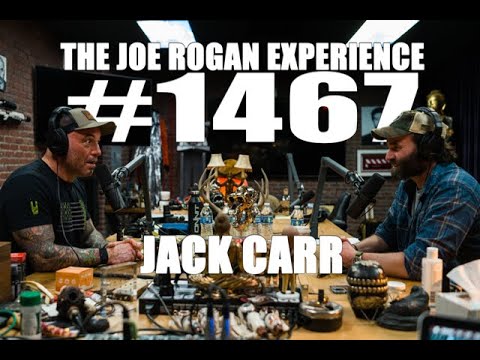
Joe Rogan Experience #1467 - Jack Carr
Joe Rogan (host), Jack Carr (guest), Narrator
In this episode of The Joe Rogan Experience, featuring Joe Rogan and Jack Carr, Joe Rogan Experience #1467 - Jack Carr explores navy SEAL-Turned-Novelist Jack Carr On War, Writing, And Resilience Joe Rogan talks with former Navy SEAL and bestselling thriller author Jack Carr about Carr’s path from 20 years in special operations to creating the James Reece novel series, now being adapted for TV with Chris Pratt and Antoine Fuqua.
Navy SEAL-Turned-Novelist Jack Carr On War, Writing, And Resilience
Joe Rogan talks with former Navy SEAL and bestselling thriller author Jack Carr about Carr’s path from 20 years in special operations to creating the James Reece novel series, now being adapted for TV with Chris Pratt and Antoine Fuqua.
Carr explains how a lifetime of reading, his mother’s influence as a librarian, and deep study of warfare and storytelling shaped his fiction more than any formal writing education.
They dig into his writing process, gear obsession, and how combat experience, government scrutiny, and real-world geopolitics (Russia, bio‑weapons, terrorism) feed directly into his plots and torture sequences.
The conversation broadens into COVID-19, civil liberties, preparedness, firearms, hunting, and how crises expose both societal fragility and the need for personal responsibility and financial resilience.
Key Takeaways
Long-term vision plus immersion beats formal credentials in creative work.
Carr never studied writing formally; he spent decades as an obsessive reader of thrillers and war history, then treated those authors as his 'professors' while coupling that with real-world combat experience to build a believable fictional world.
Get the full analysis with uListen AI
Treat a writing career like a startup, not a purely artistic endeavor.
Beyond drafting manuscripts, Carr leans into branding, social media, partnerships (e. ...
Get the full analysis with uListen AI
Clear thematic focus creates tighter, more resonant stories.
For each book Carr tapes a single-word theme—'Revenge,' 'Redemption,' 'Dark Side of Man'—to his monitor and ensures every scene ties directly or indirectly back to it, keeping plot and character arcs cohesive and emotionally focused.
Get the full analysis with uListen AI
Real experience and precise detail dramatically increase authenticity.
Carr weaves in actual tactics, weapons, gear, vehicles, and emotional reactions from Iraq, Afghanistan, Russia, Africa, and anti-poaching work; this specificity (and even his NCIS interrogation) drives scenes that feel believable and grounded.
Get the full analysis with uListen AI
Crises reveal the value of preparation and the thinness of normalcy.
Using COVID-19 and other disasters as examples, Carr argues that basic preparedness—food, water, firearms, skills, and especially financial buffers—frees bandwidth to adapt strategically instead of panicking when systems fail.
Get the full analysis with uListen AI
Civil liberties and emergency powers must be weighed very carefully.
Rogan and Carr warn that tracking regimes, expanded surveillance, and 'temporary' measures adopted during pandemics are rarely rolled back, and citizens should be wary of trading privacy for promises of safety.
Get the full analysis with uListen AI
Adversity, including institutional pushback, can enrich creative work.
Carr’s negative experience with NCIS after another SEAL’s book, and his friction with the Pentagon’s pre‑publication review, directly informed some of his most compelling interrogation and conspiracy scenes, turning personal frustration into narrative fuel.
Get the full analysis with uListen AI
Notable Quotes
“The only difference between a published author and an unpublished author is that the published author never quit.”
— Jack Carr (quoting advice from Brad Thor)
“You have to sit down and do the work. No one’s going to do it for you.”
— Jack Carr
“This invisible virus has done to the United States what the Soviet Union couldn’t do in 40-plus years of trying.”
— Jack Carr
“The whole structure of our civilization is very thin. The veil that keeps you from bad things happening is very small.”
— Joe Rogan
“There are very few things that separate us from our enemy. One of them is that we have to maintain the moral high ground.”
— Jack Carr
Questions Answered in This Episode
How should fiction writers balance operational secrecy with authenticity when drawing on real military or intelligence experience?
Joe Rogan talks with former Navy SEAL and bestselling thriller author Jack Carr about Carr’s path from 20 years in special operations to creating the James Reece novel series, now being adapted for TV with Chris Pratt and Antoine Fuqua.
Get the full analysis with uListen AI
In an age of surveillance capitalism and pandemics, where should societies draw the line between public health measures and civil liberties?
Carr explains how a lifetime of reading, his mother’s influence as a librarian, and deep study of warfare and storytelling shaped his fiction more than any formal writing education.
Get the full analysis with uListen AI
What practical steps can an average person take now to become meaningfully more prepared—physically, financially, and mentally—for future disruptions?
They dig into his writing process, gear obsession, and how combat experience, government scrutiny, and real-world geopolitics (Russia, bio‑weapons, terrorism) feed directly into his plots and torture sequences.
Get the full analysis with uListen AI
Does Jack Carr’s view of targeted killing and torture evolve across the James Reece series, and what does that say about our shifting ethics in warfare?
The conversation broadens into COVID-19, civil liberties, preparedness, firearms, hunting, and how crises expose both societal fragility and the need for personal responsibility and financial resilience.
Get the full analysis with uListen AI
How might the success of the James Reece TV adaptation influence future portrayals of special operations and national security in popular media?
Get the full analysis with uListen AI
Transcript Preview
And we're live. Hey, what's up? How are you?
Oh, hey. Thanks for having me on.
My pleasure.
This is awesome.
My pleasure. Good to see you again. And good to-
Good to see you.
You know, when we first met, uh, I knew you were an author and I knew that Chris Pratt was involved in doing that thing with you, and that you guys were working towards making a se- which is happening now.
Yeah.
Which is very exciting.
Crazy.
But, uh, I'd never read any of your work until now. So, getting ready for this, I actually listened to the audiobook, which is really well done. The guy who reads it, what is his name?
Ray Porter.
He's fucking great.
Yeah. He's awesome.
He's, he's a little disturbing when he does a girl's voice. But- (laughs)
There's no getting around that.
(laughs)
Like, if a guy's doing a girl voice, especially putting an accent to it-
Yeah.
... there's, like, no getting around the creepy part of that.
It's a little, it's a little weird. But you, you take ... But he's so good at, like, Russian accents and then, uh, South African accents.
Yeah.
And it's a really good book, man.
Thank you.
It's fucking riveting. Like, it's-
Thank you.
... it's hard to put down. It's, it's really good. And most of it I listened to either, uh, on workouts, walking, uh, hikes with the dog, or in the sauna. (laughs)
Nice. Perfect place to listen to it.
So I burned through it in a few days.
Nice.
It's, it's really good, man.
You had ... You know like half the characters, uh, are the one, people that were inspired by actual people.
I know. That was what's crazy is, like, so many people, whether it was, uh, you know, uh, John Dudley or Barklow or, you know, Half-Faced Blades.
Yeah.
Like, uh, these ... Black Rifle Coffee.
Yeah. (laughs)
ICON 4x4.
That's right. (laughs)
There's like so many different things. Sitka.
Yeah. Yeah.
So many different things that I-
Be strange not-
Yeah.
... for me to, for me not to talk about gear, just because I was a gear guy before I went in the Navy. And then, of course, in the SEAL teams, you're like, you, that's your time to shine and to, like, go down these rabbit holes and try to make the gear better or anything that's gonna make you more effective and efficient on the battlefield. So you really get to go all in. And then, just after the military, same thing, I'm just a gear guy. So it would be strange just to say, "He pulled out a rifle." You know?
Yeah. (laughs)
Install uListen to search the full transcript and get AI-powered insights
Get Full TranscriptGet more from every podcast
AI summaries, searchable transcripts, and fact-checking. Free forever.
Add to Chrome