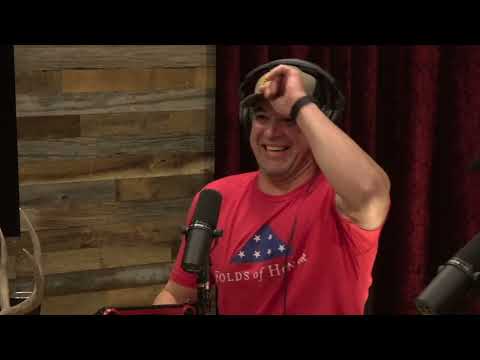
Joe Rogan Experience #1885 Andy Stumpf & Mike Sarraille
Narrator, Joe Rogan (host), Andy Stumpf (guest), Mike Sarraille (guest), Narrator, Narrator, Joe Rogan (host)
In this episode of The Joe Rogan Experience, featuring Narrator and Joe Rogan, Joe Rogan Experience #1885 Andy Stumpf & Mike Sarraille explores navy SEAL veterans defend brutal training and honor fallen warriors Joe Rogan sits down with former Navy SEALs Andy Stumpf and Mike Sarraille to discuss SEAL culture, extreme training, and the widening gap between military reality and public perception. They dissect controversies around SEAL selection, tear gas videos, and media criticism, arguing that harsh preparation is necessary for modern combat. The conversation branches into warrior archetypes in MMA, the dangers and value of high‑risk pursuits like extreme skydiving, and the psychological costs of sustained combat. They close by outlining their Triple 7 skydiving expedition to raise $7 million for Folds of Honor, supporting families of fallen and disabled service members and first responders.
Navy SEAL veterans defend brutal training and honor fallen warriors
Joe Rogan sits down with former Navy SEALs Andy Stumpf and Mike Sarraille to discuss SEAL culture, extreme training, and the widening gap between military reality and public perception. They dissect controversies around SEAL selection, tear gas videos, and media criticism, arguing that harsh preparation is necessary for modern combat. The conversation branches into warrior archetypes in MMA, the dangers and value of high‑risk pursuits like extreme skydiving, and the psychological costs of sustained combat. They close by outlining their Triple 7 skydiving expedition to raise $7 million for Folds of Honor, supporting families of fallen and disabled service members and first responders.
Key Takeaways
Brutal training prepares SEALs for real combat, not hazing.
Stumpf and Sarraille argue CS gas exposure, Hell Week sleep deprivation, and physically punishing evolutions are necessary so that recruits first experience these stresses in controlled environments, not in life‑and‑death situations downrange.
Get the full analysis with uListen AI
Selection is about character under extreme stress, not athleticism alone.
They emphasize BUD/S and Hell Week are designed to strip away comfort, revealing who will prioritize the team over self when cold, exhausted, and scared; prior hardship in life often predicts who endures.
Get the full analysis with uListen AI
Media narratives can distort special operations culture and performance.
They criticize specific New York Times reporting and broader coverage that fixates on rare failures, misconduct, or tragedies—like the Eddie Gallagher case—while ignoring decades of honorable service and operational success.
Get the full analysis with uListen AI
Progressive policy experiments can undermine war‑fighting effectiveness.
The guests say diversity and inclusion initiatives and demands for increased transparency, when applied bluntly to special operations, risk diluting standards and revealing tactics to adversaries while not improving battlefield performance.
Get the full analysis with uListen AI
Victimhood culture conflicts with elite performance mindsets.
Rogan and the SEALs contrast modern narratives of entitlement and blame with the mindset of people like Gordon Ryan or top operators, who accept extreme work, accountability, and failure as the price of being exceptional.
Get the full analysis with uListen AI
High‑risk hobbies can be repurposed into meaningful service.
Using their skydiving expertise, Stumpf and Sarraille created the Triple 7 project—seven jumps on seven continents in seven days—to raise $7 million for scholarships for the children and spouses of fallen or disabled military and first responders.
Get the full analysis with uListen AI
Veterans’ legacies depend on storytelling and tangible support.
They stress that fallen teammates are forgotten when people stop telling their stories; projects like Legacy Expeditions and Folds of Honor extend that legacy by both honoring names and funding education for their families.
Get the full analysis with uListen AI
Notable Quotes
“If the training becomes so exceedingly safe that death is not a potential, then we’re not preparing them for what the battlefield’s going to expect of them.”
— Andy Stumpf
“We’re looking for mental toughness, resiliency, the ability to work as a team… hire for character, train for skill.”
— Mike Sarraille
“As a society we’ve gotten way too comfortable here… maybe the curriculum is doing just fine, but we’re getting softer and softer with less resilience.”
— Andy Stumpf
“Everybody wants to be a bad motherfucker, but nobody wants to do what it takes to become that.”
— Joe Rogan
“I loved the men and women I served with a lot more than I hated the enemy.”
— Mike Sarraille
Questions Answered in This Episode
Where should the line be drawn between necessary brutality in training and unacceptable risk or abuse in elite military programs?
Joe Rogan sits down with former Navy SEALs Andy Stumpf and Mike Sarraille to discuss SEAL culture, extreme training, and the widening gap between military reality and public perception. ...
Get the full analysis with uListen AI
How can the public be better educated about special operations realities without compromising operational security or glorifying war?
Get the full analysis with uListen AI
To what extent are progressive social policies compatible with maintaining uncompromising combat standards in units like the SEALs?
Get the full analysis with uListen AI
How should society weigh the psychological and physical costs of repeated combat deployments against the operational benefits of keeping experienced warriors in the field?
Get the full analysis with uListen AI
What responsibilities do veterans, media creators, and influencers have in shaping accurate, respectful portrayals of warfighters and their communities?
Get the full analysis with uListen AI
Transcript Preview
(drum roll) Joe Rogan podcast, check it out. The Joe Rogan Experience. Train by day, Joe Rogan podcast by night, all day. (instrumental music plays)
So tell me about your dip problem. (laughs) What happened?
Tell us about your disgusting mouth.
Is this how I start? (laughs)
(laughs) Yes. Well, so I- I- you know, you talked about high school. You did in high school.
Yeah.
I did it one time.
He's gotta turn it on you.
Yeah.
You did it one time.
One time in high school and never touched it again. Go ahead, mister 19 years.
Mike was-
(laughs)
Mike was just saying that he had to get his skin grafted-
(laughs)
(laughs)
... and he's like, "You did it once."
(laughs)
Well, I- I remember the first time I did. Somebody gave me Redman Chew, and it was over. I was just yakking everywhere. Where I started was in the Marine Corps is, uh, when we're in a hide site, you have to stay awake when it's your turn for security, but that can be like 3:00 AM in the morning after you've been hiking for like six hours.
Right.
So eventually my team leader's like, "You are gonna put a dip in to do whatever it takes to stay awake during your watch."
Does dip keep you awake?
The, uh, nicotine does.
Yeah.
It should.
But dip will?
(inhales deeply) Yes.
Absolutely. And so it- it morphed from there in the Marines, and we lived... I like to say we lived off of three things on deployment, water, coffee, and dip. And even on a patrol with these guys, I would have a dip in, chewing caffeine gum-
Jesus.
... and drinking water.
Super healthy.
This is... I'm gonna send this to Brendan Schaub-
(laughs)
... 'cause that motherfucker keeps... He has those little pouches. They're so nasty. He keeps four or five of them in his mouth at a time. He looks like a squirrel, like he's got a little... Like he's storing nuts. Well, so tell me-
Well, no, you're grafted.
So, you have to have skin grafted?
They take the, uh, tissue from the top of your mouth and then graft it to the bottom of the teeth because it's-
Ugh.
... receded quite a bit.
Hold on one second. Sorry. Are you good now? Yeah. Okay. So, what did it do to your mouth?
I think after 19 years of... (laughs) So I did switch from long cut to pouches, and then, uh, pouches are...
(laughs)
Like that makes a fucking difference.
There was a switch. There was a logical progression.
I switched from beer to vodka. It's totally fine, guys.
(laughs)
(laughs)
(laughs)
Install uListen to search the full transcript and get AI-powered insights
Get Full TranscriptGet more from every podcast
AI summaries, searchable transcripts, and fact-checking. Free forever.
Add to Chrome