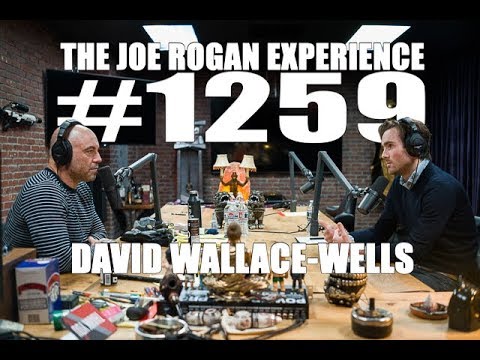
Joe Rogan Experience #1259 - David Wallace-Wells
Joe Rogan (host), David Wallace-Wells (guest), Narrator, Narrator, Narrator
In this episode of The Joe Rogan Experience, featuring Joe Rogan and David Wallace-Wells, Joe Rogan Experience #1259 - David Wallace-Wells explores climate Change Catastrophe: David Wallace-Wells Explains Our Narrow Escape Window Joe Rogan and journalist David Wallace-Wells discuss the scale, speed, and consequences of climate change, drawing heavily on Wallace-Wells’ book *The Uninhabitable Earth*.
Climate Change Catastrophe: David Wallace-Wells Explains Our Narrow Escape Window
Joe Rogan and journalist David Wallace-Wells discuss the scale, speed, and consequences of climate change, drawing heavily on Wallace-Wells’ book *The Uninhabitable Earth*.
They explore how warming drives wildfires, heat waves, sea-level rise, food crises, disease, conflict, and economic decline, emphasizing that even wealthy regions and nations are not insulated.
Wallace-Wells argues that half of all human-emitted carbon has been released in just the last 30 years and that the next 30 are just as pivotal, framing climate change as an all-encompassing civilizational challenge.
They also examine potential solutions—from carbon capture and geoengineering to policy shifts and technological innovation—while stressing that denial, short-term thinking, and political inertia are the main obstacles.
Key Takeaways
The critical climate window is the next 30 years, not centuries away.
Half of all fossil-fuel CO₂ emissions in human history occurred in the last 30 years, and a similar span ahead will largely determine whether we end up near 2°C of warming or around 4°C and beyond.
Get the full analysis with uListen AI
Even “best case” warming scenarios are catastrophic for many regions.
Two degrees Celsius of warming—now effectively the optimistic outcome—means unlivable summer heat in parts of India and the Middle East, irreversible ice-sheet loss, major sea-level rise, and hundreds of millions of climate refugees.
Get the full analysis with uListen AI
Climate impacts are systemic, touching everything from food to mental health.
Warming reduces crop yields, increases crime and conflict, worsens air pollution deaths, affects fetal brain development, and can destabilize entire societies, making climate a total-life issue rather than just an environmental one.
Get the full analysis with uListen AI
Technology can help, but it’s not a silver bullet without policy and scale.
Direct air capture could theoretically neutralize all current emissions for about $3 trillion a year and geoengineering could cool the planet, but both face massive logistical, political, and ethical hurdles and cannot substitute for rapid emissions cuts.
Get the full analysis with uListen AI
Our cognitive biases make climate change uniquely hard to act on.
Humans discount the future, prefer the status quo, and struggle to grasp massive, abstract systems; this leads many to ignore climate risks because daily life still looks normal, despite worsening trends.
Get the full analysis with uListen AI
Global politics and economics currently incentivize inaction or slow action.
Every country benefits individually from burning fossil fuels while sharing the climate costs, so without coordinated pressure and reoriented incentives (e. ...
Get the full analysis with uListen AI
Alarm and clear storytelling are necessary to shift public and political will.
Wallace-Wells argues that downplaying worst-case outcomes has failed; honest, even frightening communication—paired with concrete solutions—is more likely to produce the World War II–scale mobilization scientists say is required.
Get the full analysis with uListen AI
Notable Quotes
“We brought the world from a stable climate to the brink of total climate catastrophe in 30 years. We have about one generation to save it.”
— David Wallace-Wells
“Wherever you live, no matter how defended against nature you are, climate change is teaching us that you still live within climate, and when it gets fucked up, it will fuck you up.”
— David Wallace-Wells
“Our best case scenario is 25 holocausts worth of death from air pollution—and that’s just between 1.5 and 2 degrees of warming.”
— David Wallace-Wells
“We didn’t fight World War II out of hope. We fought World War II out of panic.”
— David Wallace-Wells
“This isn’t about affecting some part of nature over there. It’s about affecting all of human life, every aspect of human life as it’s lived on this planet.”
— David Wallace-Wells
Questions Answered in This Episode
If we accept that 2°C is now effectively the best-case outcome, what specific policies and technologies should be prioritized in the 2020s to avoid pushing toward 4°C?
Joe Rogan and journalist David Wallace-Wells discuss the scale, speed, and consequences of climate change, drawing heavily on Wallace-Wells’ book *The Uninhabitable Earth*.
Get the full analysis with uListen AI
How do we balance necessary alarm about climate risks with maintaining enough hope and agency that people don’t simply shut down or disengage?
They explore how warming drives wildfires, heat waves, sea-level rise, food crises, disease, conflict, and economic decline, emphasizing that even wealthy regions and nations are not insulated.
Get the full analysis with uListen AI
What are the ethical and geopolitical implications of large-scale geoengineering—who gets to decide the global thermostat, and how do we manage the risks?
Wallace-Wells argues that half of all human-emitted carbon has been released in just the last 30 years and that the next 30 are just as pivotal, framing climate change as an all-encompassing civilizational challenge.
Get the full analysis with uListen AI
How can wealthier nations realistically support vulnerable countries like Bangladesh as sea levels rise, without triggering massive political backlash at home?
They also examine potential solutions—from carbon capture and geoengineering to policy shifts and technological innovation—while stressing that denial, short-term thinking, and political inertia are the main obstacles.
Get the full analysis with uListen AI
Given our cognitive biases and short-term thinking, what kinds of narratives, media, or cultural shifts are most likely to change behavior and voting patterns around climate?
Get the full analysis with uListen AI
Transcript Preview
(sniffs) Four, three, two, one. David. So, first of all, thanks for doing this.
Oh, my pleasure.
And-
Really excited.
How much trouble are we in? Legitimately?
I mean, it's pretty bad already and it's gonna get, I think, a lot, lot worse, so-
It's not bad right now, right here. It's raining. It seems nice out. The hills are green.
I mean, how long ago were the fires? Right, right around the corner.
I got evacuated (laughs) . It was October.
Yeah.
Yeah, it was rough but, in all fairness I've been evacuated three times over the past 20 years.
Yeah, no. The fires, California's fires are kind of interesting in that, um, they both seem like it's like the future, the apocalypse, they're here. But also it's so familiar from like decades of wildfires. Um, but you know there are scientific estimates that say that they're gonna get, by the end of the century, 64 times worse.
What?
Yeah, I think that number's a little high, 'cause that would mean more than half of California burning every year. But, um, I mean it's gonna get, yeah, it'll get, it'll get crazy.
And there's no way to avoid any of this wildfire stuff?
Well, I mean, you know if we don't raise the temperature of the planet then...
(sighs) But is, is that the only thing that's causing wildfire- I mean like obviously if the temperature raises, uh, there's more brown dry-
Yeah.
... leaves and grass and stuff like that. But is-
Yeah, no, there's a, there's a lot of preventative stuff you can do. I mean, not building in certain areas-
Right.
... like, I mean it used to be, you know, the Indians who lived here before the white people came, um, did a lot of controlled burning. They like lived among fires and, um, I think that's like a probably more responsible way to be. But we've now built up the whole state so that they're all these homes that we don't want to burn. They're all these, you know, properties we don't wanna burn. And when you, um, when you like restrict the ability of natural wildfires to burn that means that like more tinder gets built over time, and then you know at some point something lights the match and it all burns. So that, I mean you could, um, you could do more controlled fire. You could take more aggressive action in terms of, um, you know, like spraying foam and that kind of thing.
Mm-hmm.
Um, you could have a lot more firefighters. But I was just talking to a guy yesterday, I'm out here actually doing some reporting on wildfires, and um, who was saying that no Santa Ana powered wildfire has ever been stopped by firefighters. And he is like a environmental historian.
Wow.
Install uListen to search the full transcript and get AI-powered insights
Get Full TranscriptGet more from every podcast
AI summaries, searchable transcripts, and fact-checking. Free forever.
Add to Chrome