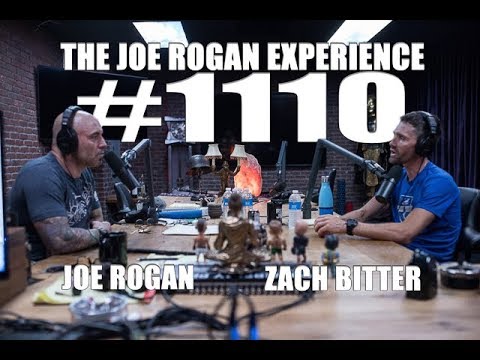
Joe Rogan Experience #1110 - Zach Bitter
Joe Rogan (host), Zach Bitter (guest)
In this episode of The Joe Rogan Experience, featuring Joe Rogan and Zach Bitter, Joe Rogan Experience #1110 - Zach Bitter explores ultrarunner Zach Bitter Explains Fat-Fueled 100-Mile World-Record Performance Joe Rogan interviews elite ultramarathoner Zach Bitter, focusing on his transition to high-fat, low-carb nutrition while running and winning extreme-distance races. Bitter describes how he became hooked on ultras, culminating in a 100-mile American record of 11 hours 40 minutes on a track, averaging about seven minutes per mile. They dive deeply into metabolic flexibility, fat adaptation, carbohydrate timing, and how he uses nutrition to avoid bonking and stomach issues over 100+ miles. The conversation also covers training structure, mental toughness, gear, the culture of ultrarunning, and how different bodies thrive on very different diets.
Ultrarunner Zach Bitter Explains Fat-Fueled 100-Mile World-Record Performance
Joe Rogan interviews elite ultramarathoner Zach Bitter, focusing on his transition to high-fat, low-carb nutrition while running and winning extreme-distance races. Bitter describes how he became hooked on ultras, culminating in a 100-mile American record of 11 hours 40 minutes on a track, averaging about seven minutes per mile. They dive deeply into metabolic flexibility, fat adaptation, carbohydrate timing, and how he uses nutrition to avoid bonking and stomach issues over 100+ miles. The conversation also covers training structure, mental toughness, gear, the culture of ultrarunning, and how different bodies thrive on very different diets.
Key Takeaways
Fat adaptation can dramatically reduce fueling needs during ultras.
By becoming highly fat-adapted, Bitter can run 4–5 hours on just water and electrolytes, and in races he typically only needs 100–200 calories per hour, about half of what he used on a high-carb approach, which lowers the risk of stomach problems.
Get the full analysis with uListen AI
Metabolic flexibility beats strict ketosis for high-performance training.
Bitter uses very low-carb/keto phases to build fat-burning capacity, then strategically adds back carbohydrates (often 200–300 g/day in peak weeks) to replenish glycogen so he can still hit high-intensity workouts and race efforts.
Get the full analysis with uListen AI
Recovery time between sessions may dictate carb needs more than workout intensity alone.
He suspects athletes training once per day can stay very low-carb, but when he stacks two-a-days with speed work, he needs more fast-acting carbs to restore glycogen quickly enough between efforts.
Get the full analysis with uListen AI
During races, carbohydrate is the smart supplement to body fat, not dietary fat.
Since even lean runners have ample body fat to fuel the ‘fat-burning side’ of the effort, Bitter opts to sip carbohydrate drinks during events to top up small glycogen stores rather than ingesting additional fats, which are already abundantly available from his body.
Get the full analysis with uListen AI
Mental strategy and logistics are as crucial as fitness in ultrarunning.
Bitter emphasizes pacing by perceived effort, planning aid, hydration, and gear, and using smaller races as “moderately hard long runs” to rehearse race-morning routines and logistics without blowing his peak performance on a B race.
Get the full analysis with uListen AI
Minimalist or low-drop shoes require slow, deliberate adaptation.
He views shoes as a ‘cast’ for the foot; going from heavily cushioned, high-heel-drop shoes to minimalist or zero-drop designs demands months of gradual progression so the foot muscles and connective tissue can strengthen without injury.
Get the full analysis with uListen AI
Diet responses are highly individual, and ideology shouldn’t override physiology.
The discussion repeatedly notes that some thrive on high-carb, some on vegan, some on meat-heavy or carnivore diets, and others like Bitter on high-fat—highlighting that people should honestly assess their own health and performance rather than force a one-size-fits-all approach.
Get the full analysis with uListen AI
Notable Quotes
“In 100 miles it’s almost not a matter of if something is going to go wrong, it’s a matter of when and how you respond to it.”
— Zach Bitter
“If I can go for a four- or even five-hour run with no fuel other than water and electrolytes, then I’m fat-adapted enough.”
— Zach Bitter
“Even the leanest endurance athletes have enough body fat to get through an endurance race.”
— Zach Bitter
“There’s something about the mind of an ultramarathoner. The type of person that can run 100 miles, 200 miles… those type of people, they’re different people.”
— Joe Rogan
“I’m not trying to say everyone should switch to doing what I do. If you feel great, do what you’re doing. If you don’t, then probably look to change something.”
— Zach Bitter
Questions Answered in This Episode
How could an everyday runner safely experiment with fat adaptation without sacrificing performance or well-being?
Joe Rogan interviews elite ultramarathoner Zach Bitter, focusing on his transition to high-fat, low-carb nutrition while running and winning extreme-distance races. ...
Get the full analysis with uListen AI
What specific markers—sleep, energy, labs—should endurance athletes track to know if their current diet is helping or hurting them?
Get the full analysis with uListen AI
How might training and fueling strategies need to shift when moving from marathons and 50Ks to 200+ mile events like Moab?
Get the full analysis with uListen AI
What are the long-term health implications, positive or negative, of spending years doing 20-hour training weeks on a high-fat, periodized-carb diet?
Get the full analysis with uListen AI
If ultrarunning remains relatively low in doping compared to other sports, what cultural and structural elements are actually protecting it—and can they last as the sport grows?
Get the full analysis with uListen AI
Transcript Preview
Five, four, three, two, one. (snaps fingers) Boom. And we're off. What's up, brother? How are you?
Good, good. Thanks for having me on.
My pleasure. Nice to meet you, man. You know, it's- it's funny that you just brought up Dr. Attia. You know, when we were- we were- you were saying that you download the podcast, you were saying-
Mm-hmm.
... "I gotta get that guy on."
Yeah, yeah. It was funny. I, I was ... It auto-downloads, and that one popped up, and I remember thinking about a week before that. I was like, well, when I- when we first scheduled this one, I was like, "I gotta tell Joe about Dr. Attia." He was one of the kinda first guys I really followed when I kinda dove into kind of the high-fat approach to, to nutrition. So, um, yeah, he's a fascinating guy who's, who's a great listen. I had to listen to it, like, twice, so. (laughs)
Yeah, he's a weird guy.
(laughs)
He's one of those guys where you, you talk to him and you think, "Oh, this is like a normal, really nice guy." And then as he starts getting into the medical aspect of things, you go, "Oh, okay."
(laughs)
"You're a fucking super genius."
Yeah, yeah. He's smart.
He tricks you. (laughs)
Yeah. I remember one of the first things he ever said that really kinda resonated with me was, I think someone was asking him about, like, what the effects are with a ketogenic diet in terms of, like, micronutrients and what maybe he'd be missing based on kinda like that normal profile of what you're supposed to get. And, and he was just like, "You know, it's, it's interesting 'cause most those studies and recommendations are based off of basically a standard American diet or a higher-carb diet." So he's like, "Well, you might just not need the same. We need to do more." And he's always looking to kind of push the envelope a bit, so cool guest for sure.
Yeah, and, uh, you know, I'm fascinated by you, and I'm fascinated by anybody who does the kind of shit that you do.
(laughs)
I mean, uh, please explain to people all the different ultra-marathons you've done and, like, what you've accomplished.
Yeah, you know, it's, it's interesting because, like, I still kinda see myself as a pretty average runner. Because, like, um, I mean, I competed in high school and made state cross-country and state track and that kind of thing, um, for a small school, and then I went to a small division three school and was, you know, pretty much, you know, average amongst a real good program at the D3 level. And, uh, I always just did kinda like running longer, though. So, um, like, once I got done with college, I kinda decided, "Well, let's, let's see what's longer than some of those traditional, like, collegiate races of like 5K to 10 kilometers." And, uh, you know, I started kinda just dabbling with that stuff, and then in, in 2010, I think, uh, I actually did my first ultra-marathon, you know, partly because I was just, like, looking around and there turned out to be one in the state. I was li- I was living in Wisconsin at the time, and, uh, there was one that, uh, was kind of in my neck of the woods, and I actually had just decided to go back to grad school, and that one had a $1000 prize purse on it. And I was like, "You know what? If I, if I can win that, 1000 bucks go a long way during grad school." (laughs)
Install uListen to search the full transcript and get AI-powered insights
Get Full TranscriptGet more from every podcast
AI summaries, searchable transcripts, and fact-checking. Free forever.
Add to Chrome