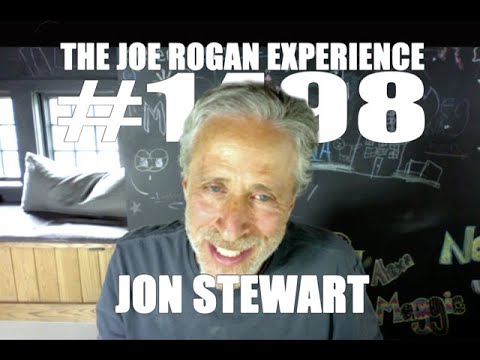
Joe Rogan Experience #1498 - Jon Stewart
Joe Rogan (host), Jon Stewart (guest), Narrator, Narrator
In this episode of The Joe Rogan Experience, featuring Joe Rogan and Jon Stewart, Joe Rogan Experience #1498 - Jon Stewart explores jon Stewart And Joe Rogan Confront America’s Rigged Systems And Hope Jon Stewart and Joe Rogan discuss why Stewart left The Daily Show, the burnout of satirizing a 24‑hour political circus, and how politics now resembles pro wrestling driven by economic incentives and media kayfabe.
Jon Stewart And Joe Rogan Confront America’s Rigged Systems And Hope
Jon Stewart and Joe Rogan discuss why Stewart left The Daily Show, the burnout of satirizing a 24‑hour political circus, and how politics now resembles pro wrestling driven by economic incentives and media kayfabe.
They move into deeper structural issues—top‑down economics, racial inequity, essential workers’ exploitation, healthcare and student debt—arguing that America must “flip the paradigm” to value work and dignity over investment returns.
The conversation examines how crises like COVID‑19 and the George Floyd protests expose systemic rot in policing, healthcare, veteran care, and economic policy, and how symbolic gestures are often substituted for real reform.
They close by reflecting on social media toxicity, the craft of long‑form conversation and stand‑up, ethics of eating animals, and why, despite a fatalistic view of mortality and corruption, both remain fundamentally hopeful about people and change.
Key Takeaways
Satire can burn out when the system you mock only worsens.
Stewart left The Daily Show because 16 years of reacting to a cyclical, 24‑hour news grind left him feeling more angry than inspired, with audiences expecting profound answers from what was fundamentally a comedy show.
Get the full analysis with uListen AI
America runs politics and media like pro wrestling kayfabe.
Both compare modern politics to Vince McMahon’s WWE: pre‑cast heroes and villains, a fixed script, and media formats that force every story into left‑versus‑right theater rather than authentic problem‑solving.
Get the full analysis with uListen AI
Symbolic gestures without structural reform are a dead end.
They argue that actions like removing statues or pulling Gone With the Wind from streaming mean little if they’re not paired with deeper fixes to policing, economic policy, housing, healthcare, and racial wealth gaps.
Get the full analysis with uListen AI
The economic game is structurally rigged from the top down.
From the COVID bailout to the 2008 crisis and Trump’s tax cuts, Stewart shows how trillions go to corporations and investors while mortgages, small businesses, and essential workers get minimal, temporary relief.
Get the full analysis with uListen AI
Veterans and first responders are routinely abandoned after service.
Using burn pits, Agent Orange, Gulf War illnesses, and 9/11 responders as examples, Stewart describes a recurring pattern: government disputes the science, delays care, and forces sick veterans to fight bureaucracies for basic benefits.
Get the full analysis with uListen AI
Health and resilience require both structural change and personal action.
They stress policies like decoupling healthcare from jobs and valuing essential work, while also urging individuals to improve sleep, diet, exercise, vitamin D, and stress management to reduce vulnerability in crises.
Get the full analysis with uListen AI
Hope lies in reforming capitalism, not replacing it outright.
Stewart contends that meaningful reforms—treating social programs as investments, rebuilding a broad middle class, and addressing racial exclusions—could actually save capitalism and democracy from the revolt that unchecked inequality invites.
Get the full analysis with uListen AI
Notable Quotes
“You create… it’s kayfabe. There are characters. Our politics is pro wrestling.”
— Jon Stewart
“It’s impotent rage at a certain point. You rage against it, and over 16 years the thing you’re raging against grows stronger.”
— Jon Stewart
“We’ve devalued work while over‑valuing investment. People should be able to work a job and not be poor.”
— Jon Stewart
“Better people outnumber shitty people by a long shot.”
— Jon Stewart
“We’re all piling our money together every year… We’re a community, man, and we’re not thinking like a community.”
— Joe Rogan
Questions Answered in This Episode
If satire and commentary don’t materially change systems, what forms of engagement or media actually can?
Jon Stewart and Joe Rogan discuss why Stewart left The Daily Show, the burnout of satirizing a 24‑hour political circus, and how politics now resembles pro wrestling driven by economic incentives and media kayfabe.
Get the full analysis with uListen AI
What would a serious, detailed blueprint for ‘flipping the paradigm’ toward valuing work over investment look like in policy terms?
They move into deeper structural issues—top‑down economics, racial inequity, essential workers’ exploitation, healthcare and student debt—arguing that America must “flip the paradigm” to value work and dignity over investment returns.
Get the full analysis with uListen AI
How can society balance personal responsibility for health with compassion for those structurally boxed into bad options?
The conversation examines how crises like COVID‑19 and the George Floyd protests expose systemic rot in policing, healthcare, veteran care, and economic policy, and how symbolic gestures are often substituted for real reform.
Get the full analysis with uListen AI
What mechanisms could permanently tie the profits of war contractors to lifetime care for veterans and affected civilians?
They close by reflecting on social media toxicity, the craft of long‑form conversation and stand‑up, ethics of eating animals, and why, despite a fatalistic view of mortality and corruption, both remain fundamentally hopeful about people and change.
Get the full analysis with uListen AI
Given the toxicity and distortion of social media, what should a next‑generation public discourse platform look like to encourage nuance and good faith?
Get the full analysis with uListen AI
Transcript Preview
And h- hi, Jon Stewart.
Hi, Joe Rogan.
What's going on behind you? What is all that jazz?
Oh, it's all my ... When my kids were younger, this was their pla- ... I'm in the attic.
Oh. (laughs)
So, when they, when they were younger, came up here with their cousins and doodle, and, uh, then I got kicked up here. It's my office now, and I'm, I'm here with the bunny and the, the guinea pig and the rat.
Hey, man-
So I've been-
... I miss you. I miss you on TV right now. I really do. This is a perfect time for you. It's, uh, it's kinda crazy-
Uh, uh- (laughs)
... that you're not hosting that show anymore.
But there's so many people doing that kind of sh- ... You know, I was ... I really did burn out. Like, I, I felt like it's just redundant. You know, the nice thing for what you do is you get to curate and kind of be more active and to follow your own rhythm for it. I was really tied to that rhythm of the 24-hour news cycle.
Right.
And how fucking redundant it is and how cyclical. And at a certain point, I was like, "I don't know what else to do with this," and so I didn't wanna stay just 'cause I could. I just done it long enough, and so I thought, "Well, let me just..." It was just time. I felt like the audience needed a fresh perspective. I needed a fresh perspective. Like, I just, I just felt done. Like, I was more, I was more mad about shit than, than inspired, you know?
I appreciate that you decided to go out at the, literally at the very top, but it seems like ex- especially, like, right now, like, uh, John Oliver's killing it and Trevor Noah's doing your show. And it's like, this is, this is the- ... Uh, th- there's so much to mock, it's almost like an overload. And doing real commentary on politics today, in my opi- ... It's almost like you're doing commentary on pro wrestling. Like, this is a rigged game-
(laughs)
... and you're out here pretending like this shit makes sense.
Oh, it- yeah, it's-
It really is.
I- I think ... You're right. Well, it's also because that's ... The economic system that's been set up around politics is the very same that Vince McMahon set up around wrestling. You create ... I mean, it is a kind of, you know, kayfabe. It's a sort of like-
Yeah.
... there are characters. Y- y- you know what it's like. When you're trying to produce something every day, you're gonna go with kind of a boilerplate structure, so you're gonna say, "All right. Our show revolves around (snaps fingers) you're from the right, you're from the left. Whatever comes in, we're gonna filter it through that. We're gonna keep it producible." But it starts to, like you say, it becomes inauthentic. But the same thing would happen to me sometimes with ... Like, I'd be doing shows, and, and you would know. You weren't necessarily feeling the outrage of something or, uh, that, that the commentary was gonna be as spicy or as deep as you might want it, but you might kick it up a notch anyway 'cause it was performative.
Install uListen to search the full transcript and get AI-powered insights
Get Full TranscriptGet more from every podcast
AI summaries, searchable transcripts, and fact-checking. Free forever.
Add to Chrome