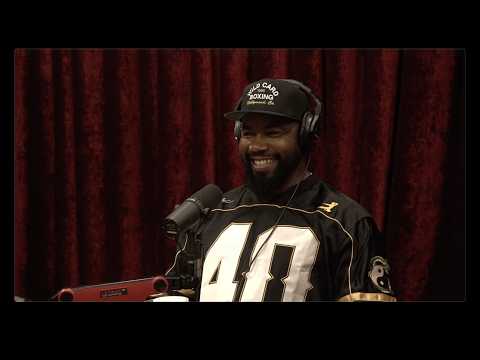
Joe Rogan Experience #2456 - Michael Jai White
Joe Rogan (host), Michael Jai White (guest)
In this episode of The Joe Rogan Experience, featuring Joe Rogan and Michael Jai White, Joe Rogan Experience #2456 - Michael Jai White explores michael Jai White on discipline, martial arts truth, and artistry’s edge The conversation ranges from early-life survival instincts and formative martial arts experiences to how pressure-testing and cross-training create real skill versus fantasy-based confidence.
Michael Jai White on discipline, martial arts truth, and artistry’s edge
The conversation ranges from early-life survival instincts and formative martial arts experiences to how pressure-testing and cross-training create real skill versus fantasy-based confidence.
White details how training with elite fighters and coaches (boxing, grappling, Kyokushin, Muay Thai, tactical shooting) shaped his analytical approach: efficiency, non-telegraphing, and humility through being “wrong.”
They discuss fighter identity, the mental cost of combat sports, and how losses, struggle, and rites of passage build character—contrasting this with “everybody gets a trophy” culture.
On the film side, White argues for more believable fight choreography and explains how studio interference and misplaced priorities (effects over story) can dilute movies like Spawn, while praising standout performances and craft in films like Collateral.
Key Takeaways
Instincts are built (and sharpened) by hard environments.
White’s story of fleeing his apartment before the 1994 quake becomes a springboard for how growing up without safety nets forces pattern recognition—spotting danger, reading “predators,” and leaving before chaos starts.
Get the full analysis with uListen AI
The most effective strikes are often the least visible.
Both emphasize that non-telegraphed technique beats raw power; White describes exploiting micro-indications (reverse motion/flex) that many fighters unknowingly broadcast when they “load up.”
Get the full analysis with uListen AI
Pressure-testing is the filter for what’s real.
White’s rule is simple: if a technique works even when the opponent knows it’s coming, it’s legitimate—otherwise it’s performance, not fighting.
Get the full analysis with uListen AI
Cross-training isn’t optional if you want mastery.
They cite dance, yoga, ballet, wushu, and Ukrainian dance (Lomachenko) as “body mastery” tools—improving balance, mobility, timing, breathing, and footwork even if the movements aren’t directly “fight applicable.”
Get the full analysis with uListen AI
Grappling exposes truth and dissolves hierarchy.
Rogan contrasts controlled striking sparring with jiu-jitsu’s daily, honest rolling—where skill can’t be faked and tapping equates to a real-world loss condition.
Get the full analysis with uListen AI
Humiliation is a feature, not a bug, of improvement.
White says he ‘brags’ about being humbled because that’s where learning happens; he frames being wrong as an advantage because it forces skill updates instead of ego defense.
Get the full analysis with uListen AI
Identity is the hidden trap that keeps fighters in danger.
Discussing Rogan advising Brendan Schaub to retire, they underline how hard it is to abandon “fighter” identity—even when health, long-term cognition, and better opportunities are on the table.
Get the full analysis with uListen AI
Believable action requires logic, imperfections, and stakes.
White argues modern audiences (raised on UFC) can spot choreography-for-choreography’s sake; he aims to choreograph mistakes and realistic decision-making, closer to Bruce Lee’s ‘skill advantage’ presentation than superhero spectacle.
Get the full analysis with uListen AI
Notable Quotes
“If I could develop a tool or a skill, and you can’t stop it even if I tell you what I’m doing—then it’s a really good technique.”
— Michael Jai White
“My philosophy is I love to be wrong, ’cause every time I’m wrong, I learn something.”
— Michael Jai White
“There’s no hiding your skill [in jiu-jitsu].”
— Joe Rogan
“Losing is the best medicine.”
— Joe Rogan
“I got angry at the audience. I fucking hated them… you’re cheering for me… like I’m a pit bull or something.”
— Michael Jai White
Questions Answered in This Episode
White describes a “non-telegraph” ‘cheat code’—what are 2–3 concrete drills to remove the common pre-movements (reverse flex/load) in punches and kicks?
The conversation ranges from early-life survival instincts and formative martial arts experiences to how pressure-testing and cross-training create real skill versus fantasy-based confidence.
Get the full analysis with uListen AI
You mentioned ‘pressure-testing’ as the standard for legitimacy. What’s an example of a popular technique you rejected after testing, and what replaced it?
White details how training with elite fighters and coaches (boxing, grappling, Kyokushin, Muay Thai, tactical shooting) shaped his analytical approach: efficiency, non-telegraphing, and humility through being “wrong.”
Get the full analysis with uListen AI
When choreographing ‘mistakes’ to make fight scenes real, what specific errors (foot placement, over-commitment, fatigue choices) do you intentionally build into scenes?
They discuss fighter identity, the mental cost of combat sports, and how losses, struggle, and rites of passage build character—contrasting this with “everybody gets a trophy” culture.
Get the full analysis with uListen AI
On Spawn, you said effects were added in ways that hurt story clarity. What scenes or story beats were lost that would’ve made audiences care more about the character’s motivation?
On the film side, White argues for more believable fight choreography and explains how studio interference and misplaced priorities (effects over story) can dilute movies like Spawn, while praising standout performances and craft in films like Collateral.
Get the full analysis with uListen AI
You called jiu-jitsu a tradition karate ‘lost’ due to commercialization. What would a modern karate school have to change to regain that credibility?
Get the full analysis with uListen AI
Transcript Preview
Joe Rogan Podcast, check it out!
The Joe Rogan Experience.
Train by day, Joe Rogan Podcast by night, all day. [upbeat music] Dude, you're all suited up. You got a Wild Card Boxing hat on-
[laughing]
... a Bruce Lee shirt. Come on, son! [laughing]
Hey, we got the, the, the yellow and, uh, thing going on.
Yeah, you got it all going on.
Yeah.
What's happening? Great to see you.
Man, things are really well.
That's good.
This thing is a little loud.
Is it? There's a, on that thing there, there's a little volume-
Okay
... knob. You can turn that sucker down.
There it is.
Last time I saw you was at Terry Black's Barbecue.
Yeah, yeah.
Random run-in.
That, yeah, that was crazy.
That was crazy.
That was crazy. Yeah, man, I was thinking about going there right after this. I'm like, "What? Terry Black's?"
That place rules.
That place was no joke.
That place rules.
Yeah.
Yeah.
Man, I got-
Are you still in LA?
Yeah, yeah, yeah.
What's it like?
It's cool, man, you know?
Is it?
Yeah.
You like it? You're the only person that said that. [laughing]
[laughing] No, no. Yeah, well, 'cause, uh... Okay, I, I defend LA in a way where, first of all, if you got a handful of good people with you, you know-
Yeah
... and your fam- then it's, then it-
Sure
... it is... So the fact that LA has all kinds of different things. You could be on a hiking trail in 20 minutes, you could be-
Oh, geographically-
Yeah
... it's amazing.
Yeah, and the l- and the weather, you can't-
Oh, you can't beat it
... you can't really beat it. But so if you got good people, good friends with you-
Yeah
... then, then it's all good.
You just run by crooks. [laughing]
[laughing]
It's a nice neighborhood run by the mob. [laughing]
[laughing]
It's run by the woke mob.
Yeah.
But, I mean, geographically, you can't beat it. You could be at the ocean, and then you could-
Yeah
... be in the mountains in two hours.
Yeah, yeah.
Yeah.
Yeah, so, you know, that's, that's... Even if you don't partake, it's still cool.
Yeah.
It still amps up the, uh, the, the ante, really.
Oh, yeah.
Yeah.
Like, the spot itself is magical.
Yeah.
It is a magical place to live. Although, I am deeply concerned that that motherfucker's gonna get hit with a big one soon.
Mm.
Um-
It's about time, right?
Yeah.
Yeah.
I was, I was reading this article about massive earthquakes in California-
Mm
... and how often they're spread out.
Mm-hmm.
And the possibility of one of them happening within the next decade, it's very high.
Yeah, yeah. And, you know, I try not to think about that. [laughing]
Yeah. I try not to think about it, too, but-
Yeah, yeah, but, um, you know, and, and now there's... You know, you can... I think they have b- better detection of that stuff now, too.
Install uListen to search the full transcript and get AI-powered insights
Get Full TranscriptGet more from every podcast
AI summaries, searchable transcripts, and fact-checking. Free forever.
Add to Chrome