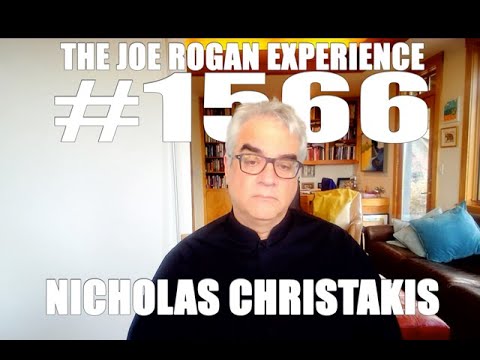
Joe Rogan Experience #1566 - Nicholas Christakis
Nicholas Christakis (guest), Joe Rogan (host), Narrator
In this episode of The Joe Rogan Experience, featuring Nicholas Christakis and Joe Rogan, Joe Rogan Experience #1566 - Nicholas Christakis explores pandemics, Policy, and Personal Health: Nicholas Christakis on COVID-19 Joe Rogan and Yale physician–scientist Nicholas Christakis discuss COVID-19’s real risks, how governments and institutions have mishandled preparation and messaging, and what evidence actually says about masks, vaccines, and immunity.
Pandemics, Policy, and Personal Health: Nicholas Christakis on COVID-19
Joe Rogan and Yale physician–scientist Nicholas Christakis discuss COVID-19’s real risks, how governments and institutions have mishandled preparation and messaging, and what evidence actually says about masks, vaccines, and immunity.
Christakis explains why the U.S. squandered the early warning window, outlines how multi-layered interventions (“Swiss cheese model”) can reduce deaths without full economic shutdowns, and details how mRNA vaccines work and what we still don’t know about them.
They explore underemphasized strategies such as improving metabolic health and immune resilience, and confront the trade-offs between saving lives from the virus versus the economic and social costs of restrictions.
Christakis forecasts the likely multi-year trajectory of the pandemic, the long-term social and economic aftershocks, and why he expects a “Roaring 2020s” period of social exuberance once the crisis fully recedes.
Key Takeaways
Early, honest leadership and preparation could have significantly reduced U.S. deaths.
Christakis argues that by late January 2020 it was obvious to experts that a serious global pandemic was coming; time that could have been used for ramping up testing, PPE, ventilators, and public education was instead largely wasted.
Get the full analysis with uListen AI
Masks are an efficient, low-cost way to keep more of the economy open.
Using the droplet vs aerosol analogy and the ‘fire hose’ metaphor, Christakis explains that even cloth masks substantially cut transmission, especially source control, making them a simple trade-off to avoid more disruptive measures like school and business closures.
Get the full analysis with uListen AI
COVID-19 risk is real but highly uneven across age and health status.
He places the infection fatality rate roughly between 0. ...
Get the full analysis with uListen AI
Vaccines greatly enhance, rather than replace, the body’s natural defenses.
Christakis explains that mRNA vaccines effectively ‘train’ the immune system by simulating infection without causing disease, reducing an already low death risk (e. ...
Get the full analysis with uListen AI
Vaccine rollout involves hard ethical and logistical choices.
He highlights dilemmas about who should be vaccinated first—frontline workers, the elderly, or highly connected working-age adults—and notes practical constraints like ultra-cold storage that favor urban over rural areas initially.
Get the full analysis with uListen AI
Lifestyle and metabolic health are crucial yet underused defenses.
Both men criticize the near-total absence of official messaging about weight loss, exercise, sleep, and vitamin D, despite strong evidence that these factors meaningfully influence COVID outcomes and overall immune competence.
Get the full analysis with uListen AI
The pandemic will reshape society for years, but it will end.
Christakis projects a timeline where epidemiological control (via infection plus vaccination) arrives around 2022, followed by a prolonged recovery of psychological, economic, and social systems, potentially culminating in a ‘Roaring 2020s’ surge of social and economic activity.
Get the full analysis with uListen AI
Notable Quotes
“There’s no life without risk in a time of deadly contagion.”
— Nicholas Christakis
“Wearing masks is like driving the speed limit or not driving on the opposite side of the road.”
— Nicholas Christakis
“We are not at the beginning of the end of this pandemic. We are just at the end of the beginning.”
— Nicholas Christakis
“We want our cake and eat it too… we all wish we didn’t have to endure this unpleasant reality that this virus is now afflicting us.”
— Nicholas Christakis
“This is our time in the crucible, and I would hope for better for us.”
— Nicholas Christakis
Questions Answered in This Episode
Given what we now know, what concrete public health messages should have been prioritized in early 2020 that might have changed the trajectory of the pandemic?
Joe Rogan and Yale physician–scientist Nicholas Christakis discuss COVID-19’s real risks, how governments and institutions have mishandled preparation and messaging, and what evidence actually says about masks, vaccines, and immunity.
Get the full analysis with uListen AI
How should societies ethically balance the lives lost to COVID-19 against those lost indirectly through economic damage, poverty, and mental health crises?
Christakis explains why the U. ...
Get the full analysis with uListen AI
If vaccine supply and logistics remain constrained, is it more effective to prioritize the most vulnerable individuals or the most socially connected people, and why?
They explore underemphasized strategies such as improving metabolic health and immune resilience, and confront the trade-offs between saving lives from the virus versus the economic and social costs of restrictions.
Get the full analysis with uListen AI
What realistic, evidence-based steps can individuals take today to improve metabolic health and immune resilience in case they are exposed to COVID-19 or future pathogens?
Christakis forecasts the likely multi-year trajectory of the pandemic, the long-term social and economic aftershocks, and why he expects a “Roaring 2020s” period of social exuberance once the crisis fully recedes.
Get the full analysis with uListen AI
Which societal changes triggered by the pandemic—such as remote work, telemedicine, or urban-to-rural migration—are likely to persist, and how might they reshape inequality and opportunity over the next decade?
Get the full analysis with uListen AI
Transcript Preview
(instrumental music plays) Joe Rogan podcast, check it out. The Joe Rogan Experience.
Train by day, Joe Rogan podcast by night. All day. (instrumental music plays) Yeah, I got into cigars lately. I did sober October and, uh, during the month of October, uh, no drinking at all and I started smoking cigars.
How did the sober October work for you?
It's great. Do it every year. It's nice. A little reset.
It's interesting, you know.
Very nice.
I mean, uh, I have another friend of mine who stopped drinking all together, uh, and, uh, he, he said that it was making him cranky when he was drinking and of course there were extra calories. And, uh, I listened patiently to him and thought, "I would love to do that," but at the same time, it's hard to give up completely, so.
I enjoy a glass of wine with a meal. That, that I miss the most. That, that was the worst when I was, uh, you know, having a steak and just like, "God, I'd like a nice glass of red wine right now."
Yeah.
But other than that, I don't drink much. I'm not much b- much of a boozer. Although when November kicks in and I know I can drink again, there's usually a few days of excess.
(laughs)
Which is, uh, speaking of the subject of, uh, COVID-19 and the current pandemic we're into, that's not a good thing. Um, there's a lot of people out there destroying their immune systems drinking. There's a very funny video that I found online of this gentleman who runs around his neighborhood and, uh, he noticed that during the lockdown, he would run around his neighborhood and he would see the recyclable bins and they were just filled with empty alcohol containers. He's like, "This is crazy. This w- this is for the weak. Like how much are these people drinking? Just vodka and wine and..." There's a lot of that going on.
Yeah, people have actually looked a little bit at that, at alcohol consumption, and it's a little bit like the toilet paper shortage. I, I don't know if you followed the whole toilet paper-
Yeah.
... shortage thing. Well, what's happening is there's a shift in consumption. You know, a lot of the drinking that was taking place in restaurants and, uh, you know, at, uh, at, uh, bars is now taking place at home. So I think it's like half and half. Like half the consumption in the past was at home and half was out of the home, and now it's almost all at home which is part of it. But I also think as you're suggesting, the actual amount is going up too, so, so yes, it's, um, you know, and it's contributing to weight gain and other problems in our society.
The toilet paper thing, there's an easy fix for this folks that's way better, and I hate to do this to plug a sponsor but it's a good sponsor. There's a sponsor called Tushy and Tushy makes a bidet attachment that just fits onto a regular toilet and it cleans your butt.
Install uListen to search the full transcript and get AI-powered insights
Get Full TranscriptGet more from every podcast
AI summaries, searchable transcripts, and fact-checking. Free forever.
Add to Chrome