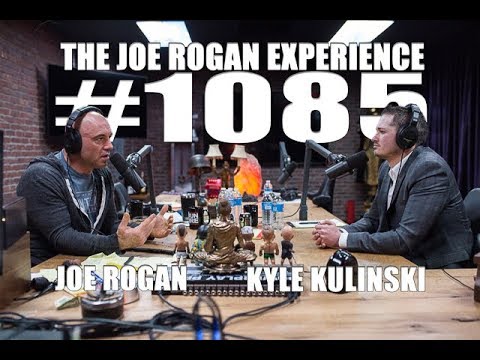
Joe Rogan Experience #1085 - Kyle Kulinski
Joe Rogan (host), Kyle Kulinski (guest), Narrator, Narrator, Narrator, Narrator, Narrator, Narrator
In this episode of The Joe Rogan Experience, featuring Joe Rogan and Kyle Kulinski, Joe Rogan Experience #1085 - Kyle Kulinski explores joe Rogan and Kyle Kulinski Tackle Politics, Culture, and Free Speech Joe Rogan and political commentator Kyle Kulinski have a wide‑ranging, three‑hour conversation that moves from fashion and cultural change to campus activism, free speech, and the ideological split within the left.
Joe Rogan and Kyle Kulinski Tackle Politics, Culture, and Free Speech
Joe Rogan and political commentator Kyle Kulinski have a wide‑ranging, three‑hour conversation that moves from fashion and cultural change to campus activism, free speech, and the ideological split within the left.
They critique identity politics, authoritarian campus behavior, and media sensationalism—especially around Trump and Russia—while arguing for a focus on concrete economic policies like living wages, healthcare, and ending wars.
The discussion also dives into criminal justice and prisons, the opioid crisis and kratom, the war on drugs, and the corrupting influence of corporate money in politics.
Throughout, they contrast highly produced, performative media formats with the authenticity and freedom of long‑form podcasts, using that lens to examine how public debate and political narratives are shaped.
Key Takeaways
Separate authoritarian from libertarian strands on the left.
Kulinski argues that shutting down speakers and deplatforming is an ‘authoritarian left’ impulse that alienates people and drives them rightward, whereas most leftists favor open debate but want to win on economic and social policy.
Get the full analysis with uListen AI
Focus on popular material issues, not symbolic identity fights.
They emphasize that left‑wing priorities like a living wage, Medicare for All, legal marijuana, and ending wars have majority support, and Democrats would be stronger if they centered these instead of leading with identity‑based messaging.
Get the full analysis with uListen AI
Free speech and open dialogue are more effective than censorship.
Both insist that trying to silence figures like Ben Shapiro or Steven Crowder is counterproductive, makes them look persecuted and correct, and that the proper response is better arguments and more speech, not bans.
Get the full analysis with uListen AI
The criminal justice system is structurally flawed and overly punitive.
They highlight wrongful convictions, unreliable eyewitness testimony, harsh sentencing, profit motives in prisons, and contrast U. ...
Get the full analysis with uListen AI
The drug war and opioid policy are driven by profit, not public health.
They point out that non‑toxic substances like marijuana and kratom are criminalized or targeted while pharmaceutical opioids that cause widespread addiction are heavily marketed, reflecting regulatory capture and corporate influence.
Get the full analysis with uListen AI
Trump’s populist rhetoric masked a standard pro‑corporate agenda.
Kulinski notes that Trump campaigned as an anti‑NAFTA, anti‑war populist, but in office passed a deeply unpopular corporate tax cut and stocked his administration with Goldman Sachs figures, showing rhetoric diverging from policy.
Get the full analysis with uListen AI
Corporate money in politics blocks broadly popular reforms.
They argue that both parties are structurally beholden to corporate donors and PACs, which explains why policies like higher minimum wage, healthcare expansion, and marijuana legalization lag far behind public opinion.
Get the full analysis with uListen AI
Notable Quotes
“Debates are like the WWE of intellectual pursuits.”
— Kyle Kulinski
“If you're on the left, put the identity politics aside and talk about the things we already have a majority of Americans with us on.”
— Kyle Kulinski
“It makes it look like you don't have an argument when you say, 'I can't let that guy talk.'”
— Joe Rogan
“A fake populist will always beat a status quo politician.”
— Kyle Kulinski
“You want the real chemtrail? They're burning gasoline in the sky above your head every day.”
— Joe Rogan
Questions Answered in This Episode
How convincing is the argument that censorship and deplatforming on campus actually strengthen right‑wing figures rather than weakening them?
Joe Rogan and political commentator Kyle Kulinski have a wide‑ranging, three‑hour conversation that moves from fashion and cultural change to campus activism, free speech, and the ideological split within the left.
Get the full analysis with uListen AI
If Democrats centered wages, healthcare, and anti‑war policies instead of identity messaging, how might that change electoral outcomes and partisan coalitions?
They critique identity politics, authoritarian campus behavior, and media sensationalism—especially around Trump and Russia—while arguing for a focus on concrete economic policies like living wages, healthcare, and ending wars.
Get the full analysis with uListen AI
What reforms to the justice system would most effectively reduce wrongful convictions and over‑incarceration without compromising public safety?
The discussion also dives into criminal justice and prisons, the opioid crisis and kratom, the war on drugs, and the corrupting influence of corporate money in politics.
Get the full analysis with uListen AI
To what extent is the opioid crisis a regulatory failure versus an inevitable outcome of a profit‑driven healthcare system?
Throughout, they contrast highly produced, performative media formats with the authenticity and freedom of long‑form podcasts, using that lens to examine how public debate and political narratives are shaped.
Get the full analysis with uListen AI
Is it realistic—or desirable—to try to remove corporate money from politics in the current system, and what concrete steps could move in that direction?
Get the full analysis with uListen AI
Transcript Preview
Boom, and we're live. Hello, Kyle.
Hello, Joe Rogan. (laughs)
How you doing? You look very good there in a suit.
Thank you. Uh, you know, I like to pretend that I'm a serious human being by wearing this, but I'm just a dick. (laughs)
Well, you're a youngish fellow, so maybe a suit would give you more of an air of, uh, uh, uh, com- composure or-
Yeah.
... authority, perhaps.
That's the idea. If you look like you're really serious, then people assume you're serious-
Yeah.
... and they don't know that I'm, you know, making dick jokes and-
Exactly.
... all the shit like that. (laughs)
It's a good move.
Yeah.
It's a very smart move.
Yeah, it works out.
I've actually, uh, had some suits made. I had to do this function for one of my kids' schools, and I had to go to this function where you had to wear nice clothes. It's like a dress up thing. And I don't really have nice clothes, nothing that, like, fits, and so I had to have something made. So now I've been wearing it when I go on special dates with Mrs. Rogan. Put it on.
So it's like... It's a suit like this? It's a-
I got a nice suit jacket and tailored, the whole deal. It fits me.
And how do you feel when you put it on? Do you feel like-
I feel like, um-
... "Oh, I'm official now"? (laughs)
... I'm a serious person. I feel like a serious person.
Yeah.
Like, if I, if I dress like this with, like, a hoodie and a T-shirt, I feel like a, a shlub. I feel like a, a dork.
There's this-
Like I am.
There's this thing that I do where, uh, especially when I'm doing my show, oftentimes you do that half-ass move where I look like this.
Mm-hmm. But you have, uh, shorts on underneath?
But then I might have basketball shorts on-
(laughs)
... or I might have sweatpants.
Do you do that?
It's just... Sometimes, yeah, sure.
(laughs)
Sure. It all depends on what mood I'm in. I mean, sometimes-
(laughs)
... I'll, I'll do the whole thing and look nice, but usually I'm just being lazy and-
Well, Guy Ritchie-
... like a professional.
... was on the podcast, and he made a very good, um, statement in defense of the suit. It was a, it was a, a really interesting sort of testimony in defense of the suit and the pocket square. He's a big believer of the pocket square, which I think is preposterous.
Yeah, it's a little too far. (laughs)
I think it's too far. I, I'm with you.
But it, it doesn't go out of style, that's the thing-
Install uListen to search the full transcript and get AI-powered insights
Get Full TranscriptGet more from every podcast
AI summaries, searchable transcripts, and fact-checking. Free forever.
Add to Chrome