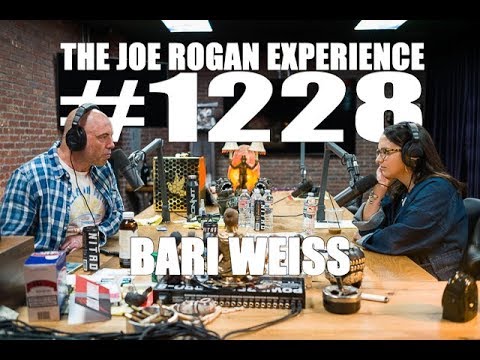
Joe Rogan Experience #1228 - Bari Weiss
Joe Rogan (host), Bari Weiss (guest), Jamie Vernon (guest), Narrator, Narrator
In this episode of The Joe Rogan Experience, featuring Joe Rogan and Bari Weiss, Joe Rogan Experience #1228 - Bari Weiss explores outrage Culture, Identity Politics, and Israel: Bari Weiss Unpacks Nuance Joe Rogan and Bari Weiss use the Covington Catholic viral video as a starting point to examine outrage culture, social media mobbing, and how quickly institutions and journalists can abandon nuance for moral grandstanding.
Outrage Culture, Identity Politics, and Israel: Bari Weiss Unpacks Nuance
Joe Rogan and Bari Weiss use the Covington Catholic viral video as a starting point to examine outrage culture, social media mobbing, and how quickly institutions and journalists can abandon nuance for moral grandstanding.
They criticize the left’s increasing comfort with dehumanization and casual calls for violence (“punch Nazis”), as well as the sloppy use of labels like “alt-right” and “white supremacy,” arguing this hollows language and radicalizes both sides.
Weiss outlines her concerns about antisemitism on both the far right and the progressive left, focusing in detail on the Women’s March leadership, Louis Farrakhan, and the way Israel is uniquely demonized in activist circles.
The conversation ranges into free speech and deplatforming (Alex Jones, InfoWars), conspiracy thinking, gun control, identity politics, and what it would take to rebuild trust, civility, and a shared civic culture in the U.S.
Key Takeaways
Slow down before joining viral outrage; context often reverses the story.
The Covington video shows how a short clip became a Rorschach test: most of the press and public leapt to a moral narrative without watching the full footage, missing the role of other groups and the actual sequence of events.
Get the full analysis with uListen AI
Treat individuals as individuals, not symbols of entire groups.
Weiss argues that turning a 16‑year‑old into ‘the face of white patriarchy’ erases his personhood and mirrors the same essentialist thinking progressives condemn in others.
Get the full analysis with uListen AI
Stop hollowing out serious terms like ‘Nazi,’ ‘alt-right,’ and ‘white supremacy.’
Calling centrist or mildly heterodox figures ‘alt-right’ dilutes language needed for real extremists, and drives disillusioned moderates toward the right out of fear of an intolerant left.
Get the full analysis with uListen AI
Casual calls for violence online normalize real-world harm.
Phrases like ‘punch Nazis’ or labeling a teen as having a ‘punchable face’ may feel like signaling to your tribe, but they lower the barrier to actual violence and ignore how little control you have once that norm is set.
Get the full analysis with uListen AI
Antisemitism today often hides behind anti-Israel rhetoric and intersectional blind spots.
Weiss details how figures like Women’s March leaders and some progressive politicians use classic antisemitic tropes about Israel and Jews, while many on the left minimize antisemitism because Jews are seen as ‘privileged’ or ‘white.’
Get the full analysis with uListen AI
Free speech dilemmas are getting harder as platforms behave like utilities.
Rogan and Weiss wrestle with whether deplatforming Alex Jones is responsible defense against harmful lies (like Sandy Hook denial) or a dangerous precedent that can creep toward banning unpopular but non-violent views.
Get the full analysis with uListen AI
Identity politics can either expand empathy or harden tribal walls.
Drawing on Jonathan Haidt and Martin Luther King Jr. ...
Get the full analysis with uListen AI
Notable Quotes
“Your initial reaction to something is not the truth. It’s your emotional reaction.”
— Bari Weiss
“If I’m alt-right, what words do we have left for people who actually are that?”
— Bari Weiss
“You can’t just say, ‘Go punch people.’ Once you normalize that, you don’t control who gets punched.”
— Joe Rogan
“Any progressive movement that’s asking you to check your Jewish identity at the door is not a space I want to be a part of.”
— Bari Weiss
“We have to treat ourselves like we’re all a family and we’re all on a big team, because that’s what we really are.”
— Joe Rogan
Questions Answered in This Episode
How can journalists and consumers practically guard against ‘Twitter as assigning editor’ and avoid repeating the Covington mistake?
Joe Rogan and Bari Weiss use the Covington Catholic viral video as a starting point to examine outrage culture, social media mobbing, and how quickly institutions and journalists can abandon nuance for moral grandstanding.
Get the full analysis with uListen AI
Where should platforms draw the line between hosting harmful misinformation (e.g., Sandy Hook denial) and protecting robust free speech?
They criticize the left’s increasing comfort with dehumanization and casual calls for violence (“punch Nazis”), as well as the sloppy use of labels like “alt-right” and “white supremacy,” arguing this hollows language and radicalizes both sides.
Get the full analysis with uListen AI
How do we distinguish legitimate criticism of Israel from rhetoric that crosses into antisemitism, especially in activist spaces?
Weiss outlines her concerns about antisemitism on both the far right and the progressive left, focusing in detail on the Women’s March leadership, Louis Farrakhan, and the way Israel is uniquely demonized in activist circles.
Get the full analysis with uListen AI
What are concrete ways individuals can push back against dehumanizing language and doxxing within their own political tribe?
The conversation ranges into free speech and deplatforming (Alex Jones, InfoWars), conspiracy thinking, gun control, identity politics, and what it would take to rebuild trust, civility, and a shared civic culture in the U.S.
Get the full analysis with uListen AI
Can the U.S. realistically move away from punitive identity politics toward a shared ‘big tent’ civic identity, and what would that require from leaders on both left and right?
Get the full analysis with uListen AI
Transcript Preview
Four, three, two, one. (hand slaps) Hello, Bari.
Hi, Joe.
And now we're live. Thanks for doing this. Appreciate it.
Thanks for having me.
It's, uh, very fortuitous. Your timing comes right in the middle of this big hubbub about, um, this, uh, Native American elder and this young boy with one of those stupid fucking red hats on.
Yep.
That... Y- y- would you have ever imagined that a slogan like "Make America Great Again" would be so divisive? That somehow or another, like, that-
(laughs)
That would be... Like, "Make America Great Again." Well sounds like they just wanna make things great, like-
No.
... all positive. (laughs)
No.
You know?
No.
And a red hat with white letters. Has there ever been a time like that where a- a- an object, like a red hat with white letters, was so repulsive to half the country?
Yes. Well, I mean, some people see it as the equivalent of a white hood.
Wow. I don't know about that. I think that's-
They do. No.
I- I- I believe they do.
They do. They believe-
I believe they do, but I think they're being ridiculous.
... that wearing it at... Wearing it... That a 16-year-old wearing that hat-
Mm-hmm.
... sort of carries intense moral weight. That surely we know that a 16-year-old is not aware of all of the implications of wearing that hat.
Well yeah, but the problem with that is Kanye wears it.
Right. Fair enough.
So, it doesn't really work.
I agree. I'm just saying-
You know?
... there are people who really make that argument.
I get it. I know they do.
And people who are paid for their opinions. (laughs)
Well, yeah. Well, there's also people that are calling for this child's name and address. They're calling to dox him and publicly expose him. This is a child. He's 16? Is that what he is?
He's 16 years old. And, uh, e- it... One of the things that was just so amazing about the whole brouhaha around it... I mean, it was in a way like this perfect encapsulation of our outrage culture, right? Because people saw a tiny clip of this video.
Yes.
And it was like a Rorschach test.
Yeah.
You saw in it this morality play of, what- what it looked to be was a group of mostly white kids from Coventry Catholic School, I think it's in Kentucky. And it looked like, at first glance, that they were smirking and smug and had these sort of shit-eating grins on their faces and that they were surrounding this older Native American man. And I have to tell you, I had a visceral reaction to it the second I saw it, like so many other people.
Install uListen to search the full transcript and get AI-powered insights
Get Full TranscriptGet more from every podcast
AI summaries, searchable transcripts, and fact-checking. Free forever.
Add to Chrome