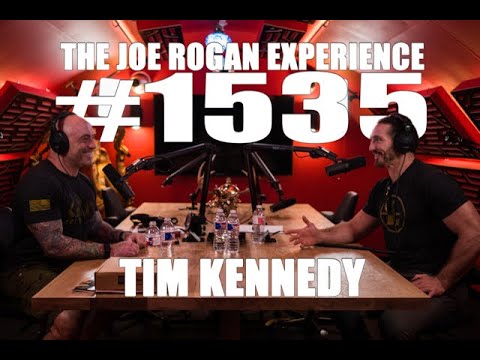
Joe Rogan Experience #1535 - Tim Kennedy
Narrator, Narrator, Joe Rogan (host), Tim Kennedy (guest), Narrator, Narrator
In this episode of The Joe Rogan Experience, featuring Narrator and Narrator, Joe Rogan Experience #1535 - Tim Kennedy explores tim Kennedy and Joe Rogan dissect outrage culture, insurgency, and freedom Joe Rogan and Tim Kennedy move from culture-war symbols (Hawaiian shirts, the OK sign) into a broader conversation about cancel culture, free speech, and how misinformation hardens ideological echo chambers.
Tim Kennedy and Joe Rogan dissect outrage culture, insurgency, and freedom
Joe Rogan and Tim Kennedy move from culture-war symbols (Hawaiian shirts, the OK sign) into a broader conversation about cancel culture, free speech, and how misinformation hardens ideological echo chambers.
Kennedy draws on his Special Forces background to explain insurgency and counterinsurgency, arguing that U.S. presence and funding abroad have quietly prevented new 9/11‑scale attacks while enabling fragile democracies to grow.
They criticize deplatforming, defund‑the‑police rhetoric, and local COVID lockdown policies, insisting that training, stronger institutions, and individual responsibility are better answers than blanket prohibitions.
The episode closes on concerns about foreign interference in the 2020 election, media bias, and the weakness of current political leadership, alongside a shared belief that physical fitness, discipline, and local action are the best antidotes to societal decay.
Key Takeaways
Symbols can be hijacked, but you don’t have to surrender them.
Kennedy and Rogan argue that letting extremists or online mobs redefine benign symbols (Hawaiian shirts, OK hand sign) effectively cedes cultural ground; they intentionally keep using them to resist that creep.
Get the full analysis with uListen AI
Comedy is a pressure valve for taboo issues and should remain risky.
They insist that offensive or edgy jokes, when crafted carefully, allow people to process trauma and controversy; over‑policing humor neuters honest conversation and makes discourse “lukewarm.”
Get the full analysis with uListen AI
Defunding police is counterproductive; better training is the real lever.
Kennedy likens policing to special operations: more training, stress inoculation, and scenario work expose biases and incompetence so bad officers can be weeded out, while defunding removes the very resources needed to improve.
Get the full analysis with uListen AI
Insurgencies are cheap; counterinsurgencies are expensive but necessary.
Drawing on deployments in Africa and the Middle East, Kennedy explains that extremists exploit poverty and ignorance with minimal resources, while preventing another 9/11 requires sustained, costly training and support missions abroad.
Get the full analysis with uListen AI
Foreign adversaries don’t care who wins; they want America divided.
They contend that Russia, China, and Iran support both extremes online, organizing and amplifying conflict not to elect a specific candidate but to delegitimize U. ...
Get the full analysis with uListen AI
Lockdowns and deplatforming create echo chambers that radicalize people.
Months of isolation combined with curated news and social feeds intensify untested beliefs; instead of silencing bad ideas, they argue for more open debate so bad arguments publicly collapse under scrutiny.
Get the full analysis with uListen AI
Individual discipline—fitness, training, and purpose—counters nihilism.
Kennedy describes transforming aimless or fearful people through hard physical training, self‑defense, and skill‑building, arguing that incremental effort (1% better daily) restores agency and makes people less vulnerable to extremist narratives.
Get the full analysis with uListen AI
Notable Quotes
“I think comedy is the best way to address socially sensitive issues.”
— Tim Kennedy
“The best way to combat things you disagree with is to say how you feel, not to say that person shouldn’t be able to say that.”
— Joe Rogan
“An insurgency is cheap. A counterinsurgency is expensive—and that’s what we’re doing all over the planet so another 9/11 doesn’t happen.”
— Tim Kennedy
“When you say deplatforming people, you don’t think you’re taking away freedom, but you are. You’re taking away a little bit of freedom.”
— Tim Kennedy
“All the things you want are on the far side of hard work.”
— Tim Kennedy
Questions Answered in This Episode
How do we balance resisting cancel culture over reclaimed symbols with genuinely confronting extremist groups that use those symbols?
Joe Rogan and Tim Kennedy move from culture-war symbols (Hawaiian shirts, the OK sign) into a broader conversation about cancel culture, free speech, and how misinformation hardens ideological echo chambers.
Get the full analysis with uListen AI
If defunding police is misguided, what concrete national standards or training reforms could realistically be implemented and funded?
Kennedy draws on his Special Forces background to explain insurgency and counterinsurgency, arguing that U. ...
Get the full analysis with uListen AI
Where is the line between legitimate counterinsurgency abroad and “policing the world,” and who should decide when that line is crossed?
They criticize deplatforming, defund‑the‑police rhetoric, and local COVID lockdown policies, insisting that training, stronger institutions, and individual responsibility are better answers than blanket prohibitions.
Get the full analysis with uListen AI
Given the scale of foreign information warfare, what would a trustworthy, less manipulable information ecosystem actually look like in practice?
The episode closes on concerns about foreign interference in the 2020 election, media bias, and the weakness of current political leadership, alongside a shared belief that physical fitness, discipline, and local action are the best antidotes to societal decay.
Get the full analysis with uListen AI
How can individuals realistically move from online outrage to meaningful local action that addresses the grievances driving protests and unrest?
Get the full analysis with uListen AI
Transcript Preview
(drumming) Joe Rogan podcast, check it out.
The Joe Rogan Experience.
Train by day, Joe Rogan podcast by night, all day. (rock music plays) What's going on?
(laughs)
(laughs) Well, I c- I c- I've, of course, come bearing gifts to two new Texans, so that's, that's a separate thing. Um, but I, I did... I was at the range working, and I was wearing a Hawaiian shirt. It wasn't even a Hawaiian shirt. I had bought it in Czech Republic and, uh... But it looked like a Hawaiian shirt. And in the comments section, I was in body armor, I had my gun, I was literally working, everybody was like, "Oh, my gosh, you're wearing a Hawaiian shirt. Oh, you're part of this super extremist, like, white supremist group." And I was like-
What?
... "I'm wearing a Hawaiian shirt."
(laughs)
I... And they start, like, freaking out, like, cancel culture. And I was like, "I bought that... It doesn't matter where I bought it, but now... Because you're telling me I'm not supposed to wear it." Because I guess Hawaiian shirts are w- for a... Uniform for white supremacists now.
Oh, God. Please google this. This is a new thing.
Yeah. (sighs)
What?
Yep.
Hawaiian shirts are white supremacists?
Yeah. Can't do it. So, of course, the first thing I did was, like, buy every Hawaiian shirt (fingers snap) I can possibly find, just because I'm not supposed to, you know?
I... Who the fuck is saying this? I need to see this. That is the dumbest thing I've ever heard. How can a Hawaiian shirt be white supremacist? It's-
I don't think there's any logic ever attached to any of these things.
No.
But, um, like, the Boog- I think, like, the Boogaloo Bros-
Yeah, so that's what the Wall Street Journal says, why the extremist Boogaloo Boys wear Hawaiian shirts.
Pl- Please put that up on the screen.
(laughs)
I need to see this fucking nonsense. What? Oh, my God, this is real. "Why the extremist Boogaloo Boys wear Hawaiian-"
I'm not joking. That, the f-
Oh, my God. "Aloha shirts have become a disconcerting signature for members of a gun-toting, anti-government..." What does it say? You made it a little too big.
"I work for the government," so...
Faction.
Does, does that cancel this?
Oh, my God. "In the past couple weeks, following the killing of George Floyd, curiously dressed counter-protestors have attended scattered demonstrations across the US armed and disconcertingly garbed in Magnum PI-style floral Hawaiian shirts." Magnum PI is pretty fucking American.
He... Yeah, it's pretty epic. Three things here. They're really comfortable.
Yeah.
Floral- floral's a great pattern, and they're very breathable, and you can... And on the range, I, I like to do the top button thing and pop a collar so you don't get hot brass down your neck.
Install uListen to search the full transcript and get AI-powered insights
Get Full TranscriptGet more from every podcast
AI summaries, searchable transcripts, and fact-checking. Free forever.
Add to Chrome