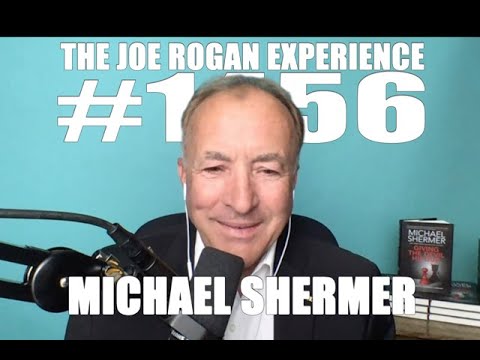
Joe Rogan Experience #1456 - Michael Shermer
Joe Rogan (host), Michael Shermer (guest)
In this episode of The Joe Rogan Experience, featuring Joe Rogan and Michael Shermer, Joe Rogan Experience #1456 - Michael Shermer explores michael Shermer, Free Speech, and COVID: Weighing Risk, Reason, Liberty Joe Rogan and skeptic Michael Shermer discuss how COVID-19 is reshaping daily life, from remote work and education to long-term public health, economics, and personal fitness. They examine policy trade‑offs between saving lives and saving the economy, comparing U.S. responses with South Korea and Germany, and touching on treatments, mortality data, and conspiracy theories about the virus and 5G. Shermer then pivots to themes from his book *Giving the Devil His Due*, arguing for robust free speech, engagement with ideological opponents, and skepticism toward both government overreach and cancel culture. The conversation ranges into moral progress, polarization, race and gay rights, guns, and how exposure and dialogue—rather than censorship or violence—change minds over time.
Michael Shermer, Free Speech, and COVID: Weighing Risk, Reason, Liberty
Joe Rogan and skeptic Michael Shermer discuss how COVID-19 is reshaping daily life, from remote work and education to long-term public health, economics, and personal fitness. They examine policy trade‑offs between saving lives and saving the economy, comparing U.S. responses with South Korea and Germany, and touching on treatments, mortality data, and conspiracy theories about the virus and 5G. Shermer then pivots to themes from his book *Giving the Devil His Due*, arguing for robust free speech, engagement with ideological opponents, and skepticism toward both government overreach and cancel culture. The conversation ranges into moral progress, polarization, race and gay rights, guns, and how exposure and dialogue—rather than censorship or violence—change minds over time.
Key Takeaways
COVID-19 will permanently alter social norms and accelerate digital adoption.
Shermer expects lasting changes in behaviors like handshakes and in-person meetings, with remote work and education proving more viable than previously assumed, which will reshape sectors like theaters, restaurants, and universities.
Get the full analysis with uListen AI
Policy must balance viral risk against economic and social collapse.
They argue that while early ‘no price on a life’ lockdowns were understandable, societies must soon confront explicit trade‑offs—triage strategies, targeted protection of high‑risk groups, and consideration of downstream harms like supply‑chain failure and unrest.
Get the full analysis with uListen AI
Individual health habits meaningfully affect vulnerability to disease.
Shermer and Rogan stress daily exercise, better nutrition, and weight control as crucial for immune resilience, especially given COVID’s disproportionate impact on people with obesity, diabetes, and poor baseline health.
Get the full analysis with uListen AI
Uncertainty in infection data makes early fatality rates highly misleading.
Because many infections are asymptomatic or went undetected early (possibly as far back as late 2019 in the U. ...
Get the full analysis with uListen AI
Free speech protection is most vital for ideas we dislike or find dangerous.
Drawing on John Stuart Mill, Shermer argues that even Holocaust denial, quack cures, and extremist views should be legal (though criticized) because censorship powers inevitably expand, backfire, and can later be used against reformers and minorities.
Get the full analysis with uListen AI
Online outrage and cancel culture create a chilling effect on honest discussion.
From campus ‘microaggressions’ lists to demonization of figures like Jordan Peterson, Shermer contends that social sanctions and misrepresentation discourage people—students especially—from expressing dissenting views, weakening collective reasoning.
Get the full analysis with uListen AI
Real attitude change comes from contact, empathy, and exposure, not violence.
They highlight examples like Daryl Davis converting KKK members, the impact of novels like *Uncle Tom’s Cabin*, and research on knowing gay people reducing homophobia, contrasting this with simplistic slogans like “punch Nazis,” which risk mission creep and escalation.
Get the full analysis with uListen AI
Notable Quotes
“At some point we're gonna have to do an economic calculation: how many people are going to die if we never open the economy?”
— Michael Shermer
“If you silence people, what happens when you take up a contrary position? You’ve just given up your opportunity to be heard.”
— Michael Shermer
“People identify with their ideas. If their ideas fall apart, somehow or another they're falling apart.”
— Joe Rogan
“Conservatives are more liberal now than liberals were in the 1950s.”
— Michael Shermer
“Real progress is bottom‑up—oppressed people saying, ‘Stop that, don’t do that,’ and the rest of us slowly changing how we talk and act.”
— Michael Shermer
Questions Answered in This Episode
How should governments formally weigh lives saved from lockdowns against lives harmed by economic collapse, and who should make that decision?
Joe Rogan and skeptic Michael Shermer discuss how COVID-19 is reshaping daily life, from remote work and education to long-term public health, economics, and personal fitness. ...
Get the full analysis with uListen AI
Where should democratic societies draw the line between harmful misinformation and protected speech, especially during a public health crisis?
Get the full analysis with uListen AI
What concrete practices could schools and media adopt to reduce polarization and encourage genuine engagement with opposing viewpoints?
Get the full analysis with uListen AI
To what extent can individual lifestyle changes (diet, exercise, metabolic health) realistically shift population‑level outcomes in future pandemics?
Get the full analysis with uListen AI
How do we preserve civil liberties when deploying powerful tools like digital contact tracing and NSA‑style surveillance in emergencies?
Get the full analysis with uListen AI
Transcript Preview
Okay, here we go. Three, two, one, boom, and we're live. Mr. Shermer, how are you, sir?
I'm fine, thank you. I'm, I'm still breathing. (laughs)
It's good to see you again.
Likewise.
We were just saying before we got started that the last time we saw each other was we went to dinner about six weeks ago.
Uh-huh.
And you're thinking that that might be the end of that kind of stuff.
(laughs) That was my last time I've been in a restaurant, actually. And, uh... Well, I, you know, I think restaurants, of course, will reopen, but I think the kind of social distancing we're seeing now, it's not gonna go all the way back to, to the way it used to be. I think, uh, we may quit shaking hands and hugging to the extent that we used to, although I don't think we'll ever, ever go all the way to the, say, the Japanese model of social distancing. But I think there'll be modifications like that. The other thing I've been thinking about is the change of remote, say, meetings and education. Uh, I mean, I'm in the studio here in Santa Barbara, where I've been recording lectures for my Chapman University class, Skepticism 101. And, uh, I just upload them and share them with the students, and, and then they watch them, and then I send them a quiz. They take the quiz. They send them back. Now, that's not a, a complete, uh, replacement of a brick and mortar building with a small class seminar discussion, say. But, but it does, you know, uh, adequately replace a lot of traditional education that you don't really need to be in a classroom for.
Do you think that this is preparing us for the ultimate, where we, we, we embrace the symbiotic relationship that we have with computers and become one with the machine? I mean, it seems like we're becoming-
The Borg. (laughs)
Yeah, we're becoming closer and closer to some sort of a, uh, an electronic community. It's weird.
Yeah, I think it was, I think it was happening slowly already, and this is kind of a jump starting it. I mean, already tech companies like Zoom are having to, you know, ramp up their game because, you know, the systems are crashing because pretty much everybody's doing Zoom meetings now.
Yeah.
And then they have to, and they have to adjust to Zoombombing because, of course, there's, you know, people like that out there that just wanna screw with you. And, uh, so I... Uh, and, and then I was also thinking about, um, things like theaters, you know. To what... Why do we need to go to theaters anymore? I mean, I love watching a movie on a big screen, but, you know, the, the screens we have at home now, big television screens, super high def, um, you know, why not just watch movies at home? <|agent|><|en|>
Install uListen to search the full transcript and get AI-powered insights
Get Full TranscriptGet more from every podcast
AI summaries, searchable transcripts, and fact-checking. Free forever.
Add to Chrome