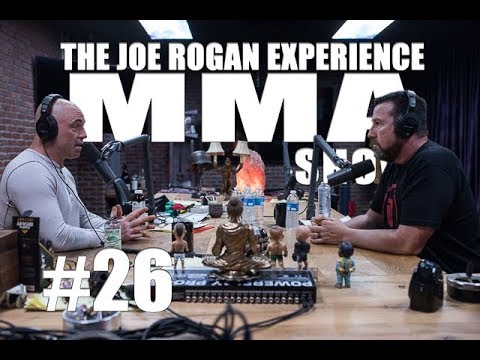
JRE MMA Show #26 with Big John McCarthy
Joe Rogan (host), Big John McCarthy (guest), Narrator
In this episode of The Joe Rogan Experience, featuring Joe Rogan and Big John McCarthy, JRE MMA Show #26 with Big John McCarthy explores big John McCarthy Rewrites MMA History, Rules, and Future Directions Joe Rogan and Big John McCarthy walk through the real, often-misunderstood history of the UFC and modern MMA—who actually created it, how the rules emerged, and why some remain illogical today.
Big John McCarthy Rewrites MMA History, Rules, and Future Directions
Joe Rogan and Big John McCarthy walk through the real, often-misunderstood history of the UFC and modern MMA—who actually created it, how the rules emerged, and why some remain illogical today.
McCarthy details his role in forming the unified rules, including the infamous 12–6 elbow ban and spiking rules, and explains how commissions, doctors, and legal fears still block sensible reform.
They dive deeply into jiu-jitsu lineage and evolution, praising figures like Rickson Gracie, Jean Jacques Machado, Eddie Bravo, John Danaher, and today’s leg-lock revolution, while contrasting “basic” vs. complex games.
The conversation also covers fighter safety, catastrophic weight cuts, corners’ responsibilities, neck and back injuries, new weight classes, and the structural differences between UFC and Bellator in a still-evolving sport.
Key Takeaways
Historical narratives around who ‘created’ the UFC are often wrong or self-serving.
McCarthy emphasizes that Art Davie conceived the original ‘War of the Worlds’ tournament concept, while figures like Campbell McLaren and Rorion Gracie contributed key pieces (pay-per-view access, Gracie validation) but later overstated their roles.
Get the full analysis with uListen AI
Many controversial rules, like the 12–6 elbow ban, are based on fear and optics, not data.
The 12–6 elbow was outlawed largely because a doctor referenced karate demo brick-breaking, not because of empirical evidence—Auburn University is now studying elbow impact to challenge that assumption.
Get the full analysis with uListen AI
Corners must prioritize long-term brain and career health over short-term heroics.
McCarthy criticizes Raquel Pennington’s corner for sending her back out after she said “I’m done,” arguing that once a fighter mentally checks out, additional rounds usually only add damage, not meaningful opportunity.
Get the full analysis with uListen AI
Weight-class structure and cutting practices are a major unresolved safety problem.
He supports adding 165, 175, 195, and 225 divisions to reduce extreme cuts and massive size disparities (e. ...
Get the full analysis with uListen AI
“Basic” jiu-jitsu, done with precision, still dominates at the highest level.
They highlight Rickson Gracie, Roger Gracie, Demian Maia, and Kron Gracie as examples of fighters who use fundamental techniques (armbars, chokes, pressure) with such precision and timing that they neutralize more elaborate modern systems.
Get the full analysis with uListen AI
Leg-lock and positional systems (the Danaher influence) are forcing a new learning curve in MMA.
Athletes like Gordon Ryan, Craig Jones, Neiman Gracie, and Dillon Danis show that modern leg entanglement systems can overwhelm traditional grapplers—and MMA fighters who don’t adapt will increasingly be exposed.
Get the full analysis with uListen AI
The sport’s structure (cages, gloves, allowed strikes) is as much about perception and liability as realism.
McCarthy argues that gloves mostly protect hands, not brains; knees to the head on the ground and 12–6 elbows likely won’t be legalized because doctors and commissions fear lawsuits, even if they’re no more dangerous than existing legal techniques.
Get the full analysis with uListen AI
Notable Quotes
““If you’re the co-creator, how come you never owned one bit of it?””
— Big John McCarthy (on Campbell McLaren’s ‘co-creator’ claim)
““I wrote ‘mixed martial arts referee’ on my LAPD work permit in ’93–’94.””
— Big John McCarthy (on early use of the term ‘mixed martial arts’)
““Once a fighter tells you, ‘I’m done,’ it’s gone.””
— Big John McCarthy (on Raquel Pennington’s corner sending her back out)
““That glove is not there to protect my head. It is there to protect his hand.””
— Big John McCarthy (on why MMA gloves don’t reduce brain trauma)
““We start at zero. When we go to one, we’re not going back to zero. We’re going to two and then to three and then to checkmate.””
— Rickson Gracie (as quoted by Joe Rogan, on positional progression in jiu-jitsu)
Questions Answered in This Episode
If Auburn’s elbow study proves 12–6 elbows aren’t uniquely dangerous, will any major commission have the courage to officially change that rule?
Joe Rogan and Big John McCarthy walk through the real, often-misunderstood history of the UFC and modern MMA—who actually created it, how the rules emerged, and why some remain illogical today.
Get the full analysis with uListen AI
How would adding 165, 175, 195, and 225-pound divisions practically change matchmaking, careers, and fighter health in major promotions?
McCarthy details his role in forming the unified rules, including the infamous 12–6 elbow ban and spiking rules, and explains how commissions, doctors, and legal fears still block sensible reform.
Get the full analysis with uListen AI
At what point should corners and commissions intervene against a fighter’s long-term detriment, even when that fighter insists on continuing?
They dive deeply into jiu-jitsu lineage and evolution, praising figures like Rickson Gracie, Jean Jacques Machado, Eddie Bravo, John Danaher, and today’s leg-lock revolution, while contrasting “basic” vs. ...
Get the full analysis with uListen AI
Could a unified, globally accepted kickboxing/Muay Thai rule set—and smarter presentation—ever make high-level striking sports mainstream in North America?
The conversation also covers fighter safety, catastrophic weight cuts, corners’ responsibilities, neck and back injuries, new weight classes, and the structural differences between UFC and Bellator in a still-evolving sport.
Get the full analysis with uListen AI
What would modern MMA look like if gloves were optional and knees to the head of a grounded opponent were legal from day one?
Get the full analysis with uListen AI
Transcript Preview
(knocking) Five, four, three, two, one. Boom, and we're live with the OG of OGs.
(laughs)
If there's more of an OG MMA character than you, uh, I don't know who the fuck they would be.
Uh-
Who's more ... Who's m- ... Hoist Gracie and you.
Hoist Gracie.
That's about as OG as it gets.
(laughs)
Right?
You w- You know what that means?
What does that mean?
You're both fucking old.
We're all old.
(laughs)
Yeah, we're old.
Dude.
I was watching the ... There was a ... The other day was the 20th anniversary of Dan Henderson's first UFC appearance.
Oh my god.
And there's me interviewing him afterwards. I'm like, "Who's that fucking little kid-"
Uh-huh.
"... interviewing Dan Henn- ... Just, who is Dan Henderson-"
I remember.
"... pretending to be Dan Henderson?"
UFC 12.
Yeah. Dothan, Alabama.
You ... Well, you got ch- ... You got transferred.
Yeah.
(laughs)
Well, we were supposed to go up to Buffalo and then they-
Niagara, go down to Dothan.
Yeah. They canceled it out of New York. New York said, "Get out of here," and we had to take a puddle jumper plane. Remember all that jazz?
Oh, dude, I remember it very well.
Those early days?
I was in court. (sighs) Goddam, I knew I was in trouble.
Yeah, you were one of the r- ... I mean, you, you're one of the people that I cite all the time for why that stupid reason that y- ... The 12 to 6 elbow. You're the one who just explained it to me.
(laughs)
'Cause I couldn't believe-
(laughs)
... that what you're telling me was true, that the reason 12 to 6 elbows were illegal ... Well, just tell the story.
(sighs) The truth of the story is ... Back ... There's so many stories about rules and how they came about.
Right.
And, you know, there's guys claiming things and it's like, "Really?" Okay. You know, look at ... I have paperwork that shows how the wor- ... How things came out, and at what time it was. And I still have my computers that I have things written on that we, we went over stuff, but-
You have computers from the '90s?
Dude, I still have ... No, I've got floppy disks.
No, you don't.
Swear to God.
You do?
Unbelievable, isn't it?
What do you do with it? (laughs)
Not a damn thing. (laughs)
(laughs) How much can a floppy disk hold? Not even like a megabyte, right?
Nothing. Nothing. There being ... It ho-
Wow.
It holds a couple of pages of a document.
But do you remember when the floppy disk went away, everybody panicked?
Install uListen to search the full transcript and get AI-powered insights
Get Full TranscriptGet more from every podcast
AI summaries, searchable transcripts, and fact-checking. Free forever.
Add to Chrome