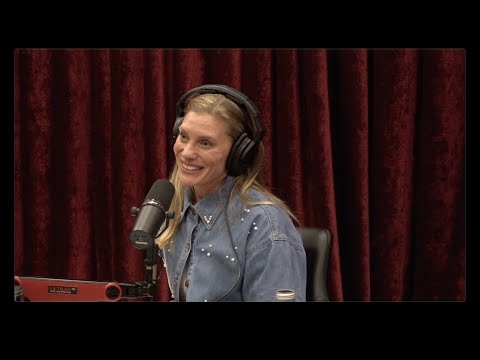
Joe Rogan Experience #2400 - Katee Sackhoff
Narrator, Narrator, Joe Rogan (host), Katee Sackhoff (guest), Narrator, Narrator, Narrator, Narrator
In this episode of The Joe Rogan Experience, featuring Narrator and Narrator, Joe Rogan Experience #2400 - Katee Sackhoff explores katee Sackhoff on sci‑fi legacy, AI fears, parenting and purpose Joe Rogan and Katee Sackhoff trace her career pivot from stereotypical “blonde” roles to redefining Starbuck in Battlestar Galactica, and how that show legitimized serious, topical sci‑fi on television. They dive deep into the emotional power of entertainment as “brain medicine,” live performance, and why sci‑fi has historically been such fertile ground for strong female characters. A large portion of the conversation centers on AI—its creative potential, its threats to artists, its psychological impact on kids, and the broader existential risks of a “digital god.” They also explore children’s mental health, pediatric cancer underfunding, homelessness, social media’s damage to young girls, and how to live meaningfully in a short, fragile life.
Katee Sackhoff on sci‑fi legacy, AI fears, parenting and purpose
Joe Rogan and Katee Sackhoff trace her career pivot from stereotypical “blonde” roles to redefining Starbuck in Battlestar Galactica, and how that show legitimized serious, topical sci‑fi on television. They dive deep into the emotional power of entertainment as “brain medicine,” live performance, and why sci‑fi has historically been such fertile ground for strong female characters. A large portion of the conversation centers on AI—its creative potential, its threats to artists, its psychological impact on kids, and the broader existential risks of a “digital god.” They also explore children’s mental health, pediatric cancer underfunding, homelessness, social media’s damage to young girls, and how to live meaningfully in a short, fragile life.
Key Takeaways
Reframing your career early can completely change how an industry sees you.
Sackhoff deliberately chased Starbuck at 21 to escape one‑dimensional ‘please die’ blonde roles; taking a risky, counter‑type part (even inheriting a male legacy character) reset her trajectory and proved to gatekeepers she could lead serious, complex stories.
Get the full analysis with uListen AI
Sci‑fi can smuggle real‑world issues past cultural defenses.
Battlestar Galactica used its futuristic setting to tackle war, politics, religion, and ethics in ways that might have been censored or dismissed in contemporary dramas, showing how genre storytelling can deeply resonate with soldiers, civilians, and marginalized audiences alike.
Get the full analysis with uListen AI
AI will be an unstoppable creative force—so humans must pivot to what only humans can do.
They acknowledge AI music and visuals are already impressive and will accelerate, but argue the irreplaceable value lies in live, embodied experiences—concerts, theater, stand‑up, handmade crafts—where shared human presence and imperfection matter more than technical perfection.
Get the full analysis with uListen AI
AI poses serious ethical and psychological risks, especially for kids and aspiring artists.
From flawless AI actors like ‘Tilly’ to hyper‑curated beauty standards, Sackhoff worries about unattainable benchmarks crushing young girls’ self‑worth and pushing creatives out of work, especially when AI is trained on unconsented human labor and likenesses.
Get the full analysis with uListen AI
Children’s health and mental wellbeing are systematically underprotected and underfunded.
Sackhoff describes how only about 4% of the U. ...
Get the full analysis with uListen AI
Social media has measurably worsened teen mental health, especially for girls.
Drawing on Jonathan Haidt’s research and personal parenting stories, they connect filters, body modification culture, and curated highlight reels to spikes in self‑harm, depression, and suicidal ideation, and discuss intentional strategies like when and how to tell a child she’s “pretty” without tying it to performance.
Get the full analysis with uListen AI
Systemic problems like homelessness and broken healthcare require multi‑pronged, humane solutions, not optics.
They slam superficial responses like camp ‘sweeps’ and massive, unaccountable spending; instead they argue for addiction treatment (e. ...
Get the full analysis with uListen AI
Notable Quotes
“Art is really important… it transports people. It makes them feel something. Whether it makes you feel whatever it makes you feel, it's incredibly important.”
— Katee Sackhoff
“Escape is not nonsense. It's actually like brain medicine.”
— Joe Rogan
“This is a life form that's emerging and it's very different than anything that's ever happened before… It's going to make a digital god.”
— Joe Rogan (on AI)
“What are we gonna do when our children are seeing something that is absolutely unattainable and better than them—and it made you obsolete?”
— Katee Sackhoff (on AI‑generated ‘perfect’ actors)
“I didn't realize how many things can kill you until I spent time in children's hospitals… It amazes me that we made it to this age.”
— Katee Sackhoff
Questions Answered in This Episode
How should the entertainment industry fairly compensate and credit human artists whose work is used to train AI models that then compete with them?
Joe Rogan and Katee Sackhoff trace her career pivot from stereotypical “blonde” roles to redefining Starbuck in Battlestar Galactica, and how that show legitimized serious, topical sci‑fi on television. ...
Get the full analysis with uListen AI
What practical boundaries, if any, should parents set around AI‑generated content, filters, and social media use for young children?
Get the full analysis with uListen AI
If live, in‑person art and performance become the main refuge from AI content, how can we make those experiences accessible beyond wealthy audiences?
Get the full analysis with uListen AI
Given Sackhoff’s account of the Give Kids a Chance Act being cut, how can voters realistically pressure legislators to protect targeted programs for children inside massive omnibus bills?
Get the full analysis with uListen AI
Are current narratives about AI as an inevitable ‘digital god’ helpful for motivating good policy and innovation, or do they risk paralyzing people and excusing inaction?
Get the full analysis with uListen AI
Transcript Preview
(drum music) Joe Rogan podcast, check it out.
The Joe Rogan Experience.
Train by day, Joe Rogan podcast by night, all day. (rock music) Especially in Hollywood, right? You always have a little bounce, this guy standing there with the big reflective thing.
You always need someone, like, wandering around-
Yeah.
... in front of you, especially when you get to a certain age. You're like, "Can we just put Vaseline on the camera?" (laughs) At certain points.
Oh, like a filter?
Yeah, exactly.
Yeah. My wife actually likes it when her lens on her camera phone is, like, blurry.
A little dirty?
She's like, "Gives you, like, a little filter." Like...
Yeah. I'm sure they offer that filter.
Yeah. Sure.
Slightly dirty lens. (laughs)
Yeah. Smudgy lens.
(laughs)
Yeah. So, uh, really nice to meet you.
It's nice to meet you.
You were a part of, I think, the most underappreciated sci-fi show ever.
I think at the time, absolutely. Yeah.
I mean, even now, I don't think people talk about it enough. It was a fucking great show.
Yeah.
And I was so skeptical about Battlestar Galactica 'cause when I was a kid, I watched the original series. And then there was a new one coming out, and I was like, "Oh, come on." And then somebody told me. I forget, one of my friends, one of my comedian friends. Like, "Dude, you gotta watch this show. It's fucking great. Like, it't not what you expect." Like, you'd think it'd be like the old Battlestar Galactica, which is kinda sorta corny a little bit.
Mm-hmm.
But it was a really fucking good show.
When did you watch it? When it was on or after?
Yeah. No, when it was on.
Okay, so originally.
Yeah.
Yeah. It was, um... God, like, when I first got the script, it was like 2001. And I was a 21-year-old kid. And at that point, I'd been playing, like, stereotypical blond roles. You know, I was in a movie where you were like, "Please die." (laughs)
(laughs)
You know, like, I was that girl, you know. Um, and so I knew that if I could, could change my career, I needed to change it. And I saw this script, and it was-
That's hilarious that you're thinking, "I need to change my career," at 21.
At 21. I was like-
That's how crazy the hourglass is in Hollywood.
Uh-huh. I was like, this is... I got, I got seven years left. (laughs)
Right. (laughs) It's so crazy.
And then it's like... (laughs)
That's just a fucking sketchy job.
I know. (laughs) And so I was like, "What am I gonna do," right? And I saw this script, and Ron Moore had put a, uh, a, like a, an entry page on the front of the, the miniseries. It was like a bible that he called it. And it was him saying what he wanted to create and what he wanted it to look like and what his intention was behind the show. And that one page was so moving that it could've been... I- I don't, it didn't even matter what it was on the inside. I was like, "If this guy is in charge, it's gonna be amazing."
Install uListen to search the full transcript and get AI-powered insights
Get Full TranscriptGet more from every podcast
AI summaries, searchable transcripts, and fact-checking. Free forever.
Add to Chrome