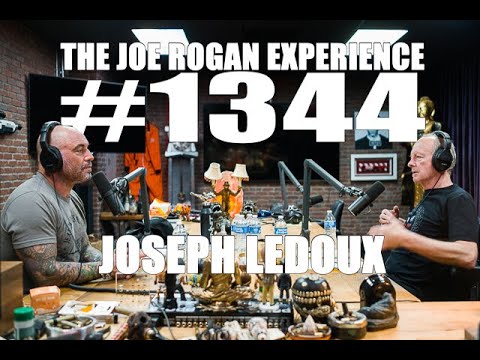
Joe Rogan Experience #1344 - Joseph LeDoux
Joe Rogan (host), Joseph LeDoux (guest), Jamie Vernon (host)
In this episode of The Joe Rogan Experience, featuring Joe Rogan and Joseph LeDoux, Joe Rogan Experience #1344 - Joseph LeDoux explores neuroscientist Joe LeDoux Rethinks Fear, Consciousness, and Human Survival Neuroscientist Joseph LeDoux joins Joe Rogan to trace how consciousness and defensive behavior evolved from single-celled organisms to modern humans over four billion years. He argues that much of what we call emotion—especially fear—is actually rooted in non-conscious survival circuits like the amygdala, while the feeling of fear arises in higher cortical systems tied to self-awareness. The conversation explores anxiety, medications like Xanax, therapy, meditation, creativity, tribal politics, and climate change through the lens of brain function and evolutionary history. LeDoux suggests that understanding the separation between bodily survival responses and conscious experience is essential for better treating anxiety and for navigating the dangers created by our uniquely self-reflective minds.
Neuroscientist Joe LeDoux Rethinks Fear, Consciousness, and Human Survival
Neuroscientist Joseph LeDoux joins Joe Rogan to trace how consciousness and defensive behavior evolved from single-celled organisms to modern humans over four billion years. He argues that much of what we call emotion—especially fear—is actually rooted in non-conscious survival circuits like the amygdala, while the feeling of fear arises in higher cortical systems tied to self-awareness. The conversation explores anxiety, medications like Xanax, therapy, meditation, creativity, tribal politics, and climate change through the lens of brain function and evolutionary history. LeDoux suggests that understanding the separation between bodily survival responses and conscious experience is essential for better treating anxiety and for navigating the dangers created by our uniquely self-reflective minds.
Key Takeaways
Separate survival circuits from conscious feelings of fear.
The amygdala detects and responds to danger (freezing, heart rate, sweating) without generating the subjective feeling of fear; the feeling arises when these bodily states are represented in higher cortical systems tied to the self. ...
Get the full analysis with uListen AI
Recognize that much behavior is non-conscious, and we post-rationalize it.
Split-brain studies show one hemisphere can initiate actions while the other, unaware of the real cause, invents a plausible story to explain them. ...
Get the full analysis with uListen AI
Understand that current anti-anxiety drugs often blunt arousal rather than remove fear.
Benzodiazepines (like Xanax) enhance GABA inhibition across the brain, globally turning down neural activity rather than specifically targeting ‘fear circuits’. ...
Get the full analysis with uListen AI
Use a multi-layered approach to treating phobias and anxiety.
LeDoux proposes a three-step strategy: first reduce non-conscious threat responses (e. ...
Get the full analysis with uListen AI
Leverage lifestyle tools like exercise, meditation, and nature to modulate anxiety.
Intense regular exercise dramatically reduces Rogan’s anxiety and internal chatter, and LeDoux acknowledges meditation as a direct, in-the-moment way to calm restlessness. ...
Get the full analysis with uListen AI
See anxiety as a byproduct of advanced self-aware cognition.
Building on Endel Tulving and Kierkegaard, LeDoux views anxiety as tied to ‘mental time travel’—our ability to envision ourselves in past and future scenarios and worry about choices and outcomes. ...
Get the full analysis with uListen AI
Question folk emotion concepts and animal ‘fear’ attributions.
LeDoux cautions that behaviors that look like fear (in humans or animals) are survival tools, not direct readouts of subjective experience. ...
Get the full analysis with uListen AI
Notable Quotes
“No self, no fear.”
— Joseph LeDoux
“Behavior is not primarily a tool of the mind; it's a tool of survival.”
— Joseph LeDoux
“The amygdala is not about fear. It's about detecting and responding to danger.”
— Joseph LeDoux
“Our kind of consciousness is our greatest achievement, but also probably our worst aspect.”
— Joseph LeDoux
“We think we know why we do the things we do, but our conscious mind is not privy to all of the things the body and brain are doing.”
— Joseph LeDoux
Questions Answered in This Episode
If the amygdala isn’t a ‘fear center,’ how should clinicians and the public rethink decades of fear-based brain models and treatments?
Neuroscientist Joseph LeDoux joins Joe Rogan to trace how consciousness and defensive behavior evolved from single-celled organisms to modern humans over four billion years. ...
Get the full analysis with uListen AI
How might therapy, medication development, and self-help practices change if we clearly separated non-conscious survival responses from conscious emotional experience?
Get the full analysis with uListen AI
What ethical and practical implications arise from the idea that other animals’ emotions are scientifically unknowable, even if they appear behaviorally similar to ours?
Get the full analysis with uListen AI
Given that our advanced, self-aware consciousness both enables creativity and fuels anxiety and tribalism, how can societies cultivate its benefits while minimizing its destructive tendencies?
Get the full analysis with uListen AI
Could a deeper public understanding of how narratives and non-conscious processes shape behavior reduce blame, stigma, and political polarization in issues like addiction, climate denial, or extremist beliefs?
Get the full analysis with uListen AI
Transcript Preview
Here we go. Joe, thank you. Thank you for being here. I really appreciate it, man.
Oh, it's a pleasure to be here.
This is a fascinating subject. I've been really looking forward to talking to you 'cause, uh, the conscious mind and how we, how we evolved our conscious mind, how we have our conscious mind. I mean, that is, uh, one of the more unique things about being a person.
It is.
How did it happen?
Oh. (laughs)
(laughs)
Well, it's only a four-billion-year story, as the subtitle-
Oh, we have some time. (laughs)
... of the book says. (laughs) Good. (laughs) So, shall I tell you how I got-
Sure.
... into it and, uh, where, where, how I ended up thinking about that problem? So I'd been working on how the brain detects and responds to danger for most of my scientific career. Uh, a little bit before that, I'd actually studied consciousness in these people who have their brains split apart to control epilepsy, called split-brain patients. So I got interested in consciousness and also in how behaviors that might be produced non-consciously, uh, affect what we know about ourselves. So, uh, we see ourselves doing something, and then we kind of consciously build that into our narrative of what we are. But a lot of what we do, we do non-consciously. And when we interpret it, that kind of, uh, solidifies the fact that you have a non-conscious system that's controlling your behavior, when in fact you, you didn't do it, but that system did, so you gotta make sense of it and generate an explanation, a narrative. So that, uh, that was where I got started, and I tried to figure out, well, what would be some ki- kinds of non-conscious systems and said, "Well, maybe emotion systems are producing behaviors that we don't fully understand." And I started studying that and ended up, uh, figuring out how this part of the brain called the amygdala receives information about the environment and then controls, orchestrates all the responses, fight-flight kinds of responses to help you protect yourself. And the, um, you know, s- after many years of doing that, I started asking, "Well, how far back does this ability to detect and respond to danger go?" We know that bugs and flies can do that, and research had been done showing that, uh, bugs and flies have certain molecules in their brain that are important in these kinds of protective defensive behaviors and including the ability to learn about them and store those as memories. So it's easier to work on those little tiny, um, uh, invertebrates than it is to do studies in a complex brain, even like a rat brain, which is pretty complex. Um, so given that what these people had discovered about invertebrates, I and others who were studying, uh, mammals decided to see if the same molecules might be involved in mammalian learning, and in fact it was. So now that raises the question, you've got the same molecules doing the same thing, the same molecules, the same genes doing the same thing in ancient invertebrates and in, uh, and animals like us. So you ask, where back in time is the ancestor that made that possible? You know, if we've got the same genes, either it kinda happened spontaneously separately or there's a common ancestor. And indeed there's a common ancestor, and that goes back to the first organism, first animal that had a bilateral body, which means it had a left, right, front, and a back, uh, and a top and a bottom. So it has kind of three-dimensional sides. Before that, there were animals like jellyfish that were radial, they had, but no front and back. They just have a, a top and a bottom. And before that, there's sponges, which have no front, back, top, bottom. They're just kind of randomly organized. So that's kind of the, that's the story of animals, sponges to jellyfish to these bilateral animals. So the ancestor, uh, the, the, the bilateral animal that we're talking about gave rise to those two lines, one that became all these invertebrates like flies and bugs and snails and octopus and all those things, and another to animals like us, vertebrates, all the, um, fish, reptiles, mammals, birds, and so forth. So those are two separate lines that inherited these genes that make the memory and defensive behavior possible. So you say, "Well, how far back then it, does it stop there?" And no, it doesn't because you can find those genes on through jellyfish and then keep going into single-cell organisms. Now, these are like protozoa, uh, things that give you intestinal, um, their, uh, intestinal parasites so they can, you know, give you upset stomach. And, um, things like amoeba, paramecia that you might have heard of in, you know, biology class in high school or something. Um, these have no nervous system, and yet they detect and respond to danger, they learn about their environment, they do all these sorts of things. And where did they come from? Well, if you go all the way back to where they came from, uh, even simpler kind of organism, s- still single-cell, of course, like bacterial cells. Now these guys go back to the beginning of life. The first cell that ever lived some 3.7 billion years ago that gave rise to the entire history of life was a bacterial-like cell that started dividing. Now what's interesting, that cell that started dividing is the mother of every bacterial cell that ever lived. So that cell is, uh, it's, it's more like its rep- you know, that cell is still alive because it's, they reproduce by cell division. So that stell- cell just keeps reproducing, and part of that first cell ever is still with us today in all the bacterial cells that are, that are around. Uh, it's kind of a mind-blowing thing, isn't it? (laughs)
Install uListen to search the full transcript and get AI-powered insights
Get Full TranscriptGet more from every podcast
AI summaries, searchable transcripts, and fact-checking. Free forever.
Add to Chrome