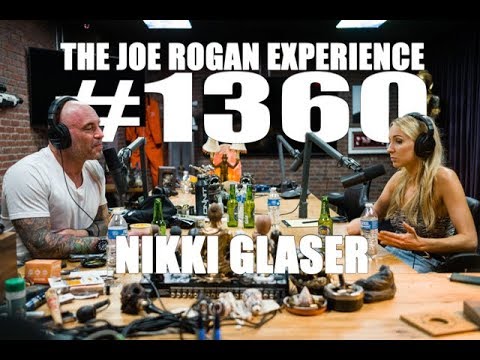
Joe Rogan Experience #1360 - Nikki Glaser
Joe Rogan (host), Nikki Glaser (guest), Narrator, Narrator, Narrator, Narrator, Narrator, Narrator, Narrator, Narrator, Narrator
In this episode of The Joe Rogan Experience, featuring Joe Rogan and Nikki Glaser, Joe Rogan Experience #1360 - Nikki Glaser explores nikki Glaser, sobriety, sex, and sanity on comedy and fame Joe Rogan and Nikki Glaser have a long-form, loose conversation that hops between dogs, veganism, exercise, sobriety, sex, language taboos, fame, and stand-up craft.
Nikki Glaser, sobriety, sex, and sanity on comedy and fame
Joe Rogan and Nikki Glaser have a long-form, loose conversation that hops between dogs, veganism, exercise, sobriety, sex, language taboos, fame, and stand-up craft.
Glaser talks candidly about rescuing animals, being a vegan with limits, quitting alcohol via Allen Carr’s method, and how sobriety and mental health work transformed her career and anxiety.
They debate factory farming, PETA, hunting, male anger and exercise, meditation, and the psychological cost of social media and cancel culture for comics like Louis C.K. and Aziz Ansari.
The episode is also a deep dive into stand-up: writing process, jealousy, imposter syndrome, relationships as a female comic, and how attention, bandwidth, and ego intersect with success.
Key Takeaways
Rescuing and rehabilitating animals is emotionally powerful but ethically messy.
Both describe deeply rewarding experiences with traumatized rescue dogs, while also critiquing shelters that fabricate backstories and highlighting PETA’s controversial practice of quickly euthanizing animals instead of rehoming them.
Get the full analysis with uListen AI
Regular intense exercise is framed as essential for managing male anger and mental agitation.
Rogan argues that many men’s ‘anger demons’ and road rage are misdirected excess energy, and that heavy physical output dramatically lowers reactivity, negative self-talk, and anxiety by satisfying evolutionary movement needs.
Get the full analysis with uListen AI
Sobriety can radically transform a career and mental health when the underlying narrative around addiction is changed.
Glaser credits Allen Carr’s books with helping her quit smoking and drinking by dismantling every justification for use and reframing withdrawal as manageable; she ties her post-2011 career acceleration directly to quitting alcohol.
Get the full analysis with uListen AI
Alcohol loosens inhibitions but reliably lowers judgment and creates dangerous illusions of control.
They emphasize that the real problem with drunk driving or ‘just two drinks’ is not capability but impaired self-assessment; once slightly drunk, the inner voice that promised moderation is also intoxicated and unreliable.
Get the full analysis with uListen AI
Social media and ‘cancel culture’ consume mental bandwidth that could be used more productively.
Rogan describes attention as finite ‘units of bandwidth’; engaging with online criticism, fights, or jealousy drains capacity from meaningful work, so he largely avoids comments and flame wars to protect focus.
Get the full analysis with uListen AI
Jealousy in comedy is inevitable but can be converted into fuel.
Both admit to early-career jealousy of other comics but argue it’s a ‘loser mentality’; seeing others crush on stage should instead be treated as proof of what’s possible and a prompt to work harder, not a reason to tear them down.
Get the full analysis with uListen AI
Being a female comic complicates dating, power dynamics, and public boundaries.
Glaser discusses men being intimidated by her intensity and success, her fear of intimacy and attachment after sex, and frequent boundary violations (e. ...
Get the full analysis with uListen AI
Notable Quotes
“Most men have anger demons. There’s a requirement your body has for the expenditure of energy, and if you don’t meet that requirement, you get agitated.”
— Joe Rogan
“I read this book and then I was done at the end of it. I drank every single night of my life and I never thought I could live without it.”
— Nikki Glaser (on Allen Carr’s ‘Easy Way to Stop Drinking’)
“Wondering why other people are successful is the refuge of losers.”
— Joe Rogan
“When I’m depressed, I get more vegan than ever. If I’m ever going off about vegan propaganda on my Instagram, someone should check in on me.”
— Nikki Glaser
“Your audience is smart people. But let’s be honest, there’s a lot of dummies out there that have a big audience. They’ve tapped into a whole river of fucking idiots.”
— Joe Rogan
Questions Answered in This Episode
How much of what we call ‘anger’ or ‘anxiety’ is actually unresolved physical energy that could be alleviated through movement rather than medication alone?
Joe Rogan and Nikki Glaser have a long-form, loose conversation that hops between dogs, veganism, exercise, sobriety, sex, language taboos, fame, and stand-up craft.
Get the full analysis with uListen AI
Are organizations like PETA justified in prioritizing ‘freedom from suffering’ over individual animal lives, or is their euthanasia policy fundamentally unethical?
Glaser talks candidly about rescuing animals, being a vegan with limits, quitting alcohol via Allen Carr’s method, and how sobriety and mental health work transformed her career and anxiety.
Get the full analysis with uListen AI
To what extent can Allen Carr–style reframing (challenging every belief about a substance) be applied to addictions beyond smoking and alcohol, such as social media or pornography?
They debate factory farming, PETA, hunting, male anger and exercise, meditation, and the psychological cost of social media and cancel culture for comics like Louis C. ...
Get the full analysis with uListen AI
Where should comedians draw their own line between pushing boundaries and causing real harm, especially when jokes about public tragedies are still in the ‘working out’ stage?
The episode is also a deep dive into stand-up: writing process, jealousy, imposter syndrome, relationships as a female comic, and how attention, bandwidth, and ego intersect with success.
Get the full analysis with uListen AI
How can public figures and performers set and enforce physical and emotional boundaries with fans in an era where parasocial relationships feel so real to the audience?
Get the full analysis with uListen AI
Transcript Preview
That's it. We're moving.
(laughs) We're doing it.
We're in mo- we're in motion.
(laughs)
Nikki Glaser, AKA Marshall's new best friend.
Oh, that's so nice to hear.
Yeah, you're definitely his new best friend.
Really?
No, for sure. Didn't you see?
But I feel like he likes everyone.
He does like everyone.
Okay.
But he likes you.
Right now.
For sure he likes you.
Yes.
Did you see, he jumped all over you?
It was so awesome. I love him. I needed it so bad.
He is a rare dog.
He is.
It's weird, right?
It... Instantly, like he looked... I told you when y- he came in, you... I didn't... Hadn't even seen you yet, and he just saw me, and it's like we met acr- our eyes met across the room, and he just like bounded towards me. It felt so good.
He runs to you like you're his best friend.
Yeah, like he's like, "I'm seeing you again."
And he hasn't seen you-
Yes.
... in forever. Oh my God. (laughs)
Like I just got back from war, and he's my child. Licking my fa- Just so excited. Ugh.
Yeah, he starts whimpering, like "Oh."
It was so good.
"I can't believe you're here."
It's so... And he lets you just hug him, and...
Yeah, I've never had a Golden before.
(sighs) I've-
Golden Retriever, they're like the nicest dogs of all time.
I've only had mutts that we've collected from the Humane Society, that didn't... You know, that are abused and damaged.
You can get lucky with them.
Yes.
You can get lucky, but you can also-
And it feels so good-
It does.
... when w- you were talking about your dog didn't want you to touch it for a year.
That was my daughter.
Your oth- Yeah.
My oldest daughter had this little tiny dog. It was, uh, part Chihuahua and part, uh, Australian Sheep... Australian Herd Dog?
Mm-hmm.
Shepherd Dog? I forget what it is, but it was a... It was a litt- m- very much like a Chihuahua, a very small dog. And he was terrified of me for like a year.
Yeah.
Wouldn't let me come anywhere near him. I'm like, "Come on, dude. I'm telling you, I love dogs." And it really wasn't until we got Marshall, and then he saw me with a little tiny puppy. He's like, "Oh, this dude is all right."
Oh.
And then, like, he wanted to play with Marshall, so he got close to me, and then I pet his head. And then next thing you know, he's hopping in my lap. And then, you know, after that, he would just run to me, and like literally jump in my arms.
Install uListen to search the full transcript and get AI-powered insights
Get Full TranscriptGet more from every podcast
AI summaries, searchable transcripts, and fact-checking. Free forever.
Add to Chrome