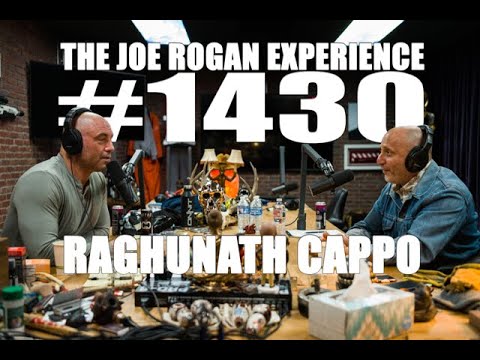
Joe Rogan Experience #1430 - Raghunath Cappo
Joe Rogan (host), Raghunath Cappo (guest), Guest (secondary questioner, likely in-room producer or companion) (guest)
In this episode of The Joe Rogan Experience, featuring Joe Rogan and Raghunath Cappo, Joe Rogan Experience #1430 - Raghunath Cappo explores from Hardcore Punk to Hare Krishna: Jiu-Jitsu, Yoga, and Karma Joe Rogan and Raghunath Cappo (aka “Yoga Ray”) reconnect after years to discuss their shared history in early no‑gi jiu-jitsu, the rise of 10th Planet, and the influence of teachers like Jean Jacques Machado and Renzo Gracie.
From Hardcore Punk to Hare Krishna: Jiu-Jitsu, Yoga, and Karma
Joe Rogan and Raghunath Cappo (aka “Yoga Ray”) reconnect after years to discuss their shared history in early no‑gi jiu-jitsu, the rise of 10th Planet, and the influence of teachers like Jean Jacques Machado and Renzo Gracie.
Raghunath traces his journey from New York hardcore frontman to Hindu monk and yoga teacher, exploring how yoga, chanting, and Vedic philosophy reshaped his views on ego, health, violence, and purpose.
They dig into diet debates, independent thinking, the impact of environment and nature on consciousness, and how practices like jiu-jitsu and yoga change one’s reactions under extreme stress.
The conversation repeatedly returns to themes of karma, ego, and dharma—how our choices, habits, and inner stories shape our experience, and how ancient texts like the Bhagavad Gita can be applied in a modern, practical way.
Key Takeaways
Jiu-jitsu and yoga both train calm under pressure.
Rolling in jiu-jitsu and disciplined yoga practice condition you to stay relaxed and think clearly in high‑stress situations—whether that’s a street altercation, a health scare, or emotional conflict.
Get the full analysis with uListen AI
You are not your thoughts; examine and replace unhelpful mental loops.
Raghunath emphasizes that thoughts are like mantras on repeat, often inherited from family or culture; consciously noticing and swapping self‑loathing or divisive narratives for more constructive or spiritual ones can change behavior and outcomes.
Get the full analysis with uListen AI
Independent thinking requires resisting ideological “uniforms.”
Locking into a fixed identity—political, dietary, religious—can shut down honest inquiry; both men argue for evaluating evidence case‑by‑case and being willing to change your mind without tying your self‑worth to being “right.”
Get the full analysis with uListen AI
Ego subtly infiltrates even spiritual and ethical pursuits.
Whether it’s collecting rare records, curating a bookcase, being “the spiritual one,” or fighting for a cause, the desire to be admired can corrupt motives; regularly checking for ego in your activism, diet, or religion keeps the practice honest.
Get the full analysis with uListen AI
Practices like chanting, fasting, and controlled breathing are behavioral experiments.
Rather than accepting or rejecting ancient methods on belief alone, Raghunath suggests treating them as experiments: apply them, observe effects on mind, body, and reactions, and then decide what to keep.
Get the full analysis with uListen AI
How you respond to hardship creates new karma and future possibilities.
From a Vedic perspective, you can’t always control what happens, but your response—to illness, violence, loss, or success—shapes the next “chapter” of your life and potentially future lives, upgrading or degrading your trajectory.
Get the full analysis with uListen AI
Using your talents as service, not self-glorification, is stabilizing.
Both in comedy and kirtan, shifting the frame from “I want to be adored” to “I’m here to uplift and serve” reduces emptiness after big performances and anchors the work in something deeper than applause.
Get the full analysis with uListen AI
Notable Quotes
“You are not your thoughts. You’re a person, and you accept thoughts and sometimes become attached to them, but it’s not good to do.”
— Joe Rogan (echoing Raghunath’s yoga teaching)
“Where is your happiness coming from? Is it coming from your day-to-day living, or is it just happiness from your ego?”
— Raghunath Cappo (paraphrasing Swami Sivananda and applying it to his own life)
“When you’re on stage, don’t do it to serve God and not be God.”
— Raghunath Cappo (advice from his ashram days that reshaped how he performs and lives)
“The ego is the biggest thing. It’s the hardest, and it’s so refined. It gets wound up in religion, diet, politics, race, animal rights—everything.”
— Raghunath Cappo
“I feel like this show made itself. I’m the person who’s been granted the curator position on this show.”
— Joe Rogan
Questions Answered in This Episode
How can someone with no background in yoga or Hindu philosophy start experimenting with practices like mantra or pranayama in a grounded, non-dogmatic way?
Joe Rogan and Raghunath Cappo (aka “Yoga Ray”) reconnect after years to discuss their shared history in early no‑gi jiu-jitsu, the rise of 10th Planet, and the influence of teachers like Jean Jacques Machado and Renzo Gracie.
Get the full analysis with uListen AI
What are practical methods to notice when your activism, spirituality, or career is being driven more by ego than by genuine service or curiosity?
Raghunath traces his journey from New York hardcore frontman to Hindu monk and yoga teacher, exploring how yoga, chanting, and Vedic philosophy reshaped his views on ego, health, violence, and purpose.
Get the full analysis with uListen AI
If karma and past lives influence our current circumstances, how should we balance accepting what we’re given with fighting strongly against injustice and suffering?
They dig into diet debates, independent thinking, the impact of environment and nature on consciousness, and how practices like jiu-jitsu and yoga change one’s reactions under extreme stress.
Get the full analysis with uListen AI
In a highly urban, technologically mediated world, what are realistic ways to reclaim the kind of nature connection Rogan describes from hunting and stargazing?
The conversation repeatedly returns to themes of karma, ego, and dharma—how our choices, habits, and inner stories shape our experience, and how ancient texts like the Bhagavad Gita can be applied in a modern, practical way.
Get the full analysis with uListen AI
How might comedians, artists, or creators systematically shift from chasing validation to treating their work as offering or service, without losing ambition or edge?
Get the full analysis with uListen AI
Transcript Preview
Three, two, one, boom. We're live. What's up, Ray? How are you, buddy?
Pretty good. (laughs)
Great to see you, man. It's been a while.
It's been-
10 years?
No, more than that.
Really?
2007, I moved out of LA.
Wow. Damn.
Unbelievable.
That's weird.
I know.
I've talked about you in the podcast several times, though.
You know what? Uh, I never listened to the pod- podcast until recently. Um, someone told me the second time you said, I think three times you've mentioned me.
Probably.
"Yoga Ray."
Yoga Ray. (laughs)
And all these kids are contacting me, "They mentioned Yoga Ray on the show."
(laughs)
Yeah. It was, it was cool. I appreciate it. I appreciate you.
I appreciate you too, man.
Yeah.
I-
I always thought, truthfully, I always thought, "Joe Rogan's gonna do something good." I honestly, I can tell you that. And it, it may be embarrassing to say, but, um, what, I'm proud of you.
Oh, thank you.
I hope- I hope you don't mind me saying that.
That's very nice. No, I don't-
I'm proud of all you've done.
That's, thank you. That's very nice. That's a funny thing to say though.
And you've had great just at the Joe Rogan time, you've had, done some great stuff. First of all, standup comedian, that's a, that's a great gig.
It's a fun gig.
It's a great gig. And if I could pick a second thing besides standup comedian, it'd be the announcer. I wouldn't wanna be in the UFC, even if I was good, because you get pounded on. It's a tough job.
(laughs)
(laughs) Right?
Yeah, for sure.
That's why, you know, I went to Thailand to see those kids fight.
Mm-hmm.
They're retired at 21.
Yeah, they get beat up.
They get beat up bad.
Yeah. It's very rare-
But to be announcer of the UFC? And you're also skilled at this stuff. M- most people think the announcers aren't so skilled sometimes, but you're very skilled. I just remember rolling around with you.
Yeah.
Those were some of the greatest m- memories of my time in LA, is when Eddie opened 10th Planet.
Yeah, we had a lot of fun, man.
I mean, it was such a special-
We did a lot of training.
... interesting time of jujitsu, I think, that was going to no, no gi. There's this-
Mm-hmm.
... demographic of jujitsu guys who didn't wanna wear a gi anymore.
Yeah. Well, it was a lot of people wanted to learn things that would transition directly into MMA, and to not have the clothes to grab onto, it changed the grips. And Eddie was one of the very first to really, truly concentrate on using wrestling grips, gable grips, over-unders, things along those lines. Uh, and then the other people were still really clinging to the gi.
Install uListen to search the full transcript and get AI-powered insights
Get Full TranscriptGet more from every podcast
AI summaries, searchable transcripts, and fact-checking. Free forever.
Add to Chrome