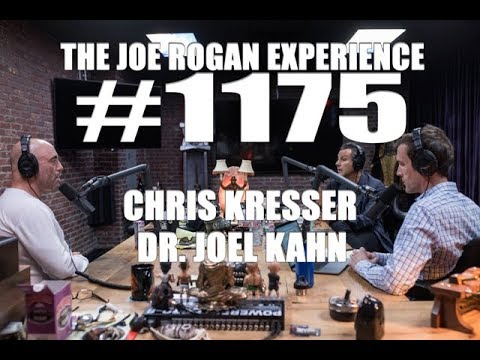
Joe Rogan Experience #1175 - Chris Kresser & Dr. Joel Kahn
Joe Rogan (host), Dr. Joel Kahn (guest), Chris Kresser (guest), Chris Kresser (guest), Narrator
In this episode of The Joe Rogan Experience, featuring Joe Rogan and Dr. Joel Kahn, Joe Rogan Experience #1175 - Chris Kresser & Dr. Joel Kahn explores vegan Cardiologist Debates Functional Medicine Critic On Meat, Fat, Science Joe Rogan moderates a long-form debate between vegan cardiologist Dr. Joel Kahn and functional medicine practitioner Chris Kresser about optimal human diet, focusing heavily on meat, saturated fat, cholesterol, and the quality of nutrition science.
Vegan Cardiologist Debates Functional Medicine Critic On Meat, Fat, Science
Joe Rogan moderates a long-form debate between vegan cardiologist Dr. Joel Kahn and functional medicine practitioner Chris Kresser about optimal human diet, focusing heavily on meat, saturated fat, cholesterol, and the quality of nutrition science.
Both agree that the standard American diet is harmful and that whole, minimally processed foods—especially vegetables—are crucial, but they diverge on whether including animal foods is beneficial or risky long term.
Kahn leans on biochemical mechanisms, epidemiology, and guideline consensus to argue that saturated fat and animal protein raise LDL cholesterol, accelerate aging pathways, and increase cardiovascular risk, while Kresser cites large meta-analyses and randomized trials suggesting saturated fat and dietary cholesterol do not increase heart disease or total mortality on average.
They also explore limitations of nutritional epidemiology, the role of the microbiome (e.g., TMAO), nutrient density and deficiencies on vegan vs. omnivorous diets, and why extreme approaches like carnivore may help some people yet remain scientifically unproven for long‑term safety.
Key Takeaways
Whole, minimally processed foods are non‑negotiable; the standard American diet is the real enemy.
All three agree that ultra-processed, sugar‑laden, refined‑carb heavy diets drive obesity, diabetes, and heart disease, and that shifting to real foods rich in vegetables and quality fats/proteins dramatically improves health markers.
Get the full analysis with uListen AI
There is no one-size-fits-all “optimal diet”; individual response matters.
Kresser emphasizes that genetics, microbiome, health status, and context mean some thrive on vegan diets while others deteriorate, so diet should be personalized rather than ideologically prescribed.
Get the full analysis with uListen AI
Saturated fat and cholesterol remain highly contested, with guideline consensus diverging from newer analyses.
Kahn cites mechanistic data, metabolic ward studies, Mendelian randomization, and global guidelines to argue saturated fat raises LDL and heart risk, whereas Kresser highlights modern meta‑analyses and RCTs finding no clear link to heart attacks or total mortality on average.
Get the full analysis with uListen AI
Epidemiology can mislead if taken as proof rather than hypothesis‑generation.
Kresser details problems such as faulty food‑frequency questionnaires, healthy‑user bias, and tiny relative risks that are indistinguishable from chance; he argues claims like “red meat causes cancer” are often built on weak associations amplified by media.
Get the full analysis with uListen AI
Animal foods are extremely nutrient‑dense but vegan diets can work with smart supplementation.
Kresser notes organ meats, shellfish, and fish are top sources of B12, iron, zinc, choline, EPA/DHA, etc. ...
Get the full analysis with uListen AI
Mechanisms like TMAO and mTOR/IGF‑1 are intriguing but not yet definitive for everyday decisions.
Kahn points to TMAO from red meat/eggs and amino‑acid‑driven mTOR activation as aging and atherosclerosis drivers; Kresser counters that fish raises TMAO far more yet correlates with less heart disease, illustrating why mechanisms must be validated against real‑world outcomes.
Get the full analysis with uListen AI
Extreme approaches like the carnivore diet may mimic fasting benefits but have unknown long‑term safety.
Both suggest carnivore might “rest the gut” and help severe autoimmune or gut cases short‑term, but emphasize we lack data on vitamin C, fiber, microbiome, cardiovascular and longevity outcomes, making it an experiment rather than an evidence‑based prescription.
Get the full analysis with uListen AI
Notable Quotes
“Eat food, not too much, mostly plants.”
— Dr. Joel Kahn (quoting Michael Pollan, endorsing it as a practical synthesis of nutrition science)
“The history of science is really the history of most scientists being wrong about most things most of the time.”
— Chris Kresser
“It takes a heretical conspiracy attitude to say everybody’s got it wrong for 60 years.”
— Dr. Joel Kahn
“Mechanistic arguments are not persuasive if it’s not happening in real people.”
— Chris Kresser
“We’re the solution, we’re not the problem, despite the differences.”
— Dr. Joel Kahn
Questions Answered in This Episode
Given the limitations of nutritional epidemiology, what research designs would most convincingly answer whether animal foods increase or decrease long‑term disease risk?
Joe Rogan moderates a long-form debate between vegan cardiologist Dr. ...
Get the full analysis with uListen AI
How should an individual practically decide their own “safe” level of saturated fat and red meat intake when experts and guidelines disagree?
Both agree that the standard American diet is harmful and that whole, minimally processed foods—especially vegetables—are crucial, but they diverge on whether including animal foods is beneficial or risky long term.
Get the full analysis with uListen AI
If animal foods are so nutrient‑dense, can a vegan diet ever truly match their benefits without heavy reliance on supplements and fortification?
Kahn leans on biochemical mechanisms, epidemiology, and guideline consensus to argue that saturated fat and animal protein raise LDL cholesterol, accelerate aging pathways, and increase cardiovascular risk, while Kresser cites large meta-analyses and randomized trials suggesting saturated fat and dietary cholesterol do not increase heart disease or total mortality on average.
Get the full analysis with uListen AI
To what extent should clinicians base dietary advice on biochemical mechanisms (like LDL receptors, mTOR, TMAO) versus large outcome trials and meta‑analyses?
They also explore limitations of nutritional epidemiology, the role of the microbiome (e. ...
Get the full analysis with uListen AI
Are extreme interventions like carnivore or prolonged fasting ethically acceptable as “self‑experiments” when long‑term risks are unknown but conventional approaches have failed?
Get the full analysis with uListen AI
Transcript Preview
Five, four, three, two, one. (claps) Gentlemen, thank you very much for being here. I really appreciate it. Dr. Kahn, uh, before we get started, why don't you tell everybody what your background is. Uh, you will be representing the vegan portion of this discussion. Uh, tell people about yourself a little bit.
Thank you. I feel like the head broccoli in the United States today. But I am from Motown, Motor City, badass. Uh, born and raised University of Michigan School of Medicine, summa cum laude, internal medicine training, cardiology training in Dallas, Texas. Very hard to be vegan in Dallas, but I did it in the '80s, because I've been doing this 42-year vegan.
42 years?
42-year vegan, thank you.
That's impressive.
Age 18. And then, uh, Kansas City, Missouri, another tough town to eat plants in, only the steakhouse, KC Masterpiece. Did, uh, training in stenting. I was blasting open heart attacks from 1990 on. Came back to Michigan, very active cath lab, heart attack, you're dead, I bring you back practice, 24 hours a day with great partners. And about three to four years ago, I used all these decades of plant-based medicine I've been basically bringing my family up with and teaching patients, but opened a completely preventive cardiology practice. And along the way with my wife and son, we now own three plant-based restaurants, two in Detroit, one in Austin, Texas. Write books, do TV, write blogs, teach, teach, teach. Not gonna stop till I'm 150.
And-
Because there's a lot of erectile dysfunction to stamp out. That's my passion.
That?
Oh my God, what else? What better purpose in life?
Um, well, okay, we can get to that later.
Heart, heart, heart, heart dise-
(laughs)
Heart disease is somewhere in that mix too.
Okay, and, uh, if people want to read more about you, website is?
Yeah, uh, D-R-J-O-E-L K-A-H-N, drjoelkahn.com.
And you've written a ton of books, right? How many books?
Five books.
Five books.
And a bunch of medical papers.
Okay.
And a whole lot of blogs.
Awesome. And Chris?
Yeah, Chris Kresser. Um, I did my undergrad at UC Berkeley, and, um, then got a Master's of Science and, um, Co-Director of the California Center for Functional Medicine, which is a functional medicine clinic in, in here in California, up in Berkeley. And, uh, I came to this from my own experience with chronic illness. I- as, as you know, Joe, got really sick, uh, back in my early 20s when I was traveling around the world, and, uh, you know, conventional medicine didn't have much to offer for me. And so, that led me on a path of trying to figure out the best approach from a diet and behavior and lifestyle perspective to heal from my own chronic illness, and then that evolved into, um, me starting to write, you know, I started a blog and a website. And then, um, wrote a couple of books and now have, uh, an organization that trains practitioners in functional medicine and also trains health coaches.
Install uListen to search the full transcript and get AI-powered insights
Get Full TranscriptGet more from every podcast
AI summaries, searchable transcripts, and fact-checking. Free forever.
Add to Chrome