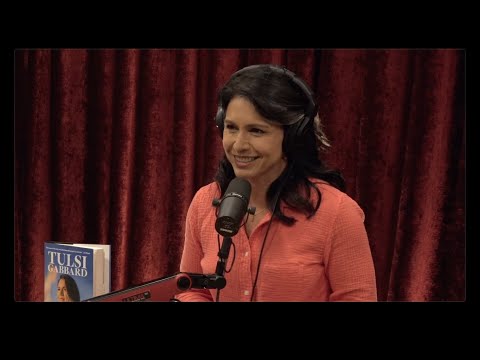
Joe Rogan Experience #2143 - Tulsi Gabbard
Narrator, Tulsi Gabbard (guest), Narrator, Joe Rogan (host), Narrator, Narrator, Narrator, Narrator
In this episode of The Joe Rogan Experience, featuring Narrator and Tulsi Gabbard, Joe Rogan Experience #2143 - Tulsi Gabbard explores tulsi Gabbard, Joe Rogan Expose Power, Propaganda, and Lost Freedoms Joe Rogan and Tulsi Gabbard move from light banter about workouts and cold plunges into a sweeping, critical conversation about U.S. drug policy, surveillance, censorship, immigration, and institutional corruption.
Tulsi Gabbard, Joe Rogan Expose Power, Propaganda, and Lost Freedoms
Joe Rogan and Tulsi Gabbard move from light banter about workouts and cold plunges into a sweeping, critical conversation about U.S. drug policy, surveillance, censorship, immigration, and institutional corruption.
They trace the history and demonization of cannabis and hemp, connecting it to media propaganda, corporate interests, and ongoing federal barriers to common‑sense reform.
Gabbard details systemic failures around the Maui wildfires, the border crisis, and government overreach via FISA and the TikTok bill, arguing these reflect a broader pattern of power consolidation and disregard for civil liberties.
Both warn that politicized institutions, captured universities, and opaque tech–government collusion are eroding trust, free speech, and foundational American freedoms faster than most citizens realize.
Key Takeaways
Propaganda and corporate interests drove early cannabis criminalization—and still distort policy.
Rogan outlines how Hearst and Anslinger used racist fearmongering and films like *Reefer Madness* to kill hemp as a commodity, protecting paper and timber interests; Gabbard notes today’s federal scheduling still blocks hemp’s huge potential for agriculture, construction, and textiles.
Get the full analysis with uListen AI
Hemp and CBD are high‑value commodities being strangled by outdated federal rules.
They highlight hemp’s durability, renewability, and nutritional value, plus its use in paper, clothing, concrete, and medicine, while Gabbard describes farmers losing entire crops over trace THC and service members banned from CBD—even gas‑station balms—because of rigid military policy.
Get the full analysis with uListen AI
Prohibition often empowers cartels and worsens public health outcomes.
Rogan cites interviews with game wardens turned tactical teams busting illegal cartel grows on U. ...
Get the full analysis with uListen AI
Government surveillance powers have quietly expanded, undermining the Fourth Amendment.
Gabbard explains how renewed and expanded FISA 702 allows warrantless collection of Americans’ data when communicating with foreign targets and broad access to Wi‑Fi histories, likening the current TikTok bill + FISA package to a post‑9/11 Patriot Act–style civil liberties rollback.
Get the full analysis with uListen AI
The TikTok “ban” bill is more about speech control than a single app.
She argues the legislation gives the Executive Branch sweeping authority to designate foreign adversaries, control which platforms Americans can use, and potentially target competitors like X, framing it as a dangerous precedent for government deciding who may speak and where.
Get the full analysis with uListen AI
Institutional failures in crises, like Maui, reveal deep governance problems.
Gabbard describes Maui residents still unhoused, toxic land delaying rebuilding, tone‑deaf FEMA responses (a one‑time $700 payment), unclear water decisions during the fire, and talk of government taking burned land—fueling fears that victims will be displaced while land is consolidated.
Get the full analysis with uListen AI
Universities and social media are amplifying radical, often foreign‑influenced ideologies.
They discuss Ivy League campus protests praising Hamas, students chanting for repeated October 7ths, and “Queers for Palestine” as evidence of ideological capture; Rogan suggests foreign governments and bot networks push these narratives via TikTok and other platforms to destabilize the West.
Get the full analysis with uListen AI
Big Tech’s data monopolies and state partnerships threaten genuine free speech.
Rogan and Gabbard point to Twitter Files revelations, coordination between agencies and platforms to suppress dissenting experts, Apple/Google’s control of ecosystems, and DNA/data sales as examples of how commercial platforms and government together can shape reality and limit debate.
Get the full analysis with uListen AI
Gabbard sees today’s Democratic leadership as a direct threat to constitutional freedoms.
She recounts leaving the party over censorship, lawfare, and politicized agencies, arguing that re‑electing the current administration would be read as public approval for further crackdowns on opponents, and urges Americans of any party to unite around core liberties rather than partisan identity.
Get the full analysis with uListen AI
Notable Quotes
“Forget about the drug part. They should be encouraging hemp production in this country.”
— Joe Rogan
“If you are choosing security over liberty, you will neither be secure nor will you have liberty.”
— Tulsi Gabbard (paraphrasing Benjamin Franklin)
“This legislation is the most egregious violation of civil liberty since the Patriot Act.”
— Tulsi Gabbard (citing Ron Paul on the TikTok/FISA bill)
“No one is coming to save us.”
— Tulsi Gabbard
“We’re living in the strangest of strange times.”
— Joe Rogan
Questions Answered in This Episode
If propaganda and corporate interests shaped cannabis policy a century ago, what similar forces might be distorting today’s drug and health regulations?
Joe Rogan and Tulsi Gabbard move from light banter about workouts and cold plunges into a sweeping, critical conversation about U. ...
Get the full analysis with uListen AI
How should a free society balance genuine national security needs with strict limits on surveillance and government control over digital platforms?
They trace the history and demonization of cannabis and hemp, connecting it to media propaganda, corporate interests, and ongoing federal barriers to common‑sense reform.
Get the full analysis with uListen AI
What concrete reforms could reduce cartel power and overdose deaths without normalizing or expanding hard‑drug use?
Gabbard details systemic failures around the Maui wildfires, the border crisis, and government overreach via FISA and the TikTok bill, arguing these reflect a broader pattern of power consolidation and disregard for civil liberties.
Get the full analysis with uListen AI
In disasters like the Maui fires, what governance structures or accountability mechanisms could prevent bureaucratic paralysis and land grabs while speeding rebuilding?
Both warn that politicized institutions, captured universities, and opaque tech–government collusion are eroding trust, free speech, and foundational American freedoms faster than most citizens realize.
Get the full analysis with uListen AI
Given the ideological capture Gabbard and Rogan describe in universities and media, how can individuals reliably seek truth and resist large‑scale narrative manipulation?
Get the full analysis with uListen AI
Transcript Preview
(drumming) Joe Rogan podcast, check it out.
The Joe Rogan Experience.
Train by day, Joe Rogan podcast by night. All day. (rock music)
Cheers. Here we go, my friend.
This is the second time-
I feel great.
... we ever worked out together.
I know. I feel great.
It was awesome, right?
That was great. (laughs)
It's a great way to get the day started.
It was perfect, actually.
We do these, uh, the, the comedian, uh, boot camps. So, you, we got, did it today, we did it with Hasan and Derek and Shane, Shane Gillis. And, and we have fun. You know?
Yeah.
So you get the workout in and you talk a lot of shit and you get silly.
(laughs) That's the best part.
It's really fun. It's just, like, real silly.
Yeah.
You know, and we have a good time.
Yeah.
So...
I, uh, yeah. Thanks for the invite. It was-
Oh, my pleasure.
It was... I've been on the road for, I don't know, for weeks. And so, you know, if you're lucky, you get a, a decent hotel gym.
Right.
But you gotta be really creative.
Yeah.
Uh, most of them, the best they'll have are dumbbells and, you know, that's it. Uh...
I just realized, you're the second celebrity to do that with us, and the second Hawaiian, 'cause The Rock did it.
The Rock. Samoan.
So it's like there's something going on with- (laughs)
Samoan pride here. (laughs)
Something going on with, uh, Hawaiians-
It's funny.
... coming here.
Well, we'll have to figure out, you know Max Holloway is Hawaiian and Samoan too.
He didn't work out though. Max, last time he was here-
Yeah.
... he was just off of his, uh, his win.
Yeah. (laughs) Yeah, he gets-
He's just chilling.
... a break (laughs) -
Yeah, he's just chilling.
... after that, man.
Yeah.
Wow.
Yeah, take some time off, bro.
No, that, that, um... I was telling you, like, the sauna, I, I am definitely, like, from the islands because I'm okay with heat.
Mm-hmm.
So 20 minutes in the sauna, it was good, it was challenging, but it was good.
Yeah.
The cold however (laughs)
(laughs)
That ice bath. I've done that, like, a quick polar plunge-
Mm-hmm.
... briefly, jumping in, jumping out, but...
And that one was at the lowest setting in terms of the jets of water.
Okay.
So what we have is called a Blue Cube, and Blue Cube is, uh, the type of, uh, cold plunge that has a, it has an engine in it that you can turn on to higher, higher levels of waves. So if you turn it, like, to the highest level, it's just rushing at you like a river. And so you-
Install uListen to search the full transcript and get AI-powered insights
Get Full TranscriptGet more from every podcast
AI summaries, searchable transcripts, and fact-checking. Free forever.
Add to Chrome