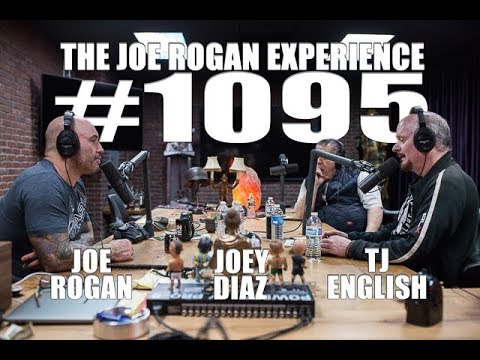
Joe Rogan Experience #1095 - TJ English & Joey Diaz
Joe Rogan (host), Joey Diaz (guest), T.J. English (guest), Joe Rogan (host), Joe Rogan (host), Joe Rogan (host), Joe Rogan (host), Joe Rogan (host), Joe Rogan (host), Joe Rogan (host)
In this episode of The Joe Rogan Experience, featuring Joe Rogan and Joey Diaz, Joe Rogan Experience #1095 - TJ English & Joey Diaz explores cuban Crime, Politics, and Mysticism: Inside TJ English’s ‘Corporation’ Joe Rogan, TJ English, and Joey Diaz discuss English’s book *The Corporation*, which chronicles a powerful Cuban‑American crime syndicate led by Bay of Pigs veteran José Miguel Battle. The conversation traces how illegal lotteries (bolita) funded a vast criminal empire intertwined with Italian mob families, U.S. politics, and Cold War covert operations. Diaz connects the history to his own upbringing in New Jersey’s Cuban enclaves, describing how numbers, corruption, and neighborhood codes of loyalty shaped daily life. The episode also dives into Cuban culture—Santería, Abakuá brotherhoods, music, and sexuality—showing how religion, ritual, and crime fused into a distinctive underworld ecosystem.
Cuban Crime, Politics, and Mysticism: Inside TJ English’s ‘Corporation’
Joe Rogan, TJ English, and Joey Diaz discuss English’s book *The Corporation*, which chronicles a powerful Cuban‑American crime syndicate led by Bay of Pigs veteran José Miguel Battle. The conversation traces how illegal lotteries (bolita) funded a vast criminal empire intertwined with Italian mob families, U.S. politics, and Cold War covert operations. Diaz connects the history to his own upbringing in New Jersey’s Cuban enclaves, describing how numbers, corruption, and neighborhood codes of loyalty shaped daily life. The episode also dives into Cuban culture—Santería, Abakuá brotherhoods, music, and sexuality—showing how religion, ritual, and crime fused into a distinctive underworld ecosystem.
Key Takeaways
Illegal lotteries functioned as both community glue and criminal goldmine.
Bolita gave poor immigrants hope and daily ritual—tying numbers to dreams and omens—while generating millions monthly for Cuban mobsters who ran hundreds of betting spots from New York to Miami.
Get the full analysis with uListen AI
José Miguel Battle leveraged war hero status to build a protected empire.
As a Bay of Pigs veteran and ex‑Havana vice cop with Mafia ties, Battle secured Mafia approval, government leniency, and immense loyalty, allowing The Corporation to operate for decades below the enforcement radar.
Get the full analysis with uListen AI
Political motives and personal revenge blurred inside organized crime.
Anti‑Castro ideology, humiliation from Bay of Pigs, and Cuban pride fueled not just terrorism against Cuban targets but also hyper‑personal vendettas, with Battle pursuing enemies for years and ordering elaborate killings.
Get the full analysis with uListen AI
Systemic corruption bound cops, politicians, judges, and gangsters together.
Diaz describes routine payoffs, staged arrests, and menu‑priced court outcomes, while English notes federal reluctance to prosecute Bay of Pigs vets—illustrating how criminal and official power structures interlocked.
Get the full analysis with uListen AI
Afro‑Cuban religions were weaponized as both faith and psychological warfare.
Santería rituals, divination, and talk of protective spirits shaped decisions and morale—mobsters tried to counter enemies’ “saints” with their own ceremonies, and believers saw uncanny alignments between rituals and real‑world events.
Get the full analysis with uListen AI
Each immigrant wave tends to replay the organized‑crime assimilation pattern.
English argues that Italians, Irish, Jews, and now Russians, Jamaicans, Dominicans, and others all use underworld structures to gain economic power when shut out of mainstream institutions; only the ethnic cast changes.
Get the full analysis with uListen AI
Official histories hide a parallel, covert narrative that surfaces decades later.
The book’s research uncovers CIA‑Cuban exile links in Watergate, airline bombings, and possible Kennedy‑assassination ties—reinforcing that what makes headlines is only a sanitized slice of how power and violence actually operated.
Get the full analysis with uListen AI
Notable Quotes
“What I try to do with these books is to tell the macro story…and then get intimate and tell the interpersonal stories between the characters that actually live the story.”
— TJ English
“The idea was, you bet the number and you try to make your dreams come true. The boliteros…they’re the dream makers.”
— TJ English
“I’ve come to believe that it’s the American story—this process of going through organized crime and gangsterism before you become accepted as a full‑blown American.”
— TJ English
“I have a hundred stories I could tell you and a thousand I can’t.”
— Joey Diaz
“What we’re receiving as information on a daily basis…is a version of what’s happening. There’s a whole other version…and you usually only find out about it 30 years later.”
— TJ English
Questions Answered in This Episode
How much did Cold War geopolitics and U.S. covert operations actively enable The Corporation’s rise and longevity?
Joe Rogan, TJ English, and Joey Diaz discuss English’s book *The Corporation*, which chronicles a powerful Cuban‑American crime syndicate led by Bay of Pigs veteran José Miguel Battle. ...
Get the full analysis with uListen AI
In what ways did bolita empower Cuban immigrant communities, and in what ways did it trap them in cycles of exploitation and violence?
Get the full analysis with uListen AI
How should we think about figures like José Miguel Battle, who were both political heroes and ruthless killers within their communities?
Get the full analysis with uListen AI
What ethical responsibilities do writers like TJ English have when revealing hidden criminal histories that still affect living families and neighborhoods?
Get the full analysis with uListen AI
Could similar protected criminal ecosystems exist today around other political or intelligence priorities, and how would we recognize them in real time?
Get the full analysis with uListen AI
Transcript Preview
Oh, okay. (laughs) Boom, and we're live with Joey Diaz and TJ English. Uh, Joey turned me on to you a long time ago, Mr. English. Uh, he gave me a copy of The Westies, right?
Yeah. It was... '98, '99.
A long time ago-
Mm-hmm.
... he gave me that book.
Yeah.
It's fantastic, really.
Thank you.
Fascinating stuff.
Yeah. First book I published.
Was it really?
Uh, The Westies, yeah, in 1990.
How'd you guys find out about each other?
He wrote a book... A friend of mine turned me onto a book named Havana Nocturne, that was a small book, a fascinating read, and I was just blown away by him. And I went to a party one night and there was a literary agent there, and I go, "Do you fucking guys read Havana Nocturne?" They go, "We optioned it." And I was like, "That's fucking in-... That's gonna be a great book." It just, uh... It broke down the, the, uh... how Fidel took over it from three different cities, how it was going down in three different categories. And then I heard that he was writing a book about West New York and Union City Cubans, where I grew up. And I emailed him and I told him who I was, that my mother had a bar, and, uh, I grew up in that shit. And he hit me back and we became friends. He came to a show and...
Yeah, Joey reached out to me, you know, unfortunately, when I was just about finishing this book. So I had done most of the work and it was down on paper, but it was a trip. It was like he w-... He was like a character who walked out of the book.
(laughs)
And, uh, I wished I'd met him earlier, 'cause I hadn't met too many characters like him. Union City's amazing place. Uh, I don't think people realize it. It's one of those little enclaves, happens to be Cuban. It's like a mafia neighborhood, but it was Cubans, not Italians. Or it was like Hell's Kitchen, which I wrote about in The Westies, which was-
Yeah.
... an Irish neighborhood. Very intense neighborhood. Uh, high premium on loyalty. Um, young males running loyalty games on each other all the time, from the age of six. Am I right?
How so? What do you mean?
How far you'll go-
T- Can I turn the sucker up towards you? Yeah.
How far, how far will you go for me, uh, you know?
Yeah.
Uh, what are you willing to do for me? In the case of Hell's Kitchen and The Westies, it was cut up bodies. It was not only would you kill somebody for me, but will you make the body disappear? And they tested each other with, with the cutting up of the bodies. In Union City, a lot of it was, was political. Some of it was polit-... How anti-Fidel are you? How badly do you want to kill, you know, Fidel and help us reclaim our lost homeland? That was kind of behind a lot of things. It wasn't spoken about a lot, but it was sort of the hidden motivation.
Install uListen to search the full transcript and get AI-powered insights
Get Full TranscriptGet more from every podcast
AI summaries, searchable transcripts, and fact-checking. Free forever.
Add to Chrome