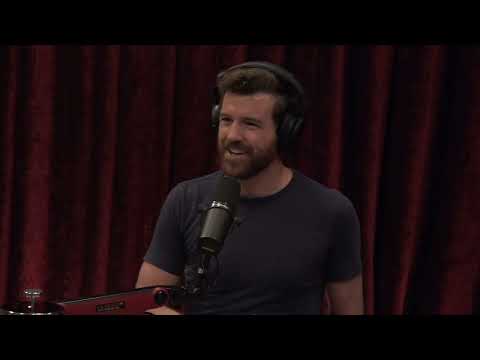
Joe Rogan Experience #1832 - Charlie Walker
Joe Rogan (host), Charlie Walker (guest), Narrator
In this episode of The Joe Rogan Experience, featuring Joe Rogan and Charlie Walker, Joe Rogan Experience #1832 - Charlie Walker explores explorer Charlie Walker Survives Siberian Prison Amid Ukraine Invasion Chaos British adventurer Charlie Walker recounts his evolution from curious bike traveler to full-time expedition writer, including a four-year, low-budget cycling journey across Europe, Asia, and Africa. He describes extreme overland trips through Tibet, the Congo, Mongolia, Papua New Guinea, and Siberia, emphasizing physical hardship, profound solitude, and improvised logistics. The conversation centers on his recent winter expedition in Arctic Russia’s Yakutia, where he was arrested, tried on fabricated ‘journalism’ charges, and held in a migrant detention prison as the Ukraine war began. Walker also reflects on Russian propaganda, the dangers of traveling there now, and broader issues of belief, motivation, history, and how we interpret extreme experiences.
Explorer Charlie Walker Survives Siberian Prison Amid Ukraine Invasion Chaos
British adventurer Charlie Walker recounts his evolution from curious bike traveler to full-time expedition writer, including a four-year, low-budget cycling journey across Europe, Asia, and Africa. He describes extreme overland trips through Tibet, the Congo, Mongolia, Papua New Guinea, and Siberia, emphasizing physical hardship, profound solitude, and improvised logistics. The conversation centers on his recent winter expedition in Arctic Russia’s Yakutia, where he was arrested, tried on fabricated ‘journalism’ charges, and held in a migrant detention prison as the Ukraine war began. Walker also reflects on Russian propaganda, the dangers of traveling there now, and broader issues of belief, motivation, history, and how we interpret extreme experiences.
Key Takeaways
Physical hardship is often more accessible than people think—logistics and mindset matter more than athleticism.
Walker stresses he is not a gifted athlete; he succeeds by starting slowly, accepting discomfort, and keeping logistics simple (cheap bikes, tents, basic food) rather than over-optimizing gear or training.
Get the full analysis with uListen AI
Arriving in remote places by simple means (bike, on foot, canoe, horse) builds trust and dismantles barriers.
He finds locals far more receptive when he shows up exhausted on a bicycle or with a pack horse than if he arrived in a 4x4, because it signals vulnerability, effort, and respect for their environment.
Get the full analysis with uListen AI
Daily journaling and photography are powerful tools for capturing and later reconstructing complex experiences.
Across years of travel, Walker wrote every single day and shot thousands of photos; those sparse notes later unlock nuanced memories for books, talks, and personal reflection.
Get the full analysis with uListen AI
Long-term solitude can be both damaging and deeply valuable, depending on how it’s framed and managed.
He distinguishes ‘loneliness’ from ‘solitude’ and limits podcasts/music on expeditions so he’s forced to think, process his life, and learn to enjoy his own company instead of constantly distracting himself.
Get the full analysis with uListen AI
Modern authoritarian states can criminalize ordinary activity by redefining terms and fabricating evidence.
In Russia, Walker was fined and deported for “committing journalism” on a tourist visa and accused of photographing sensitive sites, based largely on invented witness statements and the presumption of guilt.
Get the full analysis with uListen AI
Travelers in politically volatile regions must assume the legal deck is stacked against them.
Walker’s prior minor court run-ins and his near-miss with being charged under Russia’s new “fake news” law (carrying up to 15 years in prison) convinced him that foreigners have virtually no legal protection there now.
Get the full analysis with uListen AI
Stories of extreme adventure can inspire without becoming prescriptive self-help or guru-style ‘systems.’
Walker rejects bullet-point life formulas; he prefers to share honest stories—including mistakes and failures—so others can draw their own lessons rather than being sold a one-size-fits-all blueprint.
Get the full analysis with uListen AI
Notable Quotes
““I lived for four and a half years on about 12,000 pounds… You can live for a really small amount of money if you’re just out in the world.””
— Charlie Walker
““Being by yourself can totally suck, but if you flip the perspective, you can enjoy the space, the peace, the freedom.””
— Charlie Walker
““In Russia, if you’re accused of something, you are guilty. That’s it. There’s no dispute.””
— Charlie Walker
““When those wheels took off, I just broke down. It was the first time in the whole long month that finally just unraveled.””
— Charlie Walker
““I’m not there to say, ‘Quit your job and fuck off for years on a bicycle.’ I’m there to take some of the lessons about resilience and ambition and apply them to their lives.””
— Charlie Walker
Questions Answered in This Episode
How did your time in a Russian detention center change the way you think about risk, especially in places with weak rule of law?
British adventurer Charlie Walker recounts his evolution from curious bike traveler to full-time expedition writer, including a four-year, low-budget cycling journey across Europe, Asia, and Africa. ...
Get the full analysis with uListen AI
Looking back, is there a specific moment on any expedition where you felt your curiosity had pushed you one step too far?
Get the full analysis with uListen AI
What practical advice would you give someone who wants a ‘small dose’ of your kind of adventure without quitting their job or risking prison?
Get the full analysis with uListen AI
How do you decide what to include or leave out when turning raw, messy experiences into books and talks?
Get the full analysis with uListen AI
Given what you saw of Russian propaganda and public opinion, what do you think a realistic endgame to the Ukraine war could look like?
Get the full analysis with uListen AI
Transcript Preview
(drumbeats) Joe Rogan Podcast, check it out.
The Joe Rogan Experience.
Train by day, Joe Rogan Podcast by night. All day. (instrumental music plays) And we're up. All right, Charlie. First of all, thanks for being here.
My pleasure. Thanks for having me.
Very nice to meet you. Why do you do the things that you do?
First question is the hardest one.
(laughs)
Um, I, I guess over the years have formed a whole bunch of different answers to that, some of them flippant and sarcastic. Uh, without rambling on for ages and ages, I suppose it comes down to, I'm just really curious. I want to get to these places, see, you know, people living lives differently to mine. I grew up in a tiny little village where, you know, it was nice, but nothing happened.
Where'd you grow up?
Uh, just close to Salisbury in the southwest of England. Uh, about 10 miles from Stonehenge down there.
Oh, wow.
Um, and yeah, I suppose I, I started traveling when I was about 18. Took a year out between school and, uh, and university and just got more and more curious and slowly realized that I enjoyed traveling more if I was getting to places by, I suppose, physically difficult means.
Mm.
Um, um, and that particularly helps, I suppose, if you turn up in some remote community in a ... not that I've been doing this, but in a helicopter or 4x4, or whatever, there's instantly a, a distance, a sort of divide. You know, you're ... I spend most of my time, uh, traveling in the developing world, where that's just building a barrier. Whereas if you turn up on foot or in a little kayak or on a horse or whatever, then I think people kind of take to that a little bit more.
What was your first trip that you did like this?
Uh, besides backpacking around Africa, uh, the first time I did anything sort of particularly physically challenging was I flew to Beijing and I had a flight out of, uh, Mongolia. And kind of quite last minute I thought, "Oh, well, you know, it's, there's 1000 miles between the two, I'll take a bike, a bicycle."
(laughs)
Um, didn't get off to the best start. I, uh, I went to a friend's 21st birthday party about 10 days before leaving and, um, I don't really remember the party, but when I wake up in the morning, one of my quadriceps had snapped.
(gasps)
Not torn, but snapped. The, the doctor said that the two ends would kind of flap around like fishtails and eventually graft onto the rest. I don't know how scientific that that was. Uh, and then on my first night in Beijing, I fell over and broke my wrist a bit drunk. So-
Oh, Jesus.
... two, two weeks later when I sort of cut my cast off and sort of, you know, strapped my knee up a bit and pedaled out, I wasn't in the best shape. And, and frankly, the following two-
Install uListen to search the full transcript and get AI-powered insights
Get Full TranscriptGet more from every podcast
AI summaries, searchable transcripts, and fact-checking. Free forever.
Add to Chrome