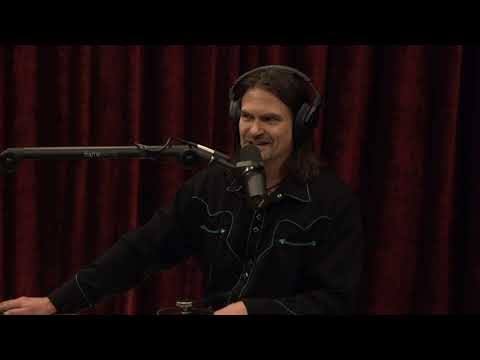
Joe Rogan Experience #1646 - David Holthouse
David Holthouse (guest), Narrator, Joe Rogan (host)
In this episode of The Joe Rogan Experience, featuring David Holthouse and Narrator, Joe Rogan Experience #1646 - David Holthouse explores from Bigfoot Myth To Murderous Reality: Inside Mendocino’s Dark Underbelly Joe Rogan interviews journalist and documentarian David Holthouse about his Hulu series *Sasquatch*, which begins with a 1993 rumor of a Bigfoot triple homicide on a Northern California weed farm but evolves into an investigation of drug war violence, cartel grows, and missing people in the Emerald Triangle.
From Bigfoot Myth To Murderous Reality: Inside Mendocino’s Dark Underbelly
Joe Rogan interviews journalist and documentarian David Holthouse about his Hulu series *Sasquatch*, which begins with a 1993 rumor of a Bigfoot triple homicide on a Northern California weed farm but evolves into an investigation of drug war violence, cartel grows, and missing people in the Emerald Triangle.
Holthouse explains how the war on drugs transformed back‑to‑the‑land hippie cannabis culture into a violent black‑market economy, and how Bigfoot lore is sometimes weaponized by growers to control and scare migrant workers.
The conversation broadens into illegal cartel grows on public lands, environmental damage, corporate weed, and the strange mix of utopian homesteaders, hardcore outlaws, and unreported murders in those woods.
Rogan also digs into Holthouse’s background: his childhood sexual assault, his near‑revenge plot, his undercover work among neo‑Nazis and ravers, and how trauma and outsider status shaped his career chasing dangerous, deeply dark stories.
Key Takeaways
The *Sasquatch* series uses a Bigfoot murder rumor as a gateway into real-world violence around illicit cannabis, not as a paranormal investigation.
Holthouse’s 1993 story of three men supposedly killed by Bigfoot leads him to uncover human killers, staged “Sasquatch” evidence, and a long-standing pattern of brutality in the Emerald Triangle’s weed trade.
Get the full analysis with uListen AI
The war on drugs inadvertently escalated violence and criminality in Northern California’s weed country.
Federal crackdowns and Operation Green Sweep raised black‑market prices, attracted cartels and hardened criminals, and pushed once‑idealistic homesteaders to arm up, booby‑trap properties, and operate in fear.
Get the full analysis with uListen AI
Bigfoot lore is sometimes deliberately fabricated to control vulnerable labor and reduce law‑enforcement risk.
Growers have used carved “Sasquatch” footprints, damage to trees, and scary stories to keep foreign trimmers from leaving farms, minimizing traffic and attention that might bring police.
Get the full analysis with uListen AI
Legalization has not eliminated the black market; in some ways it’s intensified competition and danger.
Corporate “Death Star” grow operations and heavy regulation have squeezed small legal growers, pushing many back into illicit growing or other drugs, while cartels exploit lenient penalties and public lands for massive illegal grows.
Get the full analysis with uListen AI
The Emerald Triangle has a staggering number of missing people and unreported murders.
Holthouse notes that Mendocino and Humboldt counties lead the nation in missing persons rates, and both cops and criminals acknowledge that many killings tied to the drug trade are never reported at all.
Get the full analysis with uListen AI
Holthouse’s childhood trauma both damaged him and uniquely equipped him for dangerous investigative work.
Being raped at seven, fearing he’d become a predator, and later stalking his abuser for a planned murder left him dissociative under stress and comfortable among criminal outsiders—traits he channeled into gonzo reporting instead of crime.
Get the full analysis with uListen AI
Undercover and immersion journalism carry real psychological and physical risks, but can expose hidden power structures.
From infiltrating neo‑Nazi concerts and hate groups to living with meth users and ravers overlapping with Sammy “The Bull” Gravano’s ecstasy ring, Holthouse shows how deep immersion reveals organization, financing, and strategy behind extremist and criminal scenes.
Get the full analysis with uListen AI
Notable Quotes
“It’s not a lighthearted Bigfoot show… If you go into that expecting to be entertained on that level, you’re not gonna get what you’re looking for.”
— David Holthouse
“The war on drugs drove the price of black-market weed up so high that the culture up there started to shift… it brought in a pretty hardcore criminal element.”
— David Holthouse
“Most of the murders up there are never reported to the cops. People just disappear… There’s a lot of bodies in those woods, for sure.”
— David Holthouse
“If I hadn’t been a journalist, I would’ve been a criminal. Something essential got edited out of me… I’ve always been drawn to criminals, and criminals have always felt very comfortable around me.”
— David Holthouse
“There’s something calming to me about operating in those sorts of worlds or with that sort of subject matter. The truth is, I find it relaxing.”
— David Holthouse
Questions Answered in This Episode
How should society realistically address the violence and environmental damage of illicit grows that persist even after legalization?
Joe Rogan interviews journalist and documentarian David Holthouse about his Hulu series *Sasquatch*, which begins with a 1993 rumor of a Bigfoot triple homicide on a Northern California weed farm but evolves into an investigation of drug war violence, cartel grows, and missing people in the Emerald Triangle.
Get the full analysis with uListen AI
Where is the ethical line between exposing dark subcultures through storytelling and inadvertently glorifying or amplifying them?
Holthouse explains how the war on drugs transformed back‑to‑the‑land hippie cannabis culture into a violent black‑market economy, and how Bigfoot lore is sometimes weaponized by growers to control and scare migrant workers.
Get the full analysis with uListen AI
What responsibilities do platforms like Netflix and Hulu have when portraying serial killers or extreme criminals who might have craved notoriety?
The conversation broadens into illegal cartel grows on public lands, environmental damage, corporate weed, and the strange mix of utopian homesteaders, hardcore outlaws, and unreported murders in those woods.
Get the full analysis with uListen AI
Could Holthouse’s investigative methods—code switching, immersion, flirting with real danger—be safely taught and institutionalized, or are they too tied to his specific psychology and trauma?
Rogan also digs into Holthouse’s background: his childhood sexual assault, his near‑revenge plot, his undercover work among neo‑Nazis and ravers, and how trauma and outsider status shaped his career chasing dangerous, deeply dark stories.
Get the full analysis with uListen AI
What would it take, legally and economically, to truly displace the black-market cannabis trade and the cartels from places like Mendocino and public lands nationwide?
Get the full analysis with uListen AI
Transcript Preview
(drumming music plays) Joe Rogan podcast. Check it out.
The Joe Rogan Experience.
Train by day, Joe Rogan podcast by night. All day. (rock music plays) Thanks for being here, man.
Thanks for having me.
I really enjoyed your s- your three-part docu- what do you call it? Docuseries? Is that what you call it?
Yeah, yeah.
Yeah.
Limited doc series, yeah.
Um, I watched it last night on Hulu. I binge-watched it, and, uh, it's intense. Um, you know, I've been a fan of, uh, marijuana for a long time, so I know a lot of people who've lived up there and grown up there. And, um, the- for people who don't know, the- the docuseries is called Sasquatch, and you look at it on Hulu, you go, "Oh, man, it's a Bigfoot documentary."
Nope.
Not really, no. It's a lot scarier (laughs) . How did this come about? Like how did this project fall into your lap?
Well, the genesis of the project really goes back to the fall of 1993. I was visiting a- a buddy of mine who was working on a dope farm. And he kinda ... It was harvest season, which is like a particularly dangerous time of the year up there. But he kinda got me a hall pass with the guy that owned the farm and vouched for me, for me to, uh, parachute in for about a week. And, um, (laughs) something that didn't make it in the show is that, uh, I went up there to do like a heroic mushroom trip with this guy. So the- the- the day before, uh, the day that the- that the ship went down, okay, um, we took about an eighth of muffroom- mushrooms each and went tripping around the redwoods. Now, that didn't make it in the show, okay? But that night, as we were coming down, we were, um, in the- in the cabin, the A-frame cabin that belonged to the guy that owned the farm. And these two dudes showed up late at night, covered in mud, like splattered with mud, soaked, claiming that they'd just been to a nearby dope farm where they've seen three bodies that were torn up, like mutilated. And these guys were freaking out, okay? They were- they- they seemed legitimately traumatized to me. They seemed- they were exuding this like energy of like terror and having just seen, you know, mutilated bodies to the point where I was just trying to shrink into the couch where I was. I was like really not happy to be in that room at that point.
How old were you at the time?
I was 23 years old.
Yeah, that's-
Okay?
... not bad.
I was just getting going in journalism, you know? And, um, they, you know, they, the owner of the farm kind of pulled them off to the- to the side, and they were having a conversation in the kitchen. And when they were trying to keep their voices hushed, but these guys, they were so rattled. And also like, I didn't know the signs at the time, but now looking back, I'm like, they were on crystal, they were- they were tweaking, right?
Install uListen to search the full transcript and get AI-powered insights
Get Full TranscriptGet more from every podcast
AI summaries, searchable transcripts, and fact-checking. Free forever.
Add to Chrome