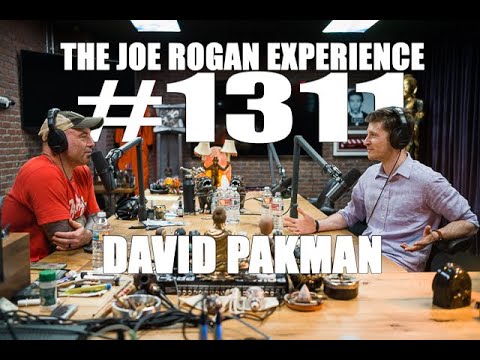
Joe Rogan Experience #1311- David Pakman
Joe Rogan (host), David Pakman (guest), Narrator, Narrator, Narrator
In this episode of The Joe Rogan Experience, featuring Joe Rogan and David Pakman, Joe Rogan Experience #1311- David Pakman explores david Pakman and Joe Rogan dissect algorithms, outrage, and free speech Joe Rogan and David Pakman explore how online outrage culture, dunking, and audience capture distort political discourse, especially on YouTube and social media. They examine the business incentives behind algorithms, Adpocalypse, and demonetization, using cases like Steven Crowder vs. Carlos Maza and Pakman’s own interview with Richard Spencer. A large part of the conversation debates free speech vs. platform rules: what private companies should police, when speech becomes targeted harassment, and whether platforms are modern town squares. They also cover U.S. healthcare and education reform, identity politics on the left, rising antisemitism, tech’s impact on mental health, and the coming wave of immersive technology.
David Pakman and Joe Rogan dissect algorithms, outrage, and free speech
Joe Rogan and David Pakman explore how online outrage culture, dunking, and audience capture distort political discourse, especially on YouTube and social media. They examine the business incentives behind algorithms, Adpocalypse, and demonetization, using cases like Steven Crowder vs. Carlos Maza and Pakman’s own interview with Richard Spencer. A large part of the conversation debates free speech vs. platform rules: what private companies should police, when speech becomes targeted harassment, and whether platforms are modern town squares. They also cover U.S. healthcare and education reform, identity politics on the left, rising antisemitism, tech’s impact on mental health, and the coming wave of immersive technology.
Key Takeaways
Algorithms reward outrage and ‘dunking,’ skewing political conversation.
Both note that YouTube and social platforms optimize for engagement, meaning content that enrages or humiliates opponents is promoted, encouraging creators to attack rather than reason and making toxic conflict feel like the norm.
Get the full analysis with uListen AI
Creators need direct audience support to survive platform volatility.
Pakman describes losing ~30% of his revenue in Adpocalypse and responding by building his own membership program off-YouTube, arguing creators should reduce dependence on opaque algorithms and advertiser whims.
Get the full analysis with uListen AI
Platform rules are applied reactively and inconsistently under public pressure.
In the Crowder–Maza case, YouTube first declined to act, then demonetized Crowder, and finally said he could re-monetize by removing a T‑shirt link—illustrating that big enforcement often follows PR crises, not clear, evenly applied standards.
Get the full analysis with uListen AI
There’s a meaningful difference between criticizing ideas and targeting identity.
Pakman argues Crowder’s repeated references to Maza’s sexuality and ethnicity crossed YouTube’s written rules (targeted harassment over sexual orientation), whereas harshly challenging his antifa arguments would not, highlighting the need to separate idea-critique from identity attacks.
Get the full analysis with uListen AI
Healthcare and education failures are moral as much as economic.
They argue the U. ...
Get the full analysis with uListen AI
Identity politics is a real but minority problem on the left.
Both see a small but loud faction that treats identity as trumping argument, punishes deviation (e. ...
Get the full analysis with uListen AI
Unchecked tech and social media reshape minds faster than we can study it.
They connect rising polarization, harassment, and youth mental-health issues to always-on phones, algorithmic feeds, and soon AR/VR, warning that like processed food, technological convenience brings hidden long-term costs we only understand years later.
Get the full analysis with uListen AI
Notable Quotes
“YouTube's bias is towards corporatism and profit.”
— David Pakman
“Bad ideas should be combated with good ideas, not with silencing someone.”
— Joe Rogan
“If I just allow what I consider to be disgusting views to be spread out like a spray bottle and not do anything else, I can’t say I’m doing something valuable.”
— David Pakman
“I really don’t understand private citizens that don’t want easy access to quality healthcare for everybody.”
— Joe Rogan
“I don’t want to participate in a false equivalency between very far left and very far right as just two sides of the same coin.”
— David Pakman
Questions Answered in This Episode
Where should the line be drawn between protected speech and targeted harassment on massive platforms like YouTube?
Joe Rogan and David Pakman explore how online outrage culture, dunking, and audience capture distort political discourse, especially on YouTube and social media. ...
Get the full analysis with uListen AI
Is it ever ethically justified—or strategically smart—to refuse to interview or ‘platform’ someone with extreme views like Richard Spencer?
Get the full analysis with uListen AI
How can creators build sustainable businesses that are resilient to sudden algorithm or policy shifts by platforms and advertisers?
Get the full analysis with uListen AI
What kind of legal or regulatory framework, if any, should govern platforms once they function as de facto public squares?
Get the full analysis with uListen AI
In practice, how can we challenge harmful identity politics and campus excesses without empowering genuinely bigoted or extremist movements?
Get the full analysis with uListen AI
Transcript Preview
Hello, David. Here we go. We're live.
We're, uh, we're doing it.
Yes, we're doing it. What's going on, man?
I'm nervous. I'm nervous.
Oh, don't be. Uh, I enjoy your show. I really do.
Thank you.
It's a pleasure to watch. Um, you, you're a very smart guy, man. You... And like I said, we were just talking about it, you're very reasonable. In this world, I think there's so much of this, uh, the YouTube political world, the YouTube commentary world, where people are so fucking toxic. You know, there's, there's so much negativity, there's so much what they call dunking on people.
Mm.
There's so much dunking. You do a little dunking, but-
Some of it's warranted.
It is warranted, yes.
Yeah.
But I don't know if it's beneficial.
Uh, to the, to the people doing the dunking?
Yes. Or even to the cause. I think it is temporarily... Well, sometimes it's good because it, it, it show-... It mocks people's positions and it makes people realize, "Yeah, that is a ridiculous position." So if you're on the fence or if you're not really quite sure how you feel about things and you see someone get mocked for a ridiculous position that maybe you've even shared for a little bit-
Right.
... maybe, maybe you haven't explored it deeply, and you see someone who has explored it deeply sort of expose all the flaws in this line of thinking, it's good. But my thing... When I'm... I... And I, I interview a lot of people on the right and a lot of people on the left, and I just hate all this conflict that I, I'd say the unnecessary conflict I think is when you, when you watch television today and you see Antifa fighting with, uh, you know, B- Trump supporters and all this, all this weird conflict, I don't, I don't necessarily think that most of it is, is necessary.
Necessary? Well, I think the devil's in the details.
Yeah.
So, like, as an example, if you want to bring together, I don't know, people who are on oppor- oppos- opposite sides of the climate debate, for example.
Good luck.
Um, sure. Right. Well, why is... Par- part of that, you could argue, is if one side just does not accept science-
Right.
... how can you really bring those people together? It doesn't mean you need physical conflict to resolve it. In fact, I completely agree with you, the physical conflict is totally counterproductive. But at a certain point on some issues, I understand why there's, like, an intractability to the debate where it seems completely impossible to move forward because whichever side you're on, I would argue that I'm on the right side of these issues and others would disagree.
Mm-hmm.
When you're far apart in a way that you can't even agree as to, like, what the starting point facts are about the conversation-
Install uListen to search the full transcript and get AI-powered insights
Get Full TranscriptGet more from every podcast
AI summaries, searchable transcripts, and fact-checking. Free forever.
Add to Chrome