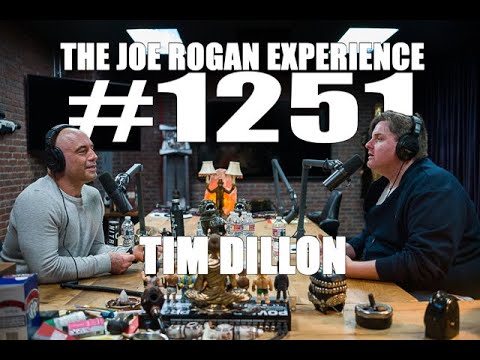
Joe Rogan Experience #1251 - Tim Dillon
Joe Rogan (host), Tim Dillon (guest), Young Jamie (guest), Narrator, Narrator
In this episode of The Joe Rogan Experience, featuring Joe Rogan and Tim Dillon, Joe Rogan Experience #1251 - Tim Dillon explores tim Dillon And Joe Rogan Skewer Conspiracies, Politics, And Comedy Culture Joe Rogan and Tim Dillon riff on everything from ancient civilizations and cataclysms to contemporary politics, media manipulation, and the state of stand-up comedy. They discuss how fringe theories and real conspiracies intersect, touching on JFK, the deep state, Russian information warfare, and child trafficking. A big portion centers on Trump, media hypocrisy, outrage culture, and high‑profile scandals like Jussie Smollett, Jeffrey Epstein, and Catholic Church abuse. Woven through is a meta‑conversation about comedy itself—how it’s built, where it’s best, what ruins it, and why being genuinely funny is different from being a careerist or a moral scold.
Tim Dillon And Joe Rogan Skewer Conspiracies, Politics, And Comedy Culture
Joe Rogan and Tim Dillon riff on everything from ancient civilizations and cataclysms to contemporary politics, media manipulation, and the state of stand-up comedy. They discuss how fringe theories and real conspiracies intersect, touching on JFK, the deep state, Russian information warfare, and child trafficking. A big portion centers on Trump, media hypocrisy, outrage culture, and high‑profile scandals like Jussie Smollett, Jeffrey Epstein, and Catholic Church abuse. Woven through is a meta‑conversation about comedy itself—how it’s built, where it’s best, what ruins it, and why being genuinely funny is different from being a careerist or a moral scold.
Key Takeaways
Real catastrophes and lost history may be more plausible than ancient aliens.
Rogan and Dillon lean toward theories of advanced ancient civilizations destroyed by cataclysms (e. ...
Get the full analysis with uListen AI
The ‘deep state’ is less a secret cabal and more a sprawling, unaccountable bureaucracy.
They describe dozens of intelligence and security entities competing for budgets and influence; policies persist across administrations, making it naive to think one elected president fully controls U. ...
Get the full analysis with uListen AI
Outrage cycles are easily weaponized and often manipulated by bad‑faith actors.
From Covington Catholic to Jussie Smollett, they show how partial clips, troll accounts, and foreign operations can trigger mass moral panics that later unravel, highlighting the danger of reacting before facts solidify.
Get the full analysis with uListen AI
Victimhood has become a powerful form of currency in media and culture.
They argue that the social and professional rewards for being perceived as a victim help explain hoaxes like Smollett’s, and why some people stretch or reframe experiences to fit victim narratives.
Get the full analysis with uListen AI
Comedy thrives on risk, authenticity, and live imperfection—not curated, safe takes.
Dillon contrasts real comics who take genuine risks (Louis C. ...
Get the full analysis with uListen AI
Social media is eroding attention, mental health, and political sanity.
Rogan describes intentionally reducing his online engagement for productivity and peace of mind; both note that platforms reward performative outrage and shallow takes while serious investigative work goes mostly ignored.
Get the full analysis with uListen AI
Powerful people are credibly tied to systemic abuse and trafficking, yet accountability is rare.
They point to Jeffrey Epstein’s ‘sweetheart deal,’ the Catholic Church’s long‑running abuse scandals, and private prison incentives as examples of real conspiracies where wealth and status shield perpetrators far more effectively than fringe theories suggest.
Get the full analysis with uListen AI
Notable Quotes
“Trump was the guy that came out and just riffed. He went out there with no material.”
— Tim Dillon
“When it was comfortable and safe to attack Louis and to bring Louis down and to elevate themselves, they did it… they didn’t do it when it could’ve hurt their career a week earlier.”
— Tim Dillon
“I’ve been trying to stress this more than ever: because the fact that I have a microphone and people are listening—don’t fucking pay attention to me. I am not right.”
— Joe Rogan
“There’s some people that are great. You can follow a few people that are really posting about real news… but the problem is, who’s a journalist? There’s very few.”
— Tim Dillon
“If you can’t make jokes about this [Jussie Smollett], what can you make jokes about?”
— Joe Rogan
Questions Answered in This Episode
Where should we draw the line between healthy skepticism about official narratives and destructive conspiracy thinking that consumes people’s lives?
Joe Rogan and Tim Dillon riff on everything from ancient civilizations and cataclysms to contemporary politics, media manipulation, and the state of stand-up comedy. ...
Get the full analysis with uListen AI
How can comedy maintain its transgressive edge in an era where social media outrage can quickly end careers?
Get the full analysis with uListen AI
Given the documented history of operations like Northwoods, Gulf of Tonkin, and Epstein’s deal, how do we realistically evaluate which new ‘conspiracies’ might be real?
Get the full analysis with uListen AI
What responsibility do tech companies like YouTube, Twitter, and Facebook have in curbing disinformation and coordinated manipulation without becoming ideological censors?
Get the full analysis with uListen AI
If outrage and victimhood are now cultural currency, what alternative incentives or values could we elevate to encourage honesty, resilience, and proportionate responses?
Get the full analysis with uListen AI
Transcript Preview
And three, two, one. No? Yes? Okay. It's live.
Okay.
W- it's been fucking up a little bit lately.
Yeah. I believe.
How are you, man? What's going on?
Good. How are you?
Good to see you. Thanks for doing this.
Thanks for having me.
My pleasure, my pleasure.
Yeah.
You brought me a, a nice conspiracy book.
I want you back.
Nice. (laughs)
I want you back. (laughs)
(laughs) I got bored with it.
I'm... Yeah, I get ya. I know.
I just had a, uh, a-
(coughs)
... a lunch with-
Yeah.
... Erich von Däniken.
Oh, yeah.
And, uh, uh, he's the author of Chariots of the Gods. The last two hours we've been talking ancient aliens.
I was deep... When I was, like, in- in my late teens, I was deep in Zecharia Sitchin-
Yeah.
... Anunnaki-
Yeah.
... Nephilium. I'm pronouncing it wrong.
Yeah. Nephilium, I think.
Nephilium.
I think that's how you say it.
Planet X.
Yeah.
Nibiru.
Mm-hmm.
All over.
Yeah. That's, uh, a lot of the conversation we had today at lunch. It was very interesting. The problem with someone... I mean, it's not, not... He's not a dishonest person, I'm not saying that, but the problem with anybody that is involved with, like, a book like this is that you're so all in. You're so committed to this idea.
Yeah.
Like, I asked him... The first thing I asked him was, like, "What is the most compelling piece of evidence?" And, um, he said the- the tablet in Palenque... I don't know if you're aware of that one. It's-
Yeah.
... the one of the- the Aztec guy... I guess it... Aztec or Mayan? I guess it's a Mayan guy. It's Mayan. Um, he's laying back, uh, it looks like in some sort of a throne with fire below him-
Yeah.
... and he's manipulating these knobs and shit.
And that, and that means that aliens landed and seeded them with technology.
Yeah. Yeah.
Yeah, they always make a little bit of a jump.
It's a big one. Not the Evil Knievel.
It's a little... (laughs)
(laughs)
It's a little bit of a jump between that bird is really a symbol of a flying saucer.
Right.
I've heard that too.
I've heard that one too.
They've been like, "That bird..." And I'm like, "Well let me ask you a question. Why didn't they etch a flying saucer-
Right.
... into the cave?"
Yeah.
And they're like, "Well, uh, you don't know how things work."
The more interesting ones in the- the art depictions, there's some really ancient depictions of people that look like they're in these flying saucer-type things. Like, they're flying-
Install uListen to search the full transcript and get AI-powered insights
Get Full TranscriptGet more from every podcast
AI summaries, searchable transcripts, and fact-checking. Free forever.
Add to Chrome