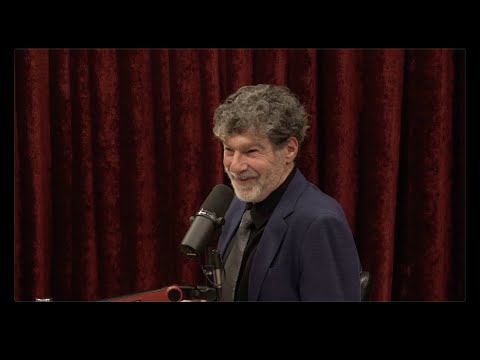
Joe Rogan Experience #2427 - Bret Weinstein
Joe Rogan (host), Bret Weinstein (guest), Joe Rogan (host), Joe Rogan (host), Joe Rogan (host), Joe Rogan (host)
In this episode of The Joe Rogan Experience, featuring Joe Rogan and Bret Weinstein, Joe Rogan Experience #2427 - Bret Weinstein explores bret Weinstein Reveals Evolution’s Hidden Layer And Pandemic Deceptions Bret Weinstein presents a hypothesis that evolution uses numerical variables encoded in DNA (like telomeres and microsatellites) to rapidly reshape body plans, adding a powerful layer on top of classic gene mutation and selection. He uses examples such as bat wings evolving from shrew-like feet and rapid ecological adaptations to argue that this “integer layer” helps evolution explore nearby design possibilities far more efficiently than random protein changes alone.
Bret Weinstein Reveals Evolution’s Hidden Layer And Pandemic Deceptions
Bret Weinstein presents a hypothesis that evolution uses numerical variables encoded in DNA (like telomeres and microsatellites) to rapidly reshape body plans, adding a powerful layer on top of classic gene mutation and selection. He uses examples such as bat wings evolving from shrew-like feet and rapid ecological adaptations to argue that this “integer layer” helps evolution explore nearby design possibilities far more efficiently than random protein changes alone.
Weinstein and Rogan then pivot to human culture and technology, arguing that hyper‑novelty—rapid shifts in tech, media, and social norms—has outpaced our biological and cultural ability to adapt, destabilizing family formation, sexuality, education, and purpose. They discuss how porn, birth control, and gender ideology are reshaping mating dynamics and undermining traditional developmental rites of passage.
The conversation spends extensive time on COVID: ivermectin, mRNA vaccines, regulatory capture, and media propaganda. Weinstein claims repurposed drugs could have made COVID manageable, that major trials were designed or framed to hide ivermectin’s benefits, and that mRNA platforms are inherently risky, with contamination and tissue damage risks not limited to myocarditis.
They also criticize figures like Sam Harris and Peter Hotez for, in their view, refusing to update their positions in light of emerging evidence and for promoting narrow, pharmaceutical‑centric definitions of health. The episode closes with warnings about financial fragility, central bank digital currencies, censorship, and how future crises could be used to consolidate control and suppress dissent.
Key Takeaways
Evolution likely encodes numeric variables in DNA to control morphology and timing.
Weinstein argues that repetitive DNA elements (e. ...
Get the full analysis with uListen AI
Classical mutation–selection models are insufficient to explain macro‑level form changes.
Random codon changes readily explain pigments and microstructures, but not large‑scale shifts in body plans; Weinstein’s proposed variable‑storage mechanism expands Darwinian power by letting evolution quickly explore adjacent design possibilities via tunable parameters.
Get the full analysis with uListen AI
Human culture itself is an “explorer mode” for evolution, now destabilized by hyper‑novelty.
Cultural evolution and consciousness let humans rapidly test ideas and niches, but when technological and social change outrun our ability to adapt, traditional guides (family structure, rites of passage, stable schooling) fail, producing confusion and psychological harm, especially in youth.
Get the full analysis with uListen AI
Modern sexual culture may be degrading pair‑bonding and long‑term family stability.
The combination of ubiquitous porn, casual sex, birth control, and soon AI/robotic companions is shifting expectations and behaviors in ways that weaken stable relationships, which Weinstein sees as central infrastructure for raising children and sustaining civilization.
Get the full analysis with uListen AI
Repurposed drugs for COVID were likely effective but systematically discredited.
Weinstein cites trials like PRINCIPLE and a set of U. ...
Get the full analysis with uListen AI
mRNA vaccine risks stem from the platform and contaminants, not only the COVID antigen.
He claims the mRNA delivery system can randomly damage tissues, is contaminated with DNA (e. ...
Get the full analysis with uListen AI
Future control may hinge on financial architecture and programmable money.
Weinstein warns that overvalued markets, opaque ownership structures, and potential crises could be used to force populations into central bank digital currencies, enabling fine‑grained economic punishment for “wrong think” and making it far harder for dissenting voices to operate as they did during COVID.
Get the full analysis with uListen AI
Notable Quotes
“Evolution not only discovers forms; it discovers ways to discover forms.”
— Bret Weinstein
“The ability to store a number in the genome is fantastically powerful.”
— Bret Weinstein
“We are in a state of hyper‑novelty where even our amazing ability to adapt can’t keep pace with technological change.”
— Bret Weinstein
“If repurposed drugs had been allowed to be used, there was no important pandemic.”
— Bret Weinstein
“The thing that does turn you into an adult is a world of consequences.”
— Bret Weinstein
Questions Answered in This Episode
How could Weinstein’s proposed “integer storage” in DNA be experimentally validated, and what would falsify his hypothesis?
Bret Weinstein presents a hypothesis that evolution uses numerical variables encoded in DNA (like telomeres and microsatellites) to rapidly reshape body plans, adding a powerful layer on top of classic gene mutation and selection. ...
Get the full analysis with uListen AI
If evolution indeed has powerful built‑in “explorer modes,” how should that change the way we teach and model evolutionary theory?
Weinstein and Rogan then pivot to human culture and technology, arguing that hyper‑novelty—rapid shifts in tech, media, and social norms—has outpaced our biological and cultural ability to adapt, destabilizing family formation, sexuality, education, and purpose. ...
Get the full analysis with uListen AI
What realistic societal measures could slow hyper‑novelty enough to protect children without halting valuable technological progress?
The conversation spends extensive time on COVID: ivermectin, mRNA vaccines, regulatory capture, and media propaganda. ...
Get the full analysis with uListen AI
How should medical science rebuild credibility after COVID, given Weinstein’s claims about biased trials and repurposed drugs?
They also criticize figures like Sam Harris and Peter Hotez for, in their view, refusing to update their positions in light of emerging evidence and for promoting narrow, pharmaceutical‑centric definitions of health. ...
Get the full analysis with uListen AI
What safeguards, if any, could make central bank digital currencies compatible with free speech and political dissent?
Get the full analysis with uListen AI
Transcript Preview
(drumming) Joe Rogan podcast, check it out.
The Joe Rogan Experience.
Train by day, Joe Rogan podcast by night, all day. (instrumental music) What's happening, man?
Hey. Good to be back?
Good to see you. So, the reason why we had such a quick turnaround is because the last episode, one of the main reasons why you wanted to come on in the first place, is you, you wanted to further discuss some discoveries about evolution.
Yes. Specifically, I have alluded in a number of different places, including here, to there being another level to Darwinian evolution that does a lot of the heavy lifting, um, that we, um, require in order to explain the diversity of forms that we see in biology. But I haven't been specific on what I believe that layer is. And I felt like it was time, I think, um, for one thing, the advances in AI mean that such things are going to emerge naturally. And I wanted to put it on the table before, uh, it simply gets discovered as a matter of computing horsepower.
And we were just rambling about so many different things that we never got to it last time, so I said, "All right, let's do another quick turnaround, come back."
Right.
All right.
So, um-
Spill the beans.
Let's, let's talk biology.
Okay.
And let me just say, you know, I know it's not everybody's bag, but I do think just about everybody has, at some point, listened to the story that we tell about adaptive evolution and wondered if it's really powerful enough to explain all of the creatures that we all know and love. Right? So, the classic story is that you have a genome, that it contains a great many genes. A gene is a sequence in DNA that results in proteins being produced. The DNA describes exactly the sequence of amino acids in a protein. And a protein would typically be one of two things. It would either be, um, an enzyme, which is a little bit misleading as a term, but an enzyme, uh, well, enzyme isn't misleading, but an enzyme is a catalyst. A catalyst is misleading. It's really a machine that puts other chemicals together. So, a lot of the genes in the genome are these little molecular machines that assemble molecules. And the other thing that proteins are likely to be are structural, so something like collagen proteins can make a matrix that allows you to sort of build a sculpture, biologically. And what we say is that the, uh, the amino acid sequence is specified by the genome in three-letter sequences, right, codons. Each three letters specifies a particular amino acid that gets tacked on. You get a sequence of amino acids that then collapse into whatever they're going to be, whether it's an enzyme or a, a structure based on little electromagnetic affinities that they have, little side chains that have a positive or a negative charge that attract each other. So basically, these machines assemble themselves by folding in very complex ways that then causes them to interact with the molecules around them in very specific ways, ways that greatly reduce the energy, um, necessary and make the reactions much more likely to happen. That's why we call it a catalyst, but really the way to think of it is a little molecular machine. So, we say the way evolution works is random changes happen to the DNA, because DNA is imperfectly copied or is impacted by radiation which will eliminate a letter in the DNA, and then that letter will get replaced by a different letter. There are only four choices. But some fraction of the time you get a three-letter combination that specifies a new amino acid. Almost all of the time, that will make the little molecular machine worse or break it altogether. Occasionally, it will leave the machine functional in a way that's somewhat better than the previous one, and then evolution will collect all of those advances, and that's how evolution works. That's the story we typically tell. And in fact, um, that's the story that is encoded in what's called the central dogma of molecular biology. Um, now the problem, most people will have thought about that and they will have heard, okay, random mutations that change this code in ways that alter proteins. That doesn't sound, that sounds like a very haphazard process and a very difficult way to get from one form of animal or plant or fungus to another. So if you've had that thought, m- that just doesn't seem powerful enough. And then biologists have said, "Well, you're not realizing how much time elapses that allows these very occasional positive changes to accumulate." And that's true. If that's a thought you've had, this is, this p- this process isn't powerful enough to explain the creatures I'm aware of, then what I'm gonna tell you is a way in which that process is not the only process, and by adding a different process, very much a Darwinian one, we can see that the power to create all of the creatures that we see is much greater than the story that we've been told. Okay? So I'm going to put a hypothesis on the table about what enhances this. And essentially what I'm arguing is if you sat down to a computer game, right, something very realistic, and somebody says, "Well, that's all binary," that's true. It's all binary. But what they're not telling you is that there's an intervening layer that greatly increases the power to use binary to make something like a computer game. Right? So there are m- multiple different levels inside your computer. One of them is that your computer can be programmed in a language that is much closer to English...And then a compiler can take the, what you've written that a computer can't understand, and turn it into a computer-understandable code. And so the ability to make powerful programs depends on our ability not to have to program our computers in binary, but to be able to program them in C++ or whatever. That's the kind of thing I'm, I'm pointing to, is a mechanism that enhances the power of evolution to do the stuff that we know evolution accomplishes. Okay, so here's what I think is the missing layer, and I will say I've done a bunch of research to figure out how much of this is understood, and I find a very confusing picture. Uh, actually depends which field I come at it from to see what the blind spots are. But I'm gonna leave that primarily, uh, for another time. Let's just say the two fields in question are my field, evolutionary biology, and a, a interdisciplinary science called evo-devo. Okay? Evo-devo is the evolution of development, and evo-devo is, um, a much newer, uh, in some ways a more vibrant field. I would argue my field is stuck. Evo-devo has been making progress from the developmental side on a number of different questions. Okay, so now let's talk about adaptive evolution and what adaptive evolution has seemed to be missing that I think does a bunch of the heavy lifting in terms of explaining creatures. So let me, uh, let me just start by saying the, the thing I said at the beginning about protein coding genes being altered by random mutation resulting in changes, I'm not arguing that that is in any way a false story. It explains a great many things. My point is that what it primarily explains are things at nanoscale, right? It can explain the difference in a pigment molecule very easily, and we know that it does. It can explain things somewhat larger than that, like the very special structure, when you're a kid, do you ever play with the feathers of a bird? You know, you pull them apart-
Install uListen to search the full transcript and get AI-powered insights
Get Full TranscriptGet more from every podcast
AI summaries, searchable transcripts, and fact-checking. Free forever.
Add to Chrome