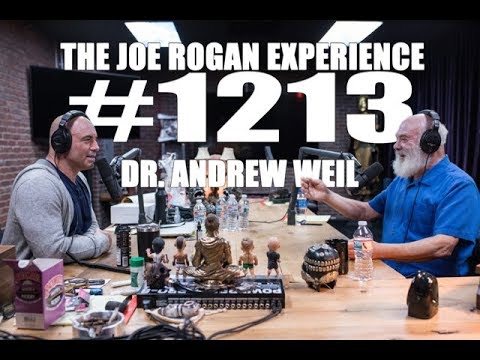
Joe Rogan Experience #1213 - Dr. Andrew Weil
Joe Rogan (host), Dr. Andrew Weil (guest), Narrator
In this episode of The Joe Rogan Experience, featuring Joe Rogan and Dr. Andrew Weil, Joe Rogan Experience #1213 - Dr. Andrew Weil explores dr. Andrew Weil and Joe Rogan Explore Healing, Mind, and Medicine Dr. Andrew Weil joins Joe Rogan to discuss integrative medicine, the body’s innate capacity to heal, and how lifestyle, mindset, and alternative therapies can complement conventional care.
Dr. Andrew Weil and Joe Rogan Explore Healing, Mind, and Medicine
Dr. Andrew Weil joins Joe Rogan to discuss integrative medicine, the body’s innate capacity to heal, and how lifestyle, mindset, and alternative therapies can complement conventional care.
They cover topics ranging from nutrition, matcha tea, and sustainable fish consumption to chronic pain, placebo/nocebo effects, psychedelics, and the limits of mainstream medical thinking.
Weil emphasizes the power of belief, mind–body interactions, and careful use of pharmaceuticals, while Rogan probes with skepticism around claims involving hypnosis, firewalking, and mind-over-matter phenomena.
The conversation also touches on cannabis policy, the opioid crisis, emotional health, and practical behavior change, highlighting a future model of medicine that is more holistic, patient-centered, and evidence-informed.
Key Takeaways
Use integrative medicine to complement—not replace—conventional care.
Weil defines integrative medicine as intelligently combining conventional treatments with evidence-supported alternatives (nutrition, mind–body work, herbs, acupuncture, etc. ...
Get the full analysis with uListen AI
Prioritize lifestyle fundamentals: whole foods, color diversity, and reduced processed foods.
He recommends avoiding refined and manufactured foods, eating “across the color spectrum” of fruits and vegetables for diverse phytonutrients, and considering anti-inflammatory patterns (fish, plants, good oils) as a baseline for long-term health.
Get the full analysis with uListen AI
For chronic pain, especially back pain, investigate psychological and muscular causes before surgery.
Citing John Sarno’s work, Weil notes that much back pain is muscle spasm influenced by stress and the mind, often poorly correlated with imaging findings; he suggests education, movement, and time before aggressive procedures like spinal fusion.
Get the full analysis with uListen AI
Cultivate and harness the placebo effect instead of dismissing it.
Weil argues that placebo responses are “pure healing from within” mediated by belief and expectation; clinicians should actively support patient confidence and avoid negative predictions that can act as “medical hexes” and worsen outcomes.
Get the full analysis with uListen AI
Be cautious and conservative with psychiatric medications, emphasizing non-drug strategies first.
Weil highlights limited long-term efficacy and significant drawbacks of SSRIs and benzodiazepines, noting phenomena like rebound anxiety and “tardive dysphoria”; he favors exercise, omega‑3s, CBD, microbiome support, breathing techniques, and psychotherapy as primary tools.
Get the full analysis with uListen AI
Recognize the potential of psychedelics and cannabis within safe, structured contexts.
They discuss promising research and anecdotes of psychedelics aiding addiction, allergies, mood, and end-of-life anxiety, as well as cannabis’s medical and industrial uses—while stressing the need for regulation, dosage care (especially edibles), and removal of legal barriers to research.
Get the full analysis with uListen AI
Frame behavior change as iterative: repeated “failed” attempts still build toward success.
For addictions like smoking or heroin use, Weil stresses that each quit attempt contributes to a reservoir of motivation; over time, this can suddenly tip into an effortless, lasting cessation, so setting quit dates and trying repeatedly is worthwhile even if you relapse.
Get the full analysis with uListen AI
Notable Quotes
“We should be ruling [the placebo effect] in, man. That’s the meat of medicine.”
— Dr. Andrew Weil
“The most marvelous thing about our bodies is that they have the capacity to heal themselves.”
— Dr. Andrew Weil
“You never wanna stay in treatment with a doctor who thinks you can’t get better.”
— Dr. Andrew Weil
“We don’t have a user’s manual for the mind or the body—especially not for how to manage the body with the mind.”
— Joe Rogan
“I have no problem telling people to stay away from refined, processed, and manufactured food. That’s the bad stuff.”
— Dr. Andrew Weil
Questions Answered in This Episode
How can mainstream medical education practically integrate mind–body and placebo-based approaches without compromising scientific rigor?
Dr. ...
Get the full analysis with uListen AI
What objective research could best test claims about hypnosis, firewalking, and other dramatic mind-over-matter phenomena that Weil describes?
They cover topics ranging from nutrition, matcha tea, and sustainable fish consumption to chronic pain, placebo/nocebo effects, psychedelics, and the limits of mainstream medical thinking.
Get the full analysis with uListen AI
Where is the line between responsibly using psychedelics or cannabis for healing and slipping into self-medication or escapism?
Weil emphasizes the power of belief, mind–body interactions, and careful use of pharmaceuticals, while Rogan probes with skepticism around claims involving hypnosis, firewalking, and mind-over-matter phenomena.
Get the full analysis with uListen AI
How can patients and doctors collaboratively decide when antidepressants or pain medications are warranted versus when to emphasize non-pharmacologic strategies?
The conversation also touches on cannabis policy, the opioid crisis, emotional health, and practical behavior change, highlighting a future model of medicine that is more holistic, patient-centered, and evidence-informed.
Get the full analysis with uListen AI
What systemic changes (insurance, training, reimbursement) are needed to make integrative, relationship-centered care the default model rather than an exception?
Get the full analysis with uListen AI
Transcript Preview
Four, three, two... All the way from Tucson, Arizona, (claps) Dr. Weil. How are you, sir?
I am good.
Thanks for doing this, man. I appreciate it.
Pleasure.
You come highly recommended by many human beings that I know.
Well, I'm glad to hear it.
How do you, uh, how do you get such a fine reputation?
Well, I've been doing the same things for a long time, just putting one foot ahead of the other and, uh, saying what I know to be true.
And, uh, and pushing matcha.
(laughs)
Everybody likes matcha. Who doesn't like matcha tea?
Well-
This is your stuff?
Yeah, but you know, a lot of people don't... have only tasted really bad matcha because-
Oh, okay, enlighten me. What's the-
Uh-
What's the deal?
You know, it's powdered tea, and it's very, very finely powdered, and it's very labor-intensive to prepare. And, uh, it's got such a huge surface area that it oxidizes very quickly. So if it's not properly packed and stored, it loses its brilliant green color, it turns yellow-green or gray-green, it gets bitter, and loses its taste. And I gotta say, most of the matcha that I see served (laughs) in this country is of that sort, and many-
Oh.
... people have never had the good stuff.
Well, what's the benefits of matcha? I know there's cognitive benefits.
First of all, it's, it's beautiful. I mean, I've never seen a green color like that.
Mm.
It's just amazing. And the flavor's amazing, but it's the only preparation of tea in which the whole leaf is consumed. Uh, and-
Mm.
... and it's grown under special conditions. The leaves are shaded, uh, deep shade for the last three weeks before harvest. So the... in response to that, the leaves produce more chlorophyll, more antioxidants, more of the good stuff. So it's got, uh, you know, much more of the things you want.
And this has like a pop top, like Pringles.
(laughs) Yeah.
Right? Is that... So the matcha's in there?
It's gotta stay fresh, and after you open it-
Right.
... you wanna keep it in the freezer and, and-
Oh, okay.
Yep.
Freezer.
You got it. Freezer. And you should sift it so it doesn't form lumps, and then you whisk it with that traditional bamboo whisk, or you buy a little electric whisker-
Ah.
... and you can whisk it in hot water or cold water, and it's very yummy.
And w- what, what does it do for you? Like, what's the good...
Well, you've got... It's got caffeine, of course.
Right.
So you get stimulated by it, but it's also got L-theanine, which is this relaxant compound that modifies the effect of ca- caffeine and produces a state of relaxed alertness.
Install uListen to search the full transcript and get AI-powered insights
Get Full TranscriptGet more from every podcast
AI summaries, searchable transcripts, and fact-checking. Free forever.
Add to Chrome