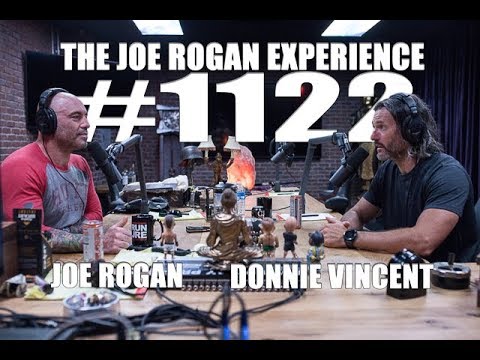
Joe Rogan Experience #1122 - Donnie Vincent
Joe Rogan (host), Donnie Vincent (guest), Narrator
In this episode of The Joe Rogan Experience, featuring Joe Rogan and Donnie Vincent, Joe Rogan Experience #1122 - Donnie Vincent explores hunting, Ethics, and Wilderness: Donnie Vincent Redefines the Modern Hunter Joe Rogan and filmmaker-hunter Donnie Vincent explore what ethical hunting really means, contrasting it with factory farming, trophy hunting, and cartoonish media portrayals of hunters and wildlife.
Hunting, Ethics, and Wilderness: Donnie Vincent Redefines the Modern Hunter
Joe Rogan and filmmaker-hunter Donnie Vincent explore what ethical hunting really means, contrasting it with factory farming, trophy hunting, and cartoonish media portrayals of hunters and wildlife.
Vincent describes his immersive, long-form hunting films as a way to convey the spiritual, ecological, and physical realities of living in wild places—from the Arctic to Australian buffalo country—rather than just kills.
They discuss predators like bears, wolves, mountain lions, and orcas, emphasizing their ecological roles, the complexity of managing their populations, and the emotional contradictions of killing animals you deeply respect.
The conversation also tackles veganism, large-scale agriculture, lab-grown meat, and overpopulation, arguing that no food choice is free of death and that hunters should be among the first to advocate for backing off when wildlife or habitat can’t sustain pressure.
Key Takeaways
No way of eating is truly bloodless or impact-free.
Rogan and Vincent argue that large-scale crop farming kills vast amounts of wildlife (from rodents to fish via fertilizer-fueled ocean dead zones), so claiming moral purity as a vegan or vegetarian ignores real ecological costs.
Get the full analysis with uListen AI
Ethical hunting requires constant self-questioning, not blind tradition.
Vincent insists hunters should repeatedly ask themselves why they hunt, when they should back off declining populations, and whether their actions improve or harm habitat and wildlife long term.
Get the full analysis with uListen AI
Predator control is emotionally difficult but sometimes ecologically necessary.
Examples like black bears taking half of moose and deer calves, or individual mountain lions eliminating nearly 10% of a sheep herd, show why targeted predator hunting can protect prey populations—if it’s data-driven and selective.
Get the full analysis with uListen AI
Trophy hunting without meat use is socially and ethically toxic.
They criticize hunters who only take hides and skulls (e. ...
Get the full analysis with uListen AI
Wild, field-harvested meat offers both superior ethics and nutrition.
Stories of elk, bear, and mountain lion tasting exceptional—and often reflecting what the animals ate (like blueberry bears)—underscore the value of clean, non-factory protein closely tied to an animal’s natural life.
Get the full analysis with uListen AI
Modern infrastructure lets people disconnect from the realities of life and death.
Because most people neither kill nor even cook their own food, they can condemn hunting while consuming factory-farmed meat, or assume zoos and cartoons represent what wild animals are actually like.
Get the full analysis with uListen AI
Immersive storytelling can reshape public understanding of hunting and wilderness.
Vincent’s hour-plus films intentionally show the hardship, awe, boredom, danger, and beauty of extended wilderness hunts, giving non-hunters a much more accurate, nuanced view than 22‑minute TV episodes or villainous movie hunters.
Get the full analysis with uListen AI
Notable Quotes
“It’s very difficult to articulate how much you love something, yet you’re willing to engage it in such a heavy way, such a violent way that you’re willing to step in, kill it, cut it up, get your hands bloody.”
— Donnie Vincent
“Life eats life. And if you want to claim the moral high ground because you’re a vegetarian or because you’re a hunter, I think you’re missing the big picture.”
— Joe Rogan
“If the population of human beings continues exponentially, hunters should almost be the first ones to give up hunting if it trends towards that someday.”
— Donnie Vincent
“We’ve set this up so you don’t ever have to crack an egg in your entire life and you can eat eggs your entire life.”
— Donnie Vincent
“We don’t even, we can’t even comprehend what that animal is… If orcas weren’t real and Bigfoot was real, we wouldn’t give a shit about Bigfoot.”
— Joe Rogan
Questions Answered in This Episode
If no diet is ethically ‘clean,’ what criteria should we actually use to judge the morality of our food choices?
Joe Rogan and filmmaker-hunter Donnie Vincent explore what ethical hunting really means, contrasting it with factory farming, trophy hunting, and cartoonish media portrayals of hunters and wildlife.
Get the full analysis with uListen AI
How should wildlife agencies and the public decide when predator hunting is appropriate and when it becomes unnecessary or cruel?
Vincent describes his immersive, long-form hunting films as a way to convey the spiritual, ecological, and physical realities of living in wild places—from the Arctic to Australian buffalo country—rather than just kills.
Get the full analysis with uListen AI
Could long-form, immersive hunting films like Vincent’s meaningfully change public opinion about hunting, or are most people too entrenched in their views?
They discuss predators like bears, wolves, mountain lions, and orcas, emphasizing their ecological roles, the complexity of managing their populations, and the emotional contradictions of killing animals you deeply respect.
Get the full analysis with uListen AI
Where should the ethical line be drawn between fair-chase hunting and high-dollar, high-assistance hunts (helicopters, scouts, high fences, pre-located animals)?
The conversation also tackles veganism, large-scale agriculture, lab-grown meat, and overpopulation, arguing that no food choice is free of death and that hunters should be among the first to advocate for backing off when wildlife or habitat can’t sustain pressure.
Get the full analysis with uListen AI
If lab-grown meat becomes scalable, how might it alter the role of hunters, conservation funding, and our relationship with wild places?
Get the full analysis with uListen AI
Transcript Preview
Five, four, three, two, one. (rock music) Donny Vincent.
What's going on?
How are you, buddy?
Good. Really good.
I'm very excited that you didn't know about floating at all. You didn't know about float tanks even remotely until you came here.
Yeah. And it's wicked looking.
It's fun, man. If you got time after the show, you could float. If you wanna do it.
(sighs) I might have to do it just to say that I've done it.
Yeah.
But yeah, I- I- I didn't know the science behind it. Um, other than obviously floating.
Right.
Would be, you know-
Just feels good.
... just to meditate-
Yeah.
... and just to sit there in a quiet like ... You know when you- when you're a little kid and you go in a swimming pool or something and you put your ears just under the water and you get that kinda (clicks tongue) ?
Yeah.
When everything's just peaceful and you can just sit there and you can't hear your mother or you can't hear your girlfriend or whatever, and it's just quiet.
Right. (laughs)
I assume it's a lot like that.
Uh, it's very telling that you said two women.
Yeah.
You didn't say your dad, you didn't say your grandpa. (laughs)
Yeah. Well, my- my dad never talked to me.
(laughs)
Maybe that's a whole nother subject matter.
Well, that's another part of the problem probably.
Yeah, yeah, yeah, yeah, yeah.
But, uh, yeah, I- I am trying to get floating spread across the world. I think it's the best way for people to relax. There's nothing like it. 'Cause first of all, physically you relax 'cause the- the water has so much Epsom salts in it and it's just really good for your muscles.
Mm-hmm.
It's good for sore ... You know, anything.
Mm-hmm.
Sore muscles-
Yeah.
... overworked. It's great for that. But it's also great in the environment where you- uh, you're in that tank with total darkness, total silence, you don't feel any-
Oh, total darkness?
Oh, yeah.
Yeah.
It's pitch black in there. You close the door, you don't see a- a ray of light.
Yeah.
And then your ears are underwater. And then I have to get some earplugs for guests, 'cause I don't mind having the- the- the salt in my ears, but some people get a little weirded out by the-
(sniffs) Mm.
salt.
Some in there.
Do we have some in there?
There's a whole bunch of like ... Yeah.
Did I buy ... I bought a big thing of it.
Yeah, yeah, yeah, yeah.
I did. My memory's fucked up, dude.
(laughs)
What's wrong with me? Um, (laughs) I bought a whole giant jug of it, right? (laughs) But, uh, the other thing is that it just gives you alone time in a way-
Install uListen to search the full transcript and get AI-powered insights
Get Full TranscriptGet more from every podcast
AI summaries, searchable transcripts, and fact-checking. Free forever.
Add to Chrome